

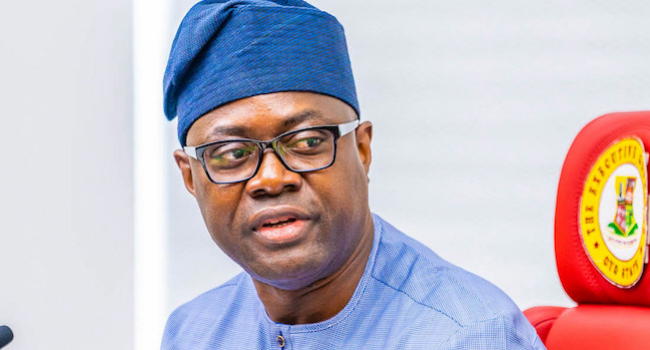
…rules out personal benefit from proposed constitutional changes, backs transitional government
By Soni Daniel & Luminous Jannamike
ABUJA — Oyo State Governor, Seyi Makinde, on Wednesday proposed a minimum 50 per cent-plus-one vote threshold for presidential elections, saying Nigeria needs a political system that compels presidential candidates to secure broader national support before assuming office.
Makinde, who unveiled the Reset Nigeria Manifesto in Abuja, also declared that he would not personally benefit from any constitutional and political arrangements that might emerge from his proposed transitional government, insisting that the process must not be manipulated to serve the interests of its promoters.
He said the proposed electoral threshold would encourage political parties to build alliances across ethnic, religious and regional divisions, while a transitional government would provide a platform for Nigerians to negotiate a new political and constitutional direction.
Offering himself as a test of his commitment to the proposed reforms, Makinde said: “Today, Wednesday, November 4, 2026, I offer myself as a guinea pig by announcing to Nigerians that whatever constitutional and political arrangements we eventually develop, I will not be a beneficiary.
“If I intend to benefit personally from the arrangements, there is a possibility that manipulation could set in. But I do not want that to happen.”
Explaining the proposed presidential election threshold, the governor argued that candidates should secure sufficient national support to command the respect of the majority rather than emerge through an electoral arrangement that leaves most voters behind.
“What we are proposing is that, to become President of Nigeria, a candidate must secure at least 50 per cent plus one vote,” Makinde said.
“That way, candidates and political parties will have to engage in discussions across party lines and other divisions to secure the support needed to form a government that commands the respect of the majority of Nigerians.”
He identified four fundamental concerns behind his Reset Agenda: the prioritisation of macroeconomic reforms over broad-based economic growth; failure by governments to accept responsibility for results; weak institutions undermined by divisions and bribery; and the exclusion of millions of poor Nigerians from government decisions.
Makinde criticised the emphasis on macroeconomic reforms without corresponding improvements in the living conditions of ordinary Nigerians, insisting that economic stability must translate into affordable food, employment, improved incomes and a lower cost of living.
“My simple proposition is that government must make life easier for the people. That is all,” he said.
Questioning the value of economic stability that does not improve household welfare, he added: “What does macroeconomic stability mean if it does not improve the living conditions of ordinary Nigerians?”
The governor identified high energy costs as one of the structural problems undermining Nigerian businesses, particularly manufacturers dependent on diesel-powered generators.
“For instance, no matter how hard I try, a manufacturer who relies on generators powered by diesel will continue to incur high production costs. We must make it possible for manufacturers to connect to the national electricity grid and access electricity at a lower cost,” he said.
He also questioned how the country was managing increased crude oil revenues, arguing that rising international oil prices should produce measurable benefits for Nigerians rather than simply increase government allocations.
Makinde, who said he had spent much of his working life in the oil and gas industry, recalled his personal journey from Ibadan to Port-Harcourt in search of opportunities in 1990.
“I left Ibadan in early October 1990 with just a bag containing a few belongings, perhaps two pairs of trousers, three or four shirts and a book. The only thing I had was the fare to travel to Kaduna with my degree,” he recalled.
He said he eventually secured employment, established a business, raised a family and built his life, experiences that informed his conviction that government policies must create opportunities for ordinary Nigerians.
On accountability, Makinde promised that his proposed administration would establish measurable performance targets within its first 100 days and make its achievements subject to public scrutiny.
Electricity & Petroleum Pricing
He also faulted the Federal Government’s handling of the electricity sector, arguing that the transfer of regulatory powers to states should not become an excuse for abandoning national responsibilities.
“Yes, but should a baby that has just been born start crawling, walking and running at the same time?” he asked.
He maintained that while states should develop their electricity markets according to their capacities, the Federal Government must continue to manage national electricity assets and address challenges affecting generation and distribution.
Makinde further called for continuity in national development policies irrespective of changes in political parties, citing the succession of different administrations in Oyo State since 1999.
“Political parties will come and go, but our national development plans and the things we must do for our people must remain constant. We must continue to implement them, irrespective of the political party in power,” he said.
On petroleum pricing, he questioned the argument that lower fuel prices in Nigeria would encourage smuggling into neighbouring countries, insisting that the government should strengthen border management rather than transfer the consequences of enforcement failures to citizens.
He also advocated a new social and political order in which institutions would function across party and regional differences, adding that more than half of Nigeria’s population lived in poverty and should not be treated as an afterthought in government decisions.
Makinde said the Reset Agenda was developed through extensive consultations and town hall meetings across the six geopolitical zones, where Nigerians were asked to articulate their expectations of government.
He recalled that some participants had challenged him to provide the kind of leadership associated with Nigeria’s founding fathers, including Tafawa Balewa, Obafemi Awolowo and Nnamdi Azikiwe.
Opposition complementary to govt, says Daura
Earlier, the APM vice-presidential candidate, Lawal Daura, called for a national conference involving government representatives and all segments of Nigerian society to resolve the country’s longstanding political contradictions.
Daura, who described the first government under their proposed arrangement as transitional, said the process would allow Nigerians to discuss their differences, reach agreements and establish a common direction for the country.
He warned against attempts by governments to weaken opposition parties, arguing that effective opposition was necessary for political stability and democratic development.
“The opposition is complementary to the government; it is not an enemy of the government,” he said.
Daura maintained that the suppression of political opponents and denial of a level playing field ultimately threatened the country and its citizens.
He said opposition parties should be allowed to participate freely in the political process, adding that the quality of opposition could help reduce political tension and strengthen democratic institutions.
Don’t use state institutions to undermine democracy, Dantalle warns
Also speaking, National Chairman of the Allied Peoples Movement, APM, Yusuf Dantalle, warned against attempts to use state institutions to undermine democratic competition, urging political leaders to protect the country’s democratic institutions.
Dantalle questioned the gap between the promises made by the governing All Progressives Congress, APC, during its election campaigns and the economic realities Nigerians were currently facing.
He criticised rising petroleum prices and the burden of taxation on citizens and businesses, arguing that the country’s economic difficulties required urgent attention.
The APM chairman also urged the Independent National Electoral Commission, INEC, to discharge its responsibilities impartially and ensure that electoral activities were conducted in an atmosphere of peace.
He warned that electoral fraud amounted to a denial of citizens’ democratic rights because it deprived them of the opportunity to choose their leaders.
Dantalle said the younger generation was looking up to political leaders to protect the country’s democratic future and called for collective efforts to prevent the weakening of democratic institutions.
In his remarks, National Chairman of the Social Democratic Party, SDP, Prof. Sadiq Gombe, described Makinde as a leading figure in the opposition, recalling how he won the 2019 Oyo governorship election on the platform of the Peoples Democratic Party, PDP, despite the dominance of the APC in the South-West at the time.
Gombe also praised Makinde and Bauchi State Governor, Bala Mohammed, for sustaining opposition cooperation, saying their efforts had helped rekindle democratic engagement among political parties.
He recalled that when the SDP struggled to secure a venue for its convention in Abuja, it eventually approached Mohammed, who offered Bauchi State as an alternative venue.
Gombe said Makinde also hosted an initiative that brought opposition political parties together, adding that the engagement had encouraged further consultations among political leaders and presidential aspirants.
He urged opposition leaders to embrace humility, patriotism and cooperation in their efforts to strengthen democracy.
The post 2027: Makinde proposes minimum 51% threshold for presidential victory appeared first on Vanguard News.