

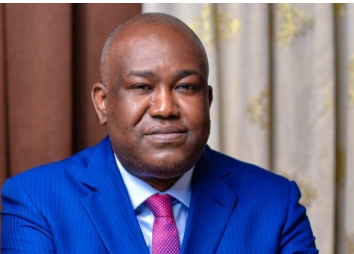
— Accord candidate proposes $4tn economy, 4m bpd crude, ₦605 petrol
By Our Correspondent
ABUJA — Presidential candidate of the Accord Party, Dr Gbenga Hashim, has urged Nigerians to reject the notion that the country must remain a third-class nation, saying citizens must take greater ownership of Nigeria’s future.
Hashim made the call in an Independence Day message issued in Abuja on Wednesday, arguing that Nigeria’s prolonged underdevelopment was not due to a lack of resources but the failure to effectively deploy its human, natural and institutional capacity.
He identified poverty, human trafficking, insecurity, institutional weaknesses, the weakening of the civil service and inadequate security infrastructure among the factors limiting the country’s development.
“Nigeria is not a poor country. We have behaved like a poor country because we have consistently underutilised the enormous capacity available to us,” he said.
Hashim said Nigeria’s large young population should be transformed from a development challenge into an economic advantage through skills acquisition, education, employment and productive opportunities.
He argued that the consequences of poor governance extended beyond economic statistics, affecting the security, dignity and future of citizens.
“You cannot permanently defeat trafficking without defeating the conditions that make human beings vulnerable to trafficking,” he said.
Proposes $4tn economy
The Accord candidate said the 2027 election should provide Nigerians with an opportunity to determine the country’s direction by demanding clear visions, measurable targets and accountability from political candidates.
He urged voters not to allow elections to be reduced to personalities, ethnicity, religion or political slogans.
“Nigeria belongs to Nigerians. We must stop behaving as spectators in the affairs of our own country,” Hashim said.
He said an Accord administration would target the transformation of Nigeria into a $4 trillion economy within eight years, driven by increased production, manufacturing, agriculture, energy, technology and services.
Hashim said Nigeria needed to move from an economy largely focused on distributing resource revenues to one that creates wealth through production and value addition.
Targets 4m barrels daily
He also reiterated his proposal to increase Nigeria’s crude oil production to at least four million barrels per day within 24 months of an Accord administration.
According to him, the target would be pursued through the recovery of commercially viable shut-in oil wells, improved security, investment in production infrastructure, better crude evacuation and reforms to petroleum production costs.
He said increased crude production should also serve as a foundation for domestic industrialisation.
“Four million barrels a day cannot simply mean four million barrels exported. Nigerian crude must power Nigerian industry,” he said.
Hashim further proposed a starting sustainable petrol price of ₦605 per litre, with a long-term objective of reducing the price to between ₦200 and ₦300 per litre.
He said the proposal would be based on reducing the actual cost of producing and delivering energy rather than returning to what he described as an opaque subsidy system.
The Accord candidate also proposed expanded investment in refining, petrochemicals, gas processing, electricity generation, pipelines, storage and other energy infrastructure.
“Nigeria must stop exporting the raw material and importing the finished value. We must capture the value chain here,” he said.
Wants West African market integration
Hashim said affordable and reliable energy would be central to reviving Nigeria’s manufacturing sector and reducing production costs across the economy.
He also proposed making West African integration a central pillar of Nigeria’s foreign policy, arguing that the region offered opportunities for Nigerian businesses to expand.
He said Nigerian manufacturers, farmers, energy companies, financial institutions and technology firms should be positioned to serve a larger integrated West African market.
“Our neighbourhood is not a burden, we are one family. West Africa is Nigeria’s strategic economic space,” he said.
Hashim said Nigeria’s growing youth population could become the country’s greatest economic asset if government invested deliberately in technical education, professional skills and productive employment.
“Our young population should be Nigeria’s greatest economic asset. We must give them the skills and opportunities to turn their energy into wealth,” he said.
He also stressed the need to reform the civil service and public institutions, arguing that ambitious economic targets could not be achieved without a competent and accountable state.
“We cannot build a $4 trillion economy with institutions that cannot perform. The Nigerian state itself must be rebuilt,” he said.
Hashim said Independence Day should remind Nigerians that political independence must ultimately be matched by economic and institutional independence.
“The Nigeria we want cannot be outsourced. It cannot be imported. It must be built by Nigerians,” he said.
He described the 2027 election as an opportunity for Nigerians to choose not only a government but also a national direction.
“We are offering the vision. We are offering the leadership. But the ultimate power belongs to Nigerians,” Hashim said.
He added: “Our independence gave us ownership of Nigeria. It is time to exercise that ownership.”
The post 2027: Nigerians must reject third-class status — Hashim appeared first on Vanguard News.