

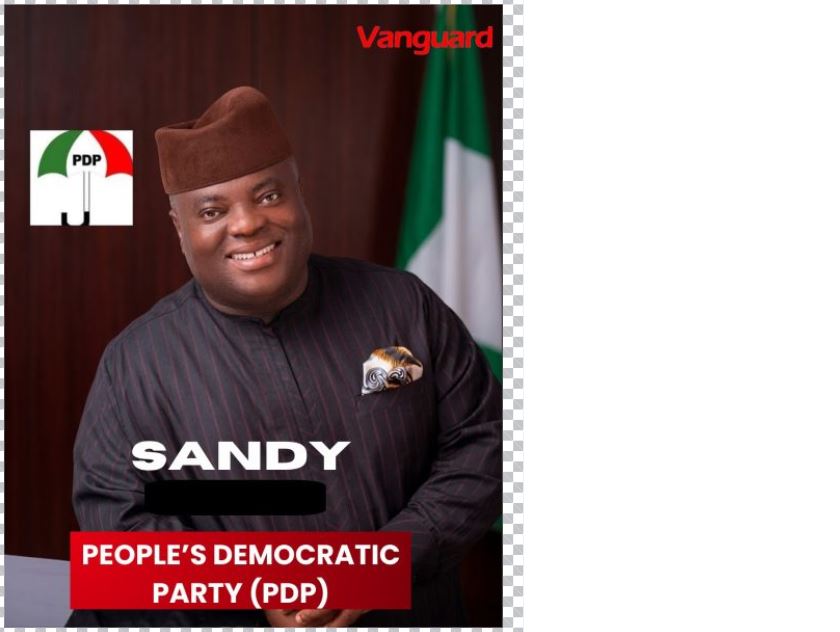
The choice of Senator (Prof.) Sandy Ojang Onor as the Peoples Democratic Party, PDP’s presidential candidate for 2027 says as much about the condition of the opposition party as it does about the man himself.
Read Also:
Onor is a Cross River politician, former senator and professor of history who spent much of his professional life in academia before moving through local government and state politics into the National Assembly. He represented Cross River Central in the 9th Senate between 2019 and 2023. In May 2026, he emerged as the sole aspirant of the PDP faction led by Abdulrahman Mohammed, a structure aligned with FCT Minister Nyesom Wike, and was adopted through a consensus process.
His name, therefore, carries an unusual combination of scholarship and electoral politics. But the bigger story is the political road that brought him to the ticket.
Born in Ikom, Cross River State, on February 14, 1966, Onor studied history at the University of Calabar, where he obtained his first degree before proceeding to a PhD in the same discipline. He entered the university system as a young academic and rose through the ranks. He later returned to the University of Calabar as an associate professor and was elevated to the rank of professor in 2019.
That academic record is more than a collection of certificates. History, in Onor’s case, has remained part of his public identity. His published works include studies of the Ejagham people, local governance and Nigeria’s civil war experience. His academic interests have also extended into governance, democracy and African political history.
But the classroom did not keep him away from politics. Onor became executive chairman of Etung Local Government Council and later held positions in the Cross River State administration before his election to the Senate. His movement from academia into local government, state administration and eventually the National Assembly gave him exposure to several layers of Nigeria’s political system.
A ticket born out of the PDP crisis
His arrival at the presidential ticket cannot be separated from PDP’s internal battle. For months, rival groups laid competing claims to the party’s leadership and presidential nomination. The Wike-aligned structure, led by Abdulrahman Mohammed, backed Onor. A rival faction associated with Tanimu Turaki moved to adopt former President Goodluck Jonathan as its preferred presidential candidate. Jonathan himself had not publicly accepted that nomination at the time. The competing claims deepened uncertainty over which structure would ultimately control the party’s 2027 machinery.
Wike publicly rejected the Turaki faction’s claim, insisting that Onor was the recognised candidate of the PDP structure he supported. The dispute was not merely about personalities; it reflected the deeper struggle over who controlled the party and which political structure could legitimately nominate candidates.
The significance of Onor’s emergence, therefore, lies partly in what it represented for that faction: proof that it could move from an internal political contest to the formal electoral process. By August, INEC had published Onor and his running mate, Babangida Umar, among the presidential candidates whose particulars were open to public scrutiny.
The publication did not erase every political argument around the PDP, but it gave the Onor camp something tangible: a ticket on the electoral umpire’s published list.
Politician behind the rhetoric
Onor has sought to present himself less as a conventional opposition politician and more as an advocate of grassroots politics.
At his emergence, he argued that rural Nigeria had been neglected, and linked rural poverty to insecurity, unemployment and the vulnerability of young people to criminal recruitment. He has called for stronger local government funding and greater attention to communities outside Nigeria’s political and economic centres.
He has also adopted an unusually measured line on some policies of the Tinubu administration. During his screening in May, he defended the removal of fuel subsidy as a courageous policy, while criticising what he described as poor implementation and inadequate accountability. His argument was that opposition politics should not require condemning every government decision.
Politically, however, he has been far less restrained towards rival opposition figures.
Onor dismissed the Atiku Abubakar, Peter Obi and Rabiu Kwankwaso camp and the opposition coalition around the ADC, portraying it as an alliance driven by competing ambitions. He argued that the PDP remained the principal opposition platform capable of challenging the APC. Those claims are political positioning, not independent assessments. But they reveal the argument his campaign intends to make: that opposition strength lies not merely in prominent personalities but in an established nationwide party structure. That is the test now facing him.
How far can he go?
Onor has a Cross River base, Senate experience and an academic record that gives him a distinctive profile among the presidential candidates. What he does not yet possess is the national visibility enjoyed by several of the figures with whom he will compete for the opposition space.
The PDP, meanwhile, has a historic national network but enters the contest after years of factional conflict, defections and organisational uncertainty.
For Onor, the burden is larger than carrying the PDP flag. He must turn a disputed party settlement into a credible national campaign, persuade voters beyond his Cross River base and demonstrate that the party that once dominated Nigerian politics can still command the political geography required to return to power. That is the real weight of the ticket now resting on his shoulders.
Vanguard News
The post 2027 Presidential Election: Meet Sandy Onor, scholar carrying PDP’s broken burden appeared first on Vanguard News.