

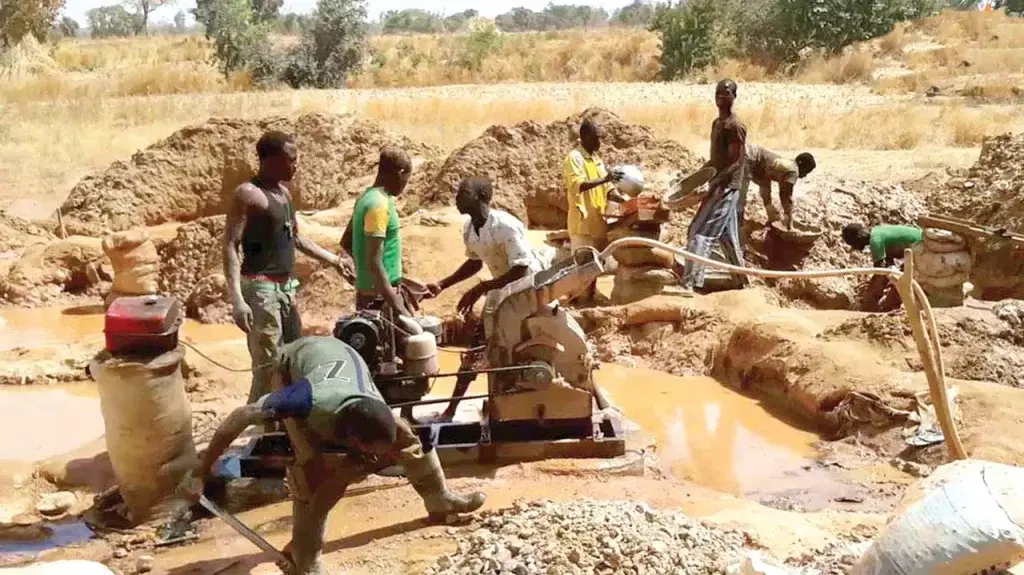
By Luminous Jannamike & Gabriel Ewepu
ABUJA — The last thing many of the miners arrested around the Wushishi-Lukoto axis of Niger State could have expected when they were taken into custody was that some of them would not come out alive.
Read Also: Full List: 20 NSCDC officers suspended over 37 miners’ death; probe panel members
Between September 15 and 16, operatives of the Nigeria Security and Civil Defence Corps, NSCDC, raided suspected illegal mining sites west of Minna and detained about 65 artisanal miners.
By the early hours of September 17, dozens were dead inside an NSCDC detention facility along David Mark Road, Minna. Hospital footage showed 33 bodies in one ward. The Niger State governor subsequently confirmed that 37 detainees had died.
The official explanation initially pointed to a suspected disease outbreak, with the bodies sent for medical examination.
But survivors gave a different account, describing a severely overcrowded cell in which breathing became difficult. An intelligence assessment reportedly also pointed to overcrowding and inadequate ventilation as the likely causes of the deaths.
Whatever the final findings establish, one fact is already beyond dispute; 37 people arrested over alleged illegal mining ended up dead in state custody within one or two days.
Some of those arrested were minors or very young people. Amnesty International subsequently demanded an independent investigation into the deaths.
By September 18, anger had spilled onto the streets of Minna. Protesters demanded answers. Police used tear gas and, according to some accounts, live ammunition to disperse the crowd. An overnight curfew was imposed, an NSCDC commander was suspended and government announced an investigation.
But beneath the immediate questions about detention conditions and responsibility for the deaths lies a much larger question.
Why is the Nigerian state so capable of finding the person holding the digger and shovel, yet seemingly less capable of identifying and dismantling the people who finance, buy, transport, and profit from the minerals that the digger and shovel produce?
That is the question Minna has forced back into the national conversation.
The 37 Who Never Came Out
The tragedy has become a grim window into Nigeria’s informal mining economy.
The men, boys, and other artisanal miners at the center of the incident were allegedly operating illegally. That point matters because illegal mining carries environmental, economic, and security consequences, and the state has a responsibility to enforce its laws.
But the manner in which the enforcement chain operates is now under scrutiny.
Dr Andrew Mamedu, Country Director, ActionAid Nigeria, believes the deaths should not be examined only as a detention tragedy.
“We must distinguish between the poor artisanal miner digging to survive and the organised interests financing, buying and profiting from illegal mining. The enforcement net should not catch only the poorest person at the bottom while those making the biggest profits remain untouched,” Mamedu said.
He put the question even more directly: “Go after the major beneficiaries of illegal mining, not only the poorest people at the bottom of the chain.”
That distinction may be crucial to understanding the country’s mining crisis.
For the person at the pit, the mineral is a livelihood. Further up the chain, it can become a commodity, an investment, an export and, potentially, a source of considerable profit.
The identities and activities of those alleged beneficiaries remain questions to be established through evidence and investigation.
But several other civil society organisations insist that enforcement which ends at the mining pit is unlikely to dismantle the wider illicit economy.
Philip Jakpor, Executive Director, Renevlyn Development Initiative, RDI, also said security agencies should focus on the bigger players.
“Arresting artisan miners trying to eke out a living cannot be a big burst when the big players walk freely on the streets,” Jakpor stated.
“We need to know what the young men were mining; who owns the particular sites where they were apprehended or if the deaths were the silencing of pawns to shield some powerful individuals,” he added.
The allegation about the deaths being intended to silence anyone remains an allegation and requires investigation.
But Jakpor’s underlying question is harder to dismiss: who owns the sites, who finances the operations and who ultimately benefits?
The Digger and Shovel are Easy to Find
Nigeria does not lack minerals. The country is estimated in the supplied material to have more than 40 commercially viable minerals, including gold, lithium, tin, columbite, limestone, and gemstones, spread across more than 500 locations and 32 states.
Yet the economic return from this geological wealth remains strikingly small.
The solid minerals sector contributed only 0.72 per cent of GDP in 2023, about N401 billion, while contributing less than one per cent of national revenue. That is the paradox.
A country can possess valuable minerals beneath its soil while many of the people living around those deposits remain poor, informal miners operate outside safety standards and the government struggles to capture the full economic value of extraction.
The sector has laws. It has institutions. It has licensing arrangements. It has enforcement agencies. It has policy roadmaps and reform announcements. Yet illegal and informal mining remain deeply entrenched.
Mamedu argues that the problem is not necessarily the absence of a regulatory framework, but its reach.
“The regulatory framework exists, but implementation remains weak,” he said.
“Government already has structures for formalising artisanal and small-scale miners, organising them into cooperatives and providing training on safety and environmental protection.”
Then comes the question that goes to the heart of the matter.
“The real question is: how many miners in rural communities actually feel the presence of that support system?” Mamedu asked.
It is a question that turns the usual description of an ‘illegal miner’ on its head. If a miner has no licence, no safety equipment, no training, no environmental safeguards and no reliable access to a legitimate market, arresting him may enforce the law without fixing the system that produced the illegality.
“We cannot regulate artisanal mining only with arrests. Regulation must also provide a legal pathway for people to work safely and responsibly,” Mamedu said.
That pathway, critics argue, remains one of the missing pieces in Nigeria’s mining economy.
Where the Money Disappears
The problems extend well beyond artisanal miners. The sector faces allegations and concerns around regulatory bottlenecks, licensing delays, overlapping titles, questionable community consents and weak enforcement. Inadequate geological information makes investment and boundary enforcement harder, while poor roads, power supply and logistics increase operating costs. Financing is another problem for legitimate Nigerian operators.
Communities, meanwhile, can be left carrying environmental and security costs without seeing commensurate benefits from the resources extracted around them.
The result is a sector caught between formal regulation and an informal economy that remains commercially powerful.
The economic consequences are significant. Revenue that could accrue through royalties, taxes and legitimate mineral sales can leak away through illicit channels.
Report produced by Nigeria’s extractive industries watchdog NEITI and the Africa Network for Environment and Economic Justice (ANEEJ) with UK government funding also points to concerns about foreign buyers, shell companies, opaque ownership structures, and criminal networks.
But the central question remains one of visibility. Who is actually making money?
ActionAid’s Mamedu believes the answer should be pursued through the entire chain.
“First, Nigeria must know who is mining, where they are mining, what they are producing and who is buying it,” he said.
“Government should also follow the money. Do not stop with the young man holding a shovel. Identify the financiers, middlemen, smugglers and powerful interests benefiting from illegal mining,” Mamedu added.
He also called for a mineral-traceability system covering extraction, processing, sale and export.
Without such visibility, the state may continue to know the location of the pit without knowing the destination of the money.
And that is where the governance problem becomes more than an illegal-mining problem. It becomes a question of whether Nigeria actually controls the mineral economy beneath its soil.
Poverty at the Pit, Profit Beyond It
The human dimension cannot be separated from the economics.
Arc Nnimmo Bassey, Executive Director, Health of Mother Earth Foundation, HOMEF, described the deaths as a warning about the human and ecological cost of Nigeria’s extractive economy.
The victims, according to reports, were reportedly aged between 14 and 20.
Bassey said the country must confront the conditions pushing young people into hazardous mining.
“We must stop treating extraction as the pathway to development while ignoring the lives, lands and ecosystems sacrificed in the process. Whether it is oil, gold or critical minerals, an economic model that destroys the ecological foundations of life cannot be the future we seek,” Bassey said.
He called for action on poverty, unemployment and the loss of sustainable livelihoods, arguing that communities need alternatives to dangerous informal extraction.
Janet Adeyemi, Founder and National President, Women in Mining Nigeria, WIMIN, similarly linked illegal mining to economic desperation.
“We cannot continue to use iron fists and lethal containment strategies against young citizens who are driven into mining pits by the sheer desperation for survival. Mining, for these teenagers and young men, is an escape from hunger and extreme hardship,” Adeyemi said.
Her position is that the answer cannot be simply more force.
“The government must shift its focus from aggressive militarisation to human-centric formalisation,” she said.
Awual Rafsanjani, Executive Director, Civil Society Legislative Advocacy Centre, CISLAC, broadened the diagnosis further.
“CISLAC’s research shows that illegal mining and the exploitation of children are being fuelled by deep-rooted poverty, unemployment, poor access to education, insecurity, weak social protection, regulatory failures and inadequate enforcement of mining and child-labour laws,” Rafsanjani said.
Those factors mean the young person at the pit is not necessarily where the story begins.
For many, the pit may simply be where poverty eventually meets mineral wealth.
Can Abuja Really Regulate the Pits?
That brings the debate to the Constitution. Against the backdrop of the Minna deaths, Oyo State Governor Seyi Makinde called for mining to be removed from the Exclusive Legislative List and placed on the Concurrent Legislative List.
Under the 1999 Constitution, mines and minerals fall under federal legislative control. Makinde argues that states, being closer to mining communities, could exercise more effective control if given greater authority to legislate and regulate mining, while the Federal Government retains an oversight role.
A bill seeking the constitutional change has passed second reading in the House of Representatives. Any constitutional amendment would still require the prescribed approval process, including support from at least two-thirds of the state Houses of Assembly.
The proposal raises an important question: would moving authority closer to the communities necessarily make the industry better governed?
There is a plausible argument on the other side. States may be closer to mining communities, local conflicts and informal operators. Greater authority could potentially allow them to respond faster and formalise operations closer to the source.
But decentralisation would not automatically supply states with geological data, trained mining personnel, laboratories, surveillance technology, environmental enforcement capacity, financing or independent regulatory institutions.
If the problem is weak governance, moving responsibility does not by itself guarantee stronger governance.
That is why Makinde’s proposal should be viewed within the wider debate about who can actually regulate Nigeria’s mineral wealth effectively, rather than as a standalone solution.
A Mineral Economy Without a System
Chima Williams, Executive Director, Environmental Defenders Network, EDEN, focuses on the enforcement gap.
“The sector suffers from inadequate manpower and training, undermining regulation and policing. Regulations exist but implementation and enforcement are weak,” Williams said.
He called for stronger manpower and training, as well as surveillance technologies, drones, helicopters and enhanced cadastral monitoring.
The environmental consequences are equally serious. Unrehabilitated excavation sites can endanger people, while chemicals used in unregulated mining can contaminate soil and water. Farmland can be destroyed. Communities can lose livelihoods.
The danger, therefore, is not only that Nigeria loses mineral revenue. It can lose farmland, water, public health, community trust and lives.
HOMEF’s Bassey cautioned against replacing one extractive problem with another.
“Nigeria must not reproduce the history of the Niger Delta by replacing oil with minerals while leaving communities to bear pollution, dispossession, livelihood losses and ecological destruction,” he said.
That warning places the mining debate in a broader context. Nigeria wants its minerals to drive economic development, but the question is whether the country can extract that wealth without reproducing the environmental and social costs associated with other extractive industries.
The missing pieces are now increasingly clear: effective formalisation of artisanal mining; credible licensing and cadastral systems; reliable geological and ownership data; mineral traceability; financing and safer equipment; infrastructure; environmental monitoring and rehabilitation; community participation; protection of children; stronger inter-agency coordination; and enforcement that reaches the entire value chain.
Most importantly, formalisation must mean more than telling a miner to obtain a licence.
It must create a realistic route from informality to legality registration, cooperatives, training, finance, equipment, safety standards and legitimate markets.
How Long Can FG Look Away?
The Federal Government has announced reforms and enforcement measures over the years. The Ministry of Solid Minerals Development’s roadmap acknowledges risks including policy uncertainty, infrastructure gaps and unclear enforcement roles between federal and state authorities.
Yet the basic contradictions remain. A sector with more than 40 commercially viable minerals contributes less than one per cent of national revenue. A country with mining laws still has large numbers of informal operators.
A government that can raid mining sites still struggles with the question of who finances and buys the minerals.
Communities near valuable deposits can bear environmental costs without necessarily receiving corresponding benefits.
And young people can be arrested as illegal miners while the larger commercial structures alleged to sustain illicit extraction remain difficult to see.
For how long should the Federal Government keep playing the ostrich over the mining industry?
The question is not whether illegal mining should be stopped. It should. The harder question is whether arrests alone can solve a problem rooted in poverty, informality, weak regulation, poor traceability and an opaque chain of financial beneficiaries.
Mamedu’s prescription is blunt: investigate the deaths, publish the findings, formalise artisanal mining, provide safer equipment and finance, strengthen environmental safeguards and rehabilitate damaged communities.
And his final reminder carries particular weight after Minna.
“Once the state takes a person into custody, it also takes responsibility for that person’s safety,” Mamedu said.
That responsibility does not end with the 37 deaths.
It extends underground, to the pits where young people still search for livelihoods, and upwards, through the buyers, financiers and commercial networks that turn what is dug from Nigerian soil into money.
The 37 miners may have been the easiest part of the mining economy for the state to find.
The harder task is finding out who benefits when the mineral leaves the pit.
Until Nigeria can answer that question with evidence, accountability and a system that works from the mining face to the final buyer, it will remain a country extraordinarily rich beneath the soil, yet strangely poor at managing what lies there.
And Minna will remain more than a tragedy. It will be a warning about what happens when a state can find the shovels and diggers, but loses sight of the hands counting the money.
Vanguard News
The post 37 miners’ death: CSOs demand mining sector overhaul; illegal operations deepen, fuel revenue flight appeared first on Vanguard News.