

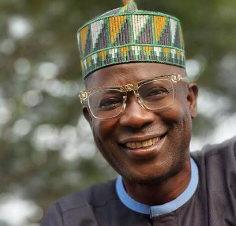
- Proposes 7-year single tenure for President, governors
- Wants strong states, weaker centre
- Demands free, compulsory education
- Says current democracy’s elitist, exclusionary and divisive
By Clifford Ndujihe, Politics Editor
Nigeria’s political, economic and security crises are not isolated problems but manifestations of a deeper structural malfunction in the way the country organises democracy, federalism and education, Professor Adewunmi Falode has said.
Falode, Professor of International Relations and Strategic Studies at Lagos State University, LASU, said Nigeria could overcome its seemingly intractable challenges if it stopped importing political models wholesale and began designing institutions around its own history, realities and peculiarities.
Delivering LASU’s 115th Inaugural Lecture, titled “Bespoke Solutions: Reimagining, Reifying and Realigning the Wheels of the Nigerian State,” recently, identified democracy, federalism and education as the three major “wheels” that must be realigned to put Nigeria firmly on the path of stability, development, peace and national integration.
His prescriptions included a single, non-renewable seven-year tenure for elected public office holders, a decentralised centre with stronger and fiscally empowered states, and free and compulsory primary and secondary education.
Falode also called for the domestication of Nigeria’s democratic and federal systems, arguing that the country had for decades operated institutions that were not sufficiently adapted to its social, historical and economic circumstances.
His central argument was that Nigeria’s problem was not a lack of resources or ideas but the failure to align the country’s political and socioeconomic institutions with its realities.
He said: “Nigeria’s democracy is alien, expensive and exclusionary. It has failed to deliver its dividends in the First, Second, Third and Fourth Republics.”
Costly four-year democratic cycle
Falode picked holes in Nigeria’s four-year, two-term presidential and governorship system, which he said encourages permanent electioneering, litigation and political manoeuvring at the expense of governance.
Under his proposed arrangement, elected public officers would serve one non-renewable seven-year term.
He argued that the existing system leaves little time for effective governance because politicians spend substantial periods dealing with election petitions, positioning for another election and managing political battles.
How? “The presumed winner uses two out of four years fending off petitions, five months to govern, and the remaining one and a half years preparing for reelection,” he said, adding that Nigeria’s democracy has become an expensive cycle in which enormous public and private resources are expended during elections, while the aftermath is frequently followed by litigation, political tension and, in some cases, violence.
Rising cost of polls
Falode cited the escalating cost of elections as evidence of the problem. He recalled that the 1983 federal elections cost about N2 billion, while Nigeria budgeted N1.5 billion for the 1999 elections, N42 billion in 2011, N108.8 billion in 2015 and about N242.2 billion for the 2023 elections, with post-election litigation and other associated expenses not fully captured in the figures.
He lamented that despite the huge resources committed to elections, the process often ended with disputes that required judicial intervention.
“The shocking thing was that at the end of such elections, where humongous money had been expended, with countless lives lost and businesses destroyed, it would still take the intervention of the judiciary for the wheel of democracy to be realigned and readjusted,” he said.
Why seven years?
Falode’s seven-year proposal is designed to create a longer period of uninterrupted governance while removing the incentive for incumbents to divert public attention and resources towards securing a second term.
He argued that the proposed arrangement could provide about four years of stable governance, with the remaining period accommodating electoral preparations and litigation.
He cited countries that operate variations of single-term arrangements and urged Nigeria to study such models rather than assume that the American system it adopted is necessarily suitable for Nigeria.
“Nigeria will have to tweak its constitution to allow for a single term of seven years,” he said, but stressed that the reform must be achieved constitutionally and democratically.
“This is democracy and you can’t just announce changes like the way the fuel subsidy removal was announced. It has to go through the constituted process and it is the best as it saves time and cost,” he said.
Domesticate Nigeria’s democracy
The professor’s argument went beyond tenure.
He said Nigeria must develop a democratic system that reflects its own history, culture and socioeconomic circumstances rather than simply reproducing foreign institutional models.
“What I am simply advocating is that Nigeria’s democracy should be domesticated to meet local realities,” he said.
For Falode, the issue is not whether Nigeria should remain democratic but how democracy can be made more participatory, affordable, inclusive and responsive.
He warned that a political system perceived by citizens as distant from their everyday experiences would continue to face legitimacy challenges.
“Our democracy should be done in a domesticated manner that will aid organic growth,” he added.
Strong states, weaker centre
The second major “wheel” identified by Falode was federalism. He argued that Nigeria’s federal system had not been sufficiently customised to the country’s peculiar circumstances and had consequently produced a powerful centre and relatively dependent constituent units.
His prescription is what he called “competitive federalism.”
“The problem with Nigeria is that the leaders adopted textbook federalism hook, line and sinker. Nigeria must customise or domesticate its federalism if it hopes to correct the obvious fractures in the nation’s seams,” he said.
Explaining his concept, Falode said: “I call this competitive federalism. This means a weak or decentralised centre with strong states.”
He was, however, emphatic that competitive federalism should not be interpreted as a return to regionalism or an invitation to fragment the country.
“I am against anything that will fracture Nigeria into different parts,” he said, adding that states should be allowed to develop while maintaining meaningful interaction with other units of the federation.
His prescription therefore combines greater state autonomy with continued national cohesion.
According to him, the objective should be to make states compete positively in revenue generation, infrastructure, education, investment, employment creation and public service delivery.
Fiscal federalism as the missing link
Falode also identified fiscal federalism as a critical component of the restructuring.
He argued that states need sufficient fiscal capacity to perform their constitutional and developmental responsibilities instead of relying excessively on allocations from the centre.
He linked this to the need for states to expand their internally generated revenue, improve taxation and develop infrastructure.
The professor welcomed moves towards fiscal restructuring, arguing that greater fiscal responsibility could encourage states to become more innovative and economically productive.
He said fiscal federalism should allow states to generate resources and use them for “construction, maintenance and rehabilitation of public facilities.”
Education as the master wheel
But if democracy and federalism constitute major wheels of the Nigerian state, Falode described education as the most important.
He linked inadequate education not only to unemployment and poverty but also to insecurity, ethnic suspicion, religious extremism and weak national integration.
“I consider education to be the most important wheel,” he declared, adding, “Education is key to national integration and political development.”
He called for universal, free and compulsory primary and secondary education, arguing that the state must deliberately invest in educating the next generation.
His proposal is not simply to expand school enrolment but to develop an education system tailored to Nigeria’s circumstances.
“It is not just education but tailored or domesticated education. This is the way to go for Nigeria to realign its economy, reduce unemployment, promote unity and peace and spur development,” he said.
He added:
“Nigeria must make universal primary and secondary education free. Sending children to school must be made compulsory up to the secondary level.”
The professor linked education directly to the battle against violent extremism.
“Importantly, it will be difficult for religious and ethnic extremism to flourish in a society that has deployed adequate resources to combat ignorance through quality education,” he said.
Insecurity: Symptom of deeper failures
Falode’s analysis also connected Nigeria’s security crisis to the wider structural weaknesses of the state.
Banditry, terrorism, insurgency, ethnic conflicts and other forms of insecurity, he argued, cannot be permanently addressed through military responses alone.
They are also products of poverty, exclusion, weak institutions, inadequate education, unemployment, governance failures and unresolved political grievances.
This means that military and security operations, while necessary, cannot constitute the entire solution.
As a way out, he prescribed a multidimensional approach: restructure political institutions, strengthen the states, improve education, deepen fiscal responsibility and create a political system capable of producing accountable and responsive governance.
His argument is consistent with his wider academic work on terrorism, insurgency, counter-terrorism, counter-insurgency and strategic studies.
Colonial inheritance and Nigeria’s structural problems
Falode also traced some of Nigeria’s institutional difficulties to the country’s colonial experience.
He examined the evolution of governance from indigenous political systems through British colonial rule and successive constitutional arrangements after independence.
He contended that Nigeria repeatedly adopted political structures without sufficiently adapting them to the country’s peculiarities. He argued that federalism could have provided an appropriate framework for managing Nigeria’s ethnic, religious and cultural diversity if it had been properly adapted and consistently implemented.
The lesson, therefore, is not necessarily to discard existing institutions but to reform and realign them.
The Constitution, he said, remains the principal instrument for undertaking the necessary reforms.
“The Nigerian Constitution is the best wheel to correct all the punctures, wear and tear Nigeria is experiencing,” Falode said.
Way forward
Falode said that Nigeria’s insecurity cannot be divorced from unemployment and poor education.
Poor economic performance cannot be divorced from weak governance and an over centralised federation.
Political instability cannot be separated from the high cost of elections, prolonged litigation and an electoral system that encourages permanent campaigning.
Ethnic and religious tensions cannot be addressed solely through security operations without tackling exclusion, ignorance, poverty and weak national integration.
In Falode’s framework, therefore, the solutions must also be interconnected.
First, Nigeria must domesticate its democracy through constitutional reform and a political structure that gives elected officials sufficient time to govern.
Second, federalism must be restructured around stronger states and a less centralised federal government, while preserving the unity of the country.
Third, fiscal federalism must accompany political restructuring so that states have both responsibility and resources.
Fourth, primary and secondary education should be free and compulsory, with emphasis on quality and a curriculum suited to Nigeria’s realities.
Fifth, education should be treated as a national-security instrument capable of reducing ignorance, unemployment, extremism and social exclusion.
Sixth, constitutional reforms must emerge through legitimate democratic processes rather than unilateral action.
There is nothing wrong with Nigeria that cannot be fixed
Canvassing for institutional renewal, Falode maintained that Nigeria possesses the human and material resources necessary to overcome its problems if its political leadership and citizens are willing to undertake the difficult process of reform.
“There is nothing wrong with Nigeria that cannot be fixed, provided the leaders and citizens are willing to realign and reify the wheels,” he said.
With his “bespoke solutions,” he said Nigeria does not necessarily need another imported political blueprint. It needs to examine its history, understand its realities, identify the punctured wheels and repair them.
The post 66 YEARS AFTER INDEPENDENCE: How to make Nigeria great again – Prof Falode appeared first on Vanguard News.