

By Juliet Umeh
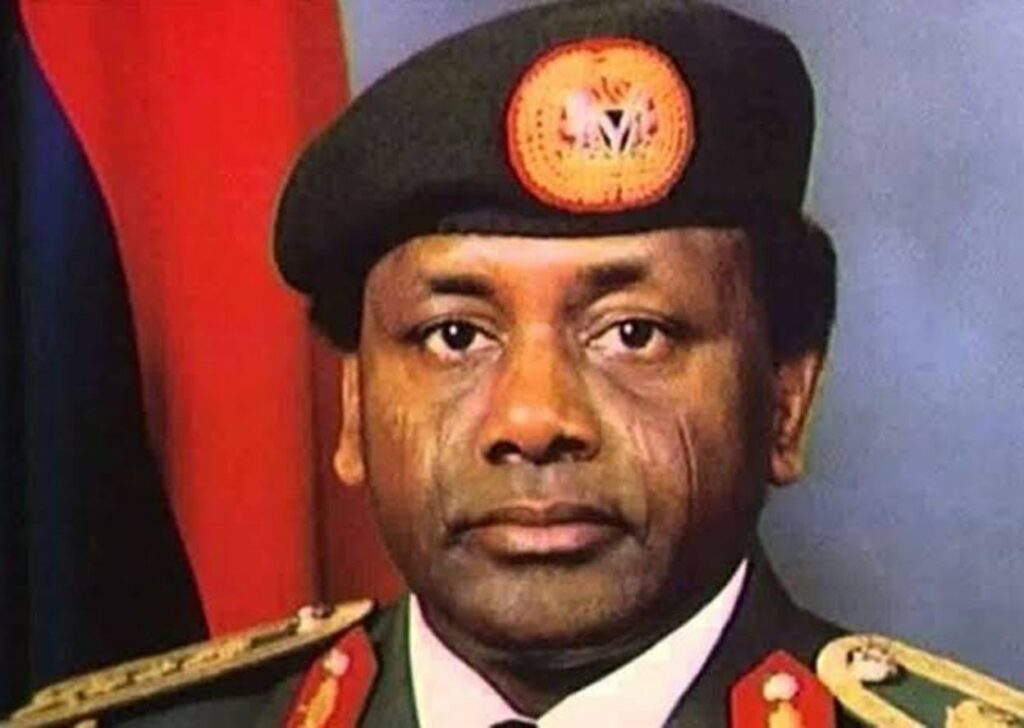
Nearly 28 years after the sudden death of
Nigeria’s former Head of State, General
Sani Abacha, the circumstances surrounding his final hours have once again returned to the centre of national conversation, following fresh claims by retired Department of State Services, DSS, officer, Dennis Amachree.
Amachree, who served as an Assistant Director in the DSS, reignited the long-running debate during an interview on Arise Television with Charles Aniagolu and another on TVC’s Breakfast Show where he defended revelations contained in his newly released memoir, DSS at 40: My Journey Behind the Shield.
His account has, however, been challenged by Abacha’s former Chief Security Officer, Major Hamza al-Mustapha (retd.), who dismissed the claims as false, setting the stage for renewed controversy over one of Nigeria’s most disputed political events.
Speaking on Arise Television, Amachree said his intention was not to create fresh controversy but to end decades of speculation.
“Contrary to what people are saying, my account is there to put to rest all the conspiracy theories surrounding how the former Head of State died,” he said.
According to him, stories about poisoned apples, Indian women and foreign intelligence plots were products of imagination.
“My colleagues and I laughed when we saw stories about Indian ladies with poisoned apples. I think that was the imagination of somebody or some journalist trying to manufacture a story.”
Eyewitness account
Amachree maintained that his version was based on the testimony of the last person who saw Abacha alive.
“The most reliable account of any event is an eyewitness account. This particular lady was right there when it happened. I interrogated her myself and I have no doubt that what she told me was true.”
When asked whether he was merely recounting personal memories or speaking on behalf of the DSS investigation, he insisted that his findings formed part of the agency’s official investigative process.
“My conclusion formed part of the DSS conclusion of the investigation. After I finished interrogating her, she was sent back to Abuja with my interrogation report.”
Although he declined to produce official documents, Amachree stressed that the report exists.
“I am giving you just a snippet of the interrogation report. I’m not going to open the files and bring them out.”
‘Nothing classified’
Responding to questions on why Nigerians were only hearing the account nearly three decades later, Amachree argued that intelligence agencies traditionally maintain silence on operational matters.
“Security agencies don’t come around telling the public details about their work. This is one of the first memoirs written by a retired DSS officer. Nigerians need to know what their intelligence agency has been doing.”
He further dismissed claims that the information remained classified.
“There is nothing classified about the death or illness of any president.”
Challenge to Al-Mustapha
Amachree also responded to former Chief Security Officer, Major Hamza al-Mustapha, who has reportedly dismissed his account and claimed to possess CCTV footage contradicting it.
“Major Al-Mustapha can say I’m lying, but he says he has footage. I would like him to bring the footage and show Nigerians. I don’t know why he would still be holding official CCTV footage.”
He also questioned why two women were reportedly arrested after Abacha’s death if, as critics claim, the incident never occurred.
“If he says two ladies were arrested after Abacha died, then Nigerians should ask why they were arrested.”
Book reduced to one chapter
Appearing on TVC, Amachree lamented that public attention had focused almost entirely on one chapter of a book that chronicles four decades of intelligence service.
“You have reduced my book to the death of Abacha, which is just one story in it.”
He said his decision to include the account was never intended to sensationalise the book.
“When I included this story, I did not put it there to be sensational. It was just a normal story, but people have made it sensational.”
He argued that correcting what he described as false narratives had become necessary.
“People still believe it was Indian ladies and poisoned apples. That was never the real story.”
DSS clearance
One revelation that has attracted significant attention is Amachree’s confirmation that the memoir underwent internal vetting before publication.
“In our service, you cannot publish anything except you pass it through the service itself. There were things I wrote that I was asked to remove because it was not yet the right time. Yes, the manuscript was approved.”
The statement has fuelled public debate over whether the publication reflects institutional acceptance of parts of his account, although the DSS has not publicly commented on the specific claims.
Beyond Abacha
Amachree urged Nigerians not to judge the memoir solely through the lens of Abacha’s death.
According to him, the book also examines intelligence operations, kidnapping, terrorism, insecurity and the role of security agencies in governance.
On intelligence reports submitted to the government, he argued that political authorities often make decisions that differ from professional security recommendations.
“The DSS can never recommend whom government should appoint. Government receives intelligence reports and decides what to do with them. Intelligence reports are objective. Politics is different.”
He added that governments would benefit more by relying on intelligence than political calculations.
“Listen to the DSS and the intelligence community. They provide a roadmap based on national interest, devoid of emotion, religion or ethnicity.”
‘History must confront its uncomfortable truths’
While Amachree’s disclosures have divided opinion, veteran columnist and author Sam Omatseye believes reopening the conversation is necessary for historical accountability.
Speaking on TVC, Omatseye argued that Abacha’s death remains one of the unresolved chapters of Nigeria’s political history and should not be dismissed simply because it happened decades ago.
“Some people ask why we are trying to dig up old bones,” he said. “But history requires us to shed light on hidden places. There was controversy over his death, so there is need for clarification.”
Describing Abacha as one of the country’s most feared military rulers, Omatseye said the circumstances surrounding his death naturally continue to attract public interest.
“Abacha was Nigeria’s most feared dictator. He put democracy under his jackboot. When such a man dies in dramatic circumstances, historians have a duty to ask what really happened.”
Injecting humour into the discussion, the columnist dismissed the long-circulated “poisoned apple” theory with one of the programme’s most memorable quips.
“People kept talking about the poisoned apple. Well, the ‘apple’ turned out to be a young lady.”
He quickly followed with another metaphor that drew laughter in the studio.
“We always hear about the apple of my eye. This one became the apple of my death.”
According to Omatseye, history is often shaped by unlikely actors.
“Some people fought Abacha through protests. Some wrote against him. Some fled the country. Yet, in the end, somebody who had no gun, no political office and no political movement became part of the story that changed Nigeria.”
In another light-hearted remark, he suggested that the unnamed woman deserved recognition—though clearly tongue-in-cheek.
“Perhaps she deserves an anonymous democracy award,” he joked, adding that history sometimes produces heroes in the most unexpected circumstances.
Drawing a biblical analogy, he added:
“Rahab helped save her people. This lady should not be seen as a villain. History sometimes remembers unlikely heroes.”
The columnist also highlighted what he described as one of history’s ironies, recalling an old account from the 1990 Orkar coup attempt.
“There is an irony here. During the Orkar coup, a woman reportedly hid Abacha inside a wardrobe and he survived. Years later, according to this account, another woman featured in the story of his death. Saved by a woman and, according to this narrative, died in the company of a woman.”
Beyond the humour, Omatseye said the episode should serve as a lesson on the vulnerabilities of powerful leaders.
“History is full of stories of powerful men brought down by human weakness. Men should be careful. Power and authority do not make anyone immune.”
He also argued that Amachree’s account should not be dismissed outright because the retired intelligence officer disclosed that the manuscript was subjected to internal DSS review before publication.
“This was not simply a retired officer writing on his own. The DSS reviewed the manuscript before publication. That tells us the account forms part of the institution’s memory, even if others disagree with it.”
What remains beyond dispute, however, is that Abacha’s death continues to rank among Nigeria’s most enduring political mysteries—one that still generates competing narratives, fresh questions and renewed public fascination nearly three decades later.
Whether Amachree’s account ultimately settled the debate or simply adds another layer to an already contested history remains to be seen. What is certain is that the publication of his memoir has reopened a conversation many Nigerians thought had long been settled.
The post Abacha’s death: Fresh claims reignite 28-year mystery appeared first on Vanguard News.