

By Chioma Obinna
At the age when most children are still learning how to spell their names, count money and tell the difference between right and wrong, nine-year-old Ade already knows the taste of alcohol. He does not hide it. Neither does he consider it unusual.
Read Also: 25 children from Kebbi, Kwara, Niger died in terrorists’ captivity — Lawmaker
The provided text describes the serious issue of underage alcohol consumption and the environmental factors that contribute to it. It highlights stories of young children being introduced to alcohol by family members and the normalized presence of alcoholic substances in their daily lives.
Underage drinking poses significant risks to a child’s physical and mental development. Early exposure to alcohol can lead to dependency, impaired judgment, and long-term health complications. Public health experts and child advocates emphasize the importance of parental supervision and the enforcement of laws to protect minors from accessing regulated substances.
For those seeking help or more information on protecting children from substance use, resources are available through local child welfare services and public health organizations dedicated to substance abuse prevention.
me to buy as usual and an uncle I met there offered to buy one for me. He said he wanted to know if I could drink it or not. So, I proved him wrong that I could take alcohol,” he recalled. “Since then, each time I go to buy, he will buy for me. That is how it all became an everyday thing.” Today, Chibuike said he drinks two to three sachets of alcohol a day, sometimes buying it with his own savings.
When errands become dangerous
The stories of Ade and Chibuike expose a troubling reality in Nigerian society. Children are often expected to obey adults unquestioningly, especially when sent on errands, yet little attention is paid to what they are being sent to buy, deliver or do. It is a practice deeply rooted in African family and social structures. Parents, older relatives and other adults exercise authority over children, while society often interprets obedience as a virtue.
In religious settings, children are similarly taught to obey their parents and elders. But what happens when obedience becomes a pathway to danger? What happens when the child sent to buy alcohol eventually becomes the child who drinks it? Across Nigeria, children are exposed to alcohol not only through friends and social gatherings, but through their homes, relatives and neighbourhood shops. Some are introduced to it by adults they trust. Others obtain it themselves from retailers who do not ask their age. The result is a disturbing cycle in which some children encounter alcohol years before they can understand its implications.
The disturbing numbers
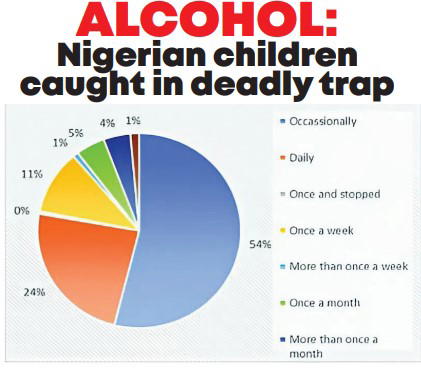
A 2021 national survey conducted by Research and Data Solutions Limited, Abuja, for the National Agency for Food and Drug Administration and Control, NAFDAC, and the Distillers and Blenders Association of Nigeria, DIBAN, found widespread access to alcohol among minors and underage persons. The study covered 1,768 respondents in six states representing the six geopolitical zones. Respondents below 13 years were classified as minors, while those aged 13 to 17 were classified as underage.
The findings showed that 54.3 percent of minors and underage respondents obtained alcohol by themselves. Nearly half, 49.9 percent, accessed alcohol through friends and relatives, while 43.9 percent obtained it at social gatherings. Another 21.7 percent had access to alcohol in their parents’ homes.
Among those who procured alcohol themselves, 57.2 percent of minors and 48.8 percent of underage respondents bought drinks in sachets, while 41.2 percent of minors and 47.2 percent of underage respondents procured alcohol in PET bottles.
The survey also found that 63.2 percent of minors and 54 percent of underage respondents consumed alcohol occasionally, while 9.3 percent of minors and 25.2 percent of underage respondents reported drinking daily.
The state-level analysis reveals disturbing variability of alcohol use by the survey; Gombe, Kaduna, the Federal Capital Territory, Anambra, Lagos and Rivers, Rivers recorded the highest procurement of alcohol in sachets and PET bottles among minors and underage persons, with 68.0 percent and 64.5 percent respectively. Lagos followed, with 52.3 percent procuring alcohol in sachets and 47.7 percent in PET bottles, while Kaduna recorded 38.6 percent and 28.4 percent respectively.
The figures show that the problem is not confined to one region or one type of community. In neighbourhood shops, markets, motor parks, social gatherings and even homes, alcohol can be within easy reach of children.
The health warning
But the danger, according to health experts, goes beyond access. The World Health Organisation, WHO, warns that alcohol use during childhood and adolescence can interfere with the normal development of the brain and increase the risk of problems involving learning, memory, judgment and decision-making. Early initiation of alcohol use is also associated with a greater risk of developing alcohol-use disorders later in life.
WHO has also noted that alcohol and drug use among children and adolescents is associated with neurocognitive changes that can contribute to behavioural, emotional, social and academic problems later in life.
For children such as Ade, whose first taste came at about five, and Chibuike, who gradually moved from buying alcohol for an adult to drinking it himself, the concern is therefore far greater than a child simply having “a little drink.” What may appear harmless at the beginning can become a pattern with consequences stretching into adolescence and adulthood, experts noted.
In an interview with Saturday Vanguard, the President of the Association of Psychiatrists of Nigeria, (APN) and Chief Consultant Psychiatrist at the Federal Neuropsychiatric Hospital, Yaba, Lagos, Dr. Veronica Nyamali, said the age of which children begin drinking alcohol is falling.
“For us psychiatrists, we’ve seen over time that the age of onset of drinking in children is actually reducing. Before now, we used to say it starts in secondary school when they are in their teens. But over time, research work even in Nigeria has seen that it starts very early, as early as nine, 10 years. And some people are still in primary school at that age,” she told Saturday Vanguard.
Nyamali said the danger lies in the fact that alcohol is being introduced at a stage when a child’s brain and other organs are still developing.
“When we talk about health implication, where it starts from is brain development. For children, alcohol will definitely interfere with the normal development of their brain,” she said.
According to her, the consequences may include problems with learning, memory, attention span, judgment and decision-making. “These are people that are supposed to be learning in school,” she said.
The physical consequences can be equally serious, she added, because alcohol can affect multiple systems in the body, including the liver and immune system, while alcohol poisoning poses an immediate danger. “For a child, the immune system is growing. Parents give them vitamins and all of that to build up their systems. They now put alcohol; it’s more or less like poisoning,” Nyamali said.
The mental health consequences are also worrying. She said underage drinking is associated with an increased risk of low self-esteem, anxiety, depression, suicidal thoughts, abnormal behaviour and aggression.
The damage does not stop at the child’s health. She said: ‘A child who drinks regularly may struggle academically, become absent from school, lose interest in learning or eventually drop out. There is also a higher incidence or possibility of dropping out from school,” Nyamali said.
She added that alcohol use could increase the likelihood of risky behaviours, violence, unsafe sexual activity, accidents and injuries.
Relationships can also suffer as children exposed to alcohol begin to reject authority and become more influenced by their peers. “And when the drinking now continues for long, it can also lead to alcohol dependence,” she said.
Business on the backs of children
For the Director-General of NAFDAC, Prof. Mojisola Adeyeye, the widespread availability of small and easily concealed alcohol products is helping to fuel the problem.
According to her, sachets and small bottles are cheap, portable and readily available in motor parks, street corners, kiosks and open markets, putting them within easy reach of children and adolescents.
“These sachets and small-pack products are cheap, portable, easily concealed and aggressively targeted at young people. They are sold in motor parks, street corners, kiosks and open markets, often within reach of children and adolescents,” Adeyeye said.
She stressed that the issue goes beyond regulation and business. “When a child starts drinking alcohol at the age of five or nine, and we have documents to show that, Nigeria will not have any future. It’s not just the future in terms of workforce, it’s future in terms of health.”
Adeyeye warned that children’s organs, including the liver, are still developing, making early exposure to alcohol particularly concerning.
NAFDAC has therefore pushed for the removal of alcoholic drinks sold in sachets and bottles below 200ml, arguing that eliminating cheap, easily concealed pack sizes would help reduce access by children. But enforcement remains a challenge.
Adeyeye said the agency had moved from manufacturer to distributors and then retailers as part of a tiered regulatory approach. She also expressed concern over the findings from independent research into underage access to alcohol. “Nine-year-old drinking alcohol. What type of country do we have?” she asked.
Beyond regulation
For Nyamali, tackling underage drinking requires more than removing small bottles and sachets from the market. It requires parents to pay closer attention to what children are doing, where they are going and what they are being asked to buy.
She called for open communication between parents and children, school-based education on substance use, community awareness campaigns and stronger enforcement of minimum drinking age laws.
The APN President also supported NAFDAC’s efforts to remove sachet alcohol and other small-pack alcoholic drinks from the streets.
“The children have access to it, it’s everywhere. It will help not only the children, it will help the adults too,” she said. She warned that easy access to alcohol can open the door to other risky behaviours, including stealing to obtain substances, involvement with the justice system and association with peers already engaged in substance use.
Instead, she said, children should be encouraged to participate in healthy recreational activities and develop positive peer relationships. “Generally speaking, underage drinking can have lasting effects on a child’s physical health, mental well-being, academic success and social development,” she said.
Preventing it, she added, requires the combined efforts of families, schools, communities, religious institutions, government and the media.
When obedience becomes dangerous
The warning is especially important in a society where sending children on errands is considered normal and where obedience to elders is often valued more than questioning the nature of an errand, even an errand may look harmless. To a five-year-old, being sent to buy a sachet of alcohol may simply be another task assigned by an adult he trusts. To an 11-year-old, carrying alcohol home every morning and evening may feel like work. But the line between carrying and consuming can be dangerously thin.
Ade’s first sip came from his father. Chibuike’s first taste came from an adult while carrying out an errand. Their stories show how adults can make informed choices about alcohol, adults have already made the choice for them. And that is the heart of the crisis.
The question is no longer only why children drink. It is also who gives them the first drink, who sends them to buy it, who sells it to them, who watches them consume it, and who looks away. For a country that repeatedly describes its children as the leaders of tomorrow, the answers may determine what kind of tomorrow Nigeria will have.
Vanguard News
The post Alcohol: Nigerian children caught in deadly trap appeared first on Vanguard News.