

By Juliet Umeh
Long before ballot papers, polling booths and electoral commissions became features of Nigeria’s political life, communities gathered to deliberate, question those who exercised authority and arrive at decisions affecting their collective existence.
Read Also: 2027: You must play according to rules, Jonathan warns politicians
There were no voter cards or electronic accreditation machines. Yet, according to the Obi of Onitsha, His Royal Majesty, Igwe Nnaemeka Alfred Achebe, beneath those traditional systems lay an important democratic principle: power required the consent and participation of the people.
For Achebe, therefore, democracy should not simply be regarded as a foreign political idea handed down to Africans. Its fundamental values, he argued, have deep roots in indigenous African society.
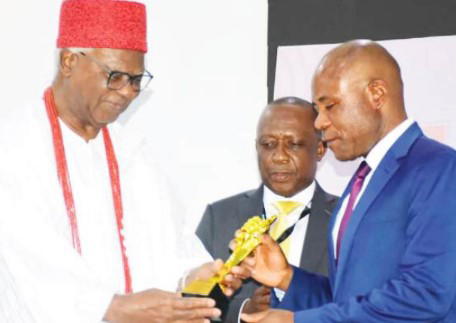
Speaking as chairman of the All Nigeria Editors Conference, ANEC, in Enugu, Achebe reached into Igbo traditional governance to make his point.
“In our Igbo tradition, the Obi does not rule by decree. He rules in council, in dialogue, in the constant testing of truth against the wisdom of elders and the voice of the people.
“Igbo democratic instinct is ancient. Even kingship here has always been checked by the community, by consultation, by honest speech,” he said.
It was a striking intervention at a conference devoted to the ballot, media and survival of democracy.
Democracy beyond election day
Modern democracy is commonly associated with periodic elections, political parties, legislatures and constitutions. But Achebe’s argument goes deeper: these institutions may be modern, but the underlying idea that leaders should listen to the people is not necessarily new to African societies.
He declared: “The ballot box, in this sense, is not an import grafted onto our soil. It is a modern vessel for an old African value, which states that legitimate power flows from the consent, the voice, and the informed judgment of the people.”
That distinction is significant.
It suggests that the real test of democracy is not merely whether citizens queue every four years to cast ballots, but whether their voices continue to matter after the votes have been counted.
Achebe, who reflected on Nigeria’s journey from independence through military rule to democratic government, described the country’s democracy as a continuing project rather than a finished achievement.
“I have watched Nigeria’s journey from the optimism of independence, through the turbulence of military rule, into the fragile and still-unfinished project of democratic self-governance,” he said.
His message was that democracy requires constant protection.
“Democracy is not a monument we erect and then walk away from,” Achebe warned.
“It is more like a fire lit to keep the house warm. It must be tended, fed, protected from wind and rain, or it dies quietly in the night while everyone believes it still burns.”
Consent must be informed
But Achebe also identified a complication in the principle of popular consent.
For the people’s choices to confer meaningful legitimacy, he argued, those choices must be informed.
“Consent is only meaningful if it is informed,” he said.
That is where he placed journalism at the heart of the democratic process.
“The ballot is the citizen’s voice. The media is the mirror by which that citizen sees the world clearly enough to know what to say with that voice.
“When the mirror is cracked, or worse, deliberately distorted, the citizen no longer votes from truth but votes from illusion.And a democracy built on illusion is not genuine democracy but drama. It becomes a theatre,” he said.
For editors gathered in Enugu, the traditional ruler’s argument effectively connected two institutions separated by centuries: the village council where voices were heard and the modern newsroom through which citizens receive information.
In both, he suggested, honest speech matters.
When the people stop mattering
Achebe’s reflection also raises a larger question for Nigeria: if consultation, consent and accountability are deeply rooted values, why should democratic participation begin and end at the polling booth?
His description of traditional leadership offers an interesting contrast to any system in which obtaining political office is treated as sufficient authority to govern without listening.
Even an Obi, he stressed, is subject to restraints.
“Even kingship here has always been checked by the community, by consultation, by honest speech.”
It is perhaps one of the most important messages from his address.
Democracy may have acquired modern institutions and technologies, but its survival still rests on an old and remarkably simple principle: those who govern must remain connected to those they govern.
And citizens, in turn, must have truthful information with which to judge them.
That explains why Achebe charged journalists not merely to report democracy, but to help preserve it.
“In the face of challenges, politicking, electioneering and partisanship, you must stand upright for democracy and the nation.
“Even if politicians, electoral body, institutions, and other things fail, you must be the ultimate last man standing in the task of defending democracy,” he told the editors.
From the traditional council to the modern ballot box, Achebe’s argument is ultimately about the same thing: power derives its legitimacy not simply from those who wield it, but from the people whose consent gives it meaning.
Vanguard News
The post All Nigeria Editors Confab, 2026: Before ballot box, Africans already knew democracy — Achebe appeared first on Vanguard News.