

By Samuel Oyadongha, Yenagoa
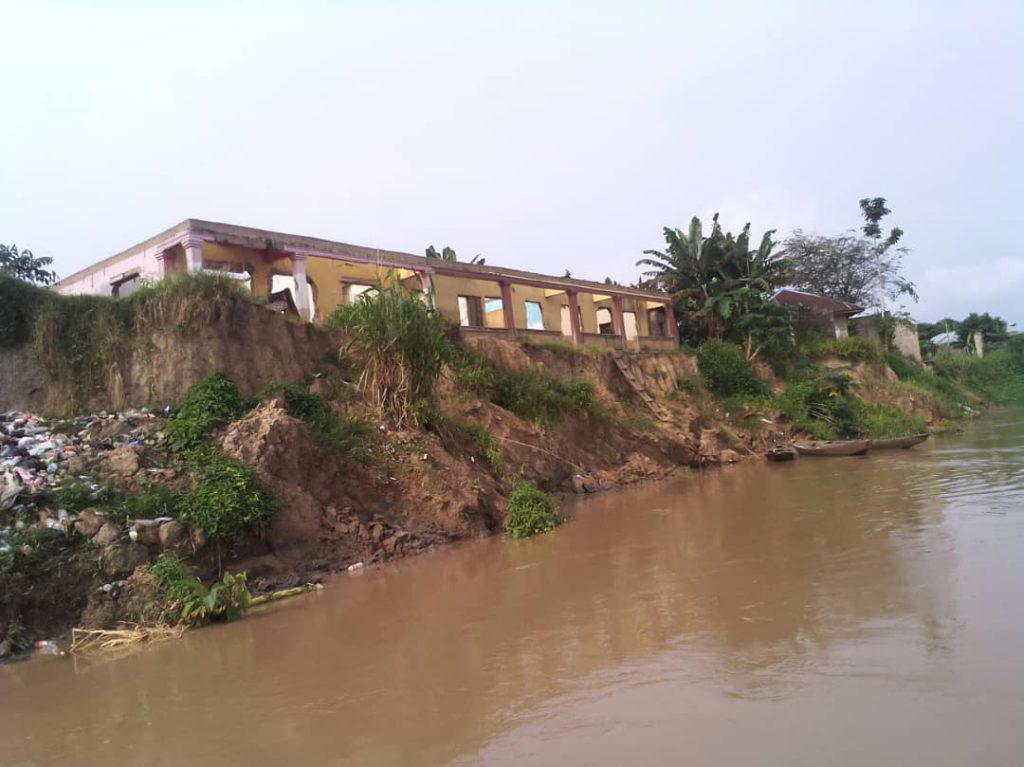
Four years ago, Ayi, a resident of Obogoro, a riverside community on the fringe of Yenagoa Local Government Area, Bayelsa State, gathered her six children around her and told them they would have to leave. Not because of conflict, not because of family strife but because the river was coming for their home.
“The Ekole River was more than sixteen plots from our house when we moved in, she recalled. “Now that same house is on the verge of being swallowed.”
Today, Ayi is a tenant in a neighbouring community, paying rent she can barely afford while her own family home, built with years of sacrifice, teeters on the edge of destruction. She is not alone.
A Community Under Siege
For years, Obogoro has been a thriving riverside settlement where fishing, farming, and trade sustained families. Civil servants, traders, farmers and strangers lived side by side, their lives intertwined with the ebb and flow of the Ekole River that gave them sustenance. But the river that once gave life is now taking it away. A large portion of the community land has been washed away in the last few years.
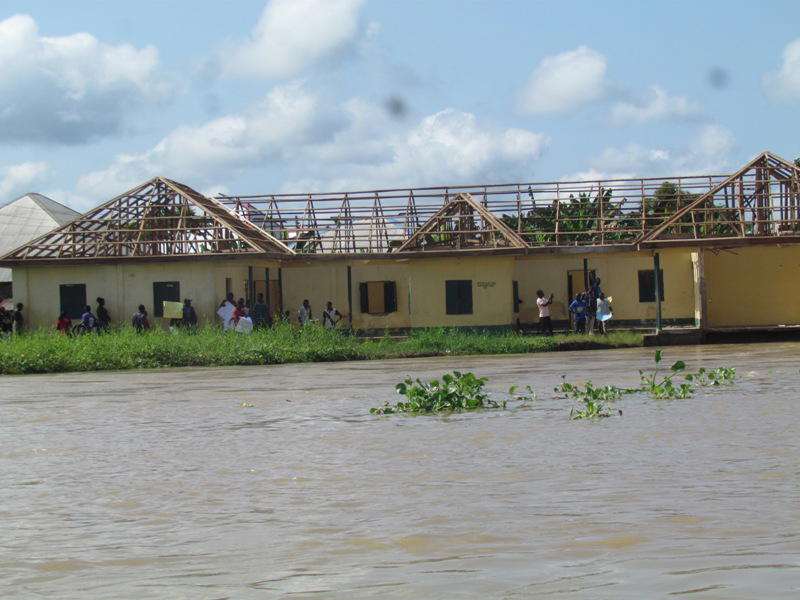
Coastal erosion has transformed the once vibrant community into a landscape of fear. Homes that stood for decades have crumbled into the water. Farmlands that fed families now lie submerged. Even the community’s Corpers’ Lodge, a symbol of progress and connection to the wider world has been lost to the relentless advance of the wave.
The government relocated the community school to safer ground, but for many residents, the damage has already cut too deep.
“It’s horrifying staying in my house given the erosion menace,” said Madam Eunice, who fled her home after a terrifying night that will forever haunt her memory.
“There was a night when we heard a frightening noise,” she recalled. “When we summoned courage to come out, we discovered that the river had claimed a large portion of land. That was when we realised the risk of staying back.”
For four years now, Eunice has been paying “high rent as a tenant” in Yenagoa’s Amarata suburb, even as her own comfortable home stands empty, condemned by the advancing waters.
“I have a comfortable home that I was forced to move out of by menacing erosion,” she said, the frustration evident in her voice.
Cost Implication
The economic toll is devastating. In a region where building materials have become prohibitively expensive, losing a home means losing everything.
“Building materials have become very expensive, and nobody wants to lose their property and have to rebuild,” said Egbo Nnamdi, a distressed landlord whose property now stands dangerously close to where a dredger continues to operate.
“Even right now, as I’m speaking to you, there is still a dredger operating right in the area, very close to my property,” he added. “We have done everything humanly possible, but we are yet to get relief.”
Nnamdi points to unregulated sand mining as a key factor worsening the crisis. Dredgers, he lamented, are operating at the very top of the river, where their activities compound the erosive force of the current. His words, “Those activities are pushing the erosion directly toward the area where they are dredging. If those activities weren’t taking place, the erosion would have already passed that area by now.”
A Crisis, Decade in the Making
Bayelsa State, with its delicate deltaic geography, has endured decades of coastal erosion, flooding, and land loss. Rising sea levels, tidal surges, and the absence of critical protective infrastructure have left communities like Obogoro and others increasingly vulnerable. Many settlements have lost not just homes, but entire livelihoods. Farmlands have disappeared, access to clean water has been compromised, and families have been forced to scatter inland, fracturing the social fabric that once held communities together.
“The situation is very bad,” Nnamdi lamented..
In 2023, the Bayelsa State government intervened, awarding a contract to a local firm to address the crisis. But residents said the situation has only worsened as work stalled.
Frank Ovie paints a stark picture of what needs to happen to savage the situation. He said: “What should be done is to divert the river current either by excavating an alternate channel or building a wall at the point where the current is incident on the community. Either way, it will reduce the force of the current.” He urged stakeholders in the community not relent in crying out to the relevant authorities. “They should ensure that the issue continues to dominate public discourse,” he added.
Govt Assures
The government, on its part, had assured that the erosion control project in the community has not been abandoned. Governor Douye Diri, had years back in a statement by his Chief Press Secretary, Daniel Alabrah, explained that the government was committed to finding a lasting solution to the erosion menace.
While empathising with the community over the negative effects of the coastal erosion, including the loss of lives, land, property and sources of livelihood, Diri urged the community to keep faith with the government to rescue the situation.
The government, it was further learned, had received a detailed report from the state Ministry of Environment on the Obogoro erosion project and had given directives on how to address the menace permanently.
Coastal Erosion, a Major Problem
Speaking on the erosion menace confronting the state, Alagoa Morris, Chief Operating Officer, Environmental Conservation, Agriculture and Rural Development (ECARD) and Technical Adviser to the Governor on Environment 1, said besides oil industry induced pollution, coastal and river bank erosion is the the most pervasive environmental and ecological menace faced by communities in the state. Morris listed the communities to include Obogoro, Odi, Northern Kaiama, Anibeze, Sampou, Abobiri, Peremabiri, Olugbobiri, Okpotuwari, Lasukgbene, Odioama, Sangana, Kongho, Twon Brass, Okpoama, Koluama, Foropa, Ekeni, Ezetu, Bilabiri and Amatu among others. Morris, however, described Obogoro as the fastest battered erosion troubled site he had witnessed, making available pictures of the school premises before it was swallowed by the rampaging Ekole River.
“We met this school building during our first visit in 2018 or so… next visit in 2019 it became a victim and the community lost it completely to the erosion. Obogoro is the fastest erosion site I have witnessed. See the school building before it was eventually washed away,” ECARD Chief Operating Officer said pointing at the pictures, he once took.
A Model Worth Replicating
For environmental advocates, the solution lies in aggressive intervention. They point to the Emadike shoreline and land reclamation project in Ogbia Local Government Area carried out by the Federal Government through the Ecological office as a success story worth replicating.
“What we have seen at Emadike community is a clear testament that embarking on shoreline protection is quite beneficial to our communities suffering from flooding and coastal erosion,” Morris said.
The Emadike project, he noted, has significantly reduced tidal surges and land degradation, offering long-term environmental and economic benefits.
“We want to call on the Federal Government and the Ecological Fund Office to replicate the same project in our coastal communities where the locals are constantly threatened by erosion,” Morris noted.
A Call to Action
Collins Diepreye, a concerned Bayelsan, warned that without urgent government action, more communities along the Ekoli River face total submersion.
“Whole communities risk being displaced, leading to heightened socio-economic hardship,” he said.
For families like Ayi’s, Madam Eunice’s and others, this is not a mere threat. It is the daily reality of watching your world dissolve into the water.
The government has spoken of a redesigned project and plans for permanent solutions. But for residents watching the river inch closer with each passing day, words are not enough.
As one resident put it simply: “We are still calling on the government to look into our situation.”
For the people of Obogoro, the river that once sustained them now threatens to consume everything they have built. And as the waters continue their advance, they wait not just for intervention, but for hope.
The post Angry Ekole River: Bayelsa community fights for survival as erosion swallows homes appeared first on Vanguard News.