

By Osa Mbonu-Amadi
In a troubled country like Nigeria, artists who fail to use their work to address the problems of the society miss a significant aspect of the duty of an artist. It appears the Nigerian-born UK-based visual artist, Akinokun Isaiah Abiola, has taken that advice. It was the same advice the civil rights activist, Sandra Izsadore (also known as Sandra Smith), gave to Fela Anikolapo Kuti in 1969 during Fela’s 10-month tour of the United States. Fela took that advice, and it gave birth to the Nigerian international music genre known today as Afrobeat.
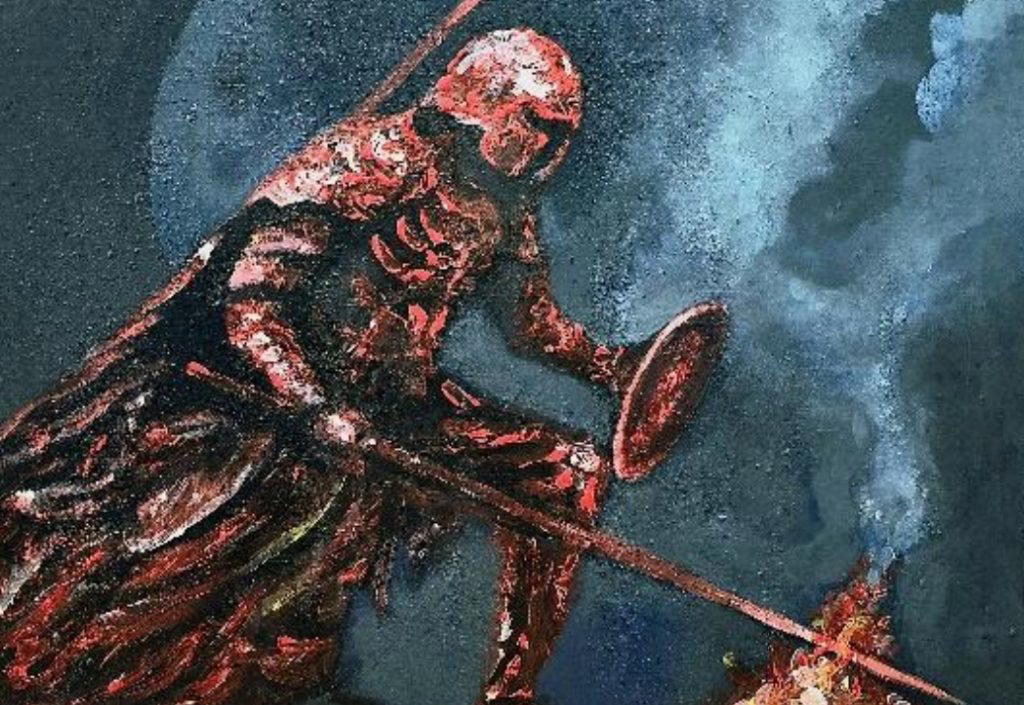
While Fela’s heed to that piece of advice led him to create Afrobeat, Abiola’s resulted in the creation of Arodan, Okunrin Meta, and Jagun Jagun, which are part of his Before, During and After Conflict series. The works do not only address the prevailing insecurity in Nigeria, but also call all citizens to take action.
Working in acrylic with the theme of conflict and sacrifice, Abiola’s figurative paintings are based on Yoruba history and mythology. His work mainly explores how people’s ideas of race, masculinity and cultural identity are shaped by their history. His training under Dotun Poopola and Jonathan Imafidor, who are among Nigeria’s best visual artists, had adequately prepared him for the deep philosophical pieces that were to later flow from the stable of his craftsmanship.
In 2025, Abiola was selected for the Billboard Showcase Artist Development Programme, an initiative funded by Arts Council England. In addition to that, his works have shown at Usher Gallery and Hammond House Gallery. With those shows, Abiola was able to take the idea of his African heritage meeting the way of life in the diaspora to global audiences, just as he stated in his artist statement: “My work seeks to create conversations between African heritage and contemporary life in the diaspora, exploring the stories we inherit, the identities we construct, and the communities we build through shared experience.” This statement is capable of being interpreted as “Although we are far away from home, we haven’t forgotten our African heritage, our history, and the problems still facing our homeland which we continue to address through our works.”
For Abiola, the greatest of those problems facing home now is the debilitating insecurity of life and property. And the artist proffers solution with his artworks titled Arodan, Okunrin Meta, and Jagun Jagun.
In Arodan, which means The Messenger, painted 2026, the artist captures that familiar tense moment, such as when roundtable discussion is held, but unfortunately breaks down, before declaration of war and shooting of the first volley. The Messenger, clad in moonlight and shadow, shuttles between the two belligerent sides suing for peace and reminding men and women that violence is an ill wind that blows nobody any good. With Arodan, a diplomat by all standards, the artist passes across the message that jaw-jaw is better than war-war. In the context of the prevailing terrorists attacks and abductions of innocent citizens in Nigeria, Abiola uses Arodan to preach peace and advise aggressors to lay down their arms and explore alternative means of communicating whatever greviances they may have against society and the government.
All jaw-jaw and diplomacy having failed, we arrive at Abiola’s Okunrin Meta (Three Men) where conflict erupts. As Arodan had warned, violent conflict results in casualties. Here, we see a warrior mourning and paying homage to his fallen compatriots by kneeling. As a warrior, he vows to fight on and avenge the death of his fellow soldiers. War and other violent conflicts have unsavory consequences: The warrior now bears the burden of waging the war meant for three men. Okurin Meta represents grief, responsibility, and endurance. But it also means strength, the strength of the living warrior and those of our heroes past. In Okurin Meta, the artist takes on the role of a master praise singer who in battle, eulogises both the living and fallen warriors. In Africa, accounts of war exist where warriors foam at the mouth upon hearing such praises sang to their names. The results were bold actions that brought victories!
After the inferno, survivors usually rummage around the charred debris. After bloody battles, the warrior that survived walks the bloody field littered with bodies, some headless, some without limbs. That is exactly what Jagun Jagun (Warrior) does here. He raises his banner, not in gloat of the demise of the foe, but in mourning the loss of lives that could have been avoided if men and women had heeded Arodan’s warnings and his diplomatic efforts.
According to the artist, “The raised banner becomes a symbol of perseverance and the possibility of peace following destruction. Jagun Jagun considers what remains after struggle and asks whether hope can endure in the shadow of violence.” Abiola is optimistic that peace will return to his fatherland after the tripartite evil of terrorism, abductions and official corruption have been defeated. But to achieve that lofty objective, warriors must step forward, and citizens must make sacrifices.
With these three works, Abiola successfully completes his Before, During, and After conflict narrative, using them as his intervention in the insecurity strangling his home country. With this series too, Akinokun Isaiah Abiola takes his place alongside artists who do not chase rats while their house burns, or emperors who fiddle while Rome burns.
The post Arodan, Okunrin Meta, Jagun Jagun: Abiola’s intervention in Nigeria’s insecurity appeared first on Vanguard News.

 Vanguard Nigeria
 Channels TV
 Business Day
 Punch Nigeria
 Premium TImes
 This Day