

By Ochuko Akuopha
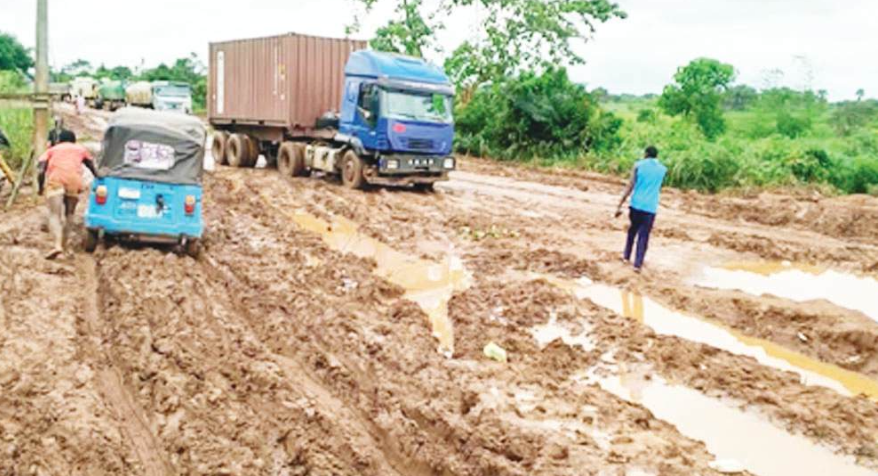
EBU — Farmers and traders in the Ebu community in Oshimili North Local Government Area, Delta State, have been cut off from major markets across the South-South and Northern regions as the Asaba-Ugbolu-Illah-Ebu federal highway has become virtually impassable due to persistent neglect and torrential rains at the peak of the rainy season.
The critical single-lane road, which serves as a primary gateway to Edo, Kogi, and the vast expanse of Northern Nigeria, has severely restricted the movement of agricultural produce and essential goods, triggering a fresh wave of economic hardship for the agrarian community.
A Road That Swallows Dreams
Drive through this corridor and you’ll witness a scene that defies belief. Where smooth asphalt once carried the hopes of traders and transporters, there now yawn deep gullies, potholes that have spread into muddy graves for vehicles. Heavy-duty trucks lie on their sides, their loads scattered, their drivers cursing the fate that brought them here.
“My brother, for the past four months, it has been a nightmare,” said Azuka, a transporter who has plied the route for fifteen years, his eyes betraying the exhaustion of countless sleepless nights spent stranded on this road.
He gestured toward a section where three trailers have crashed into each other, creating a metal sculpture of frustration. “Most drivers have decided not to follow the road anymore. We have broken down trailers everywhere.”
The statistics tell a grim story. A journey that once cost a passenger N1000 now demands N5000 and that’s if you can find a transporter willing to risk the journey at all. The cost of repairs has become prohibitive, and many vehicles simply give up, joining the growing number of abandoned cars along the roadside.
Farmers Bearing the Heaviest Load
But the human toll transcends economics. It is measured in the faces of farmers whose yams, cassava, maize, plantain, and potatoes rot in their fields because they cannot reach the markets of Asaba, Ugbolu, and Onitsha.
“The situation of the road is actually disturbing,” Mr. Andrew Onlaye, an indigene of Illah community, told NDV. “The neighbouring communities are agrarian communities that cultivate yam, cassava, maize, plantain, potatoes. The deplorable nature of the road has made it difficult for the farmers to take their goods to the market,” he added.
What the farmers have cultivated with their sweat and prayers now becomes a source of anguish. The road that should carry their produce to hungry markets instead swallows their livelihoods whole.
A Highway of Tears
But the most devastating cost cannot be counted in naira or kobo. It is measured in lives lost, in families shattered, in dreams that ended on this stretch of asphalt.
“In fact, more than two, three deaths were recorded because of the heavy duty trucks on the road. Many youths have been involved in accidents because of the deplorable nature of the road. Okada versus trailer, it killed some of them instantly. Some of them were maimed and injured. Some of the cases are still being discussed in the police station,” Onlaye revealed.
The road has become a predator. When trucks fall, when Okadas collide with trailers and when vehicles break down in the middle of nowhere, the darkness descends and with it.
“Because of the inability to pass through the road, it is very easy for people to fall victim to bandits, armed robbers and others attack,” Onlaye added, painting a picture of a community under siege from all sides.
The Politics of Neglect
As the rainy season intensifies; the road continues to steadily worsen. The heavy-duty trucks that the road was never designed to handle have accelerated its collapse. Four months ago, there were still stretches where drivers could find relief but this is no longer possible.
“The trailers are using the road too often,” Onlaye explained. “The heavy duty trucks passing through the roads especially during this rainy season have made the situation worse to the extent that small vehicles cannot pass through. It is not easy to maintain vehicles after passing through the roads.”
Mr. Nathan Oswe, another road user, expresses fears that the communities could be completely cut off. “Even during the electioneering period, many places may not be accessed and INEC officials may not be able to move election materials to the affected areas.”
A Cry for Help
The people have not suffered in silence, they have raised their voices to the Federal Government, cried out to the state government and prayed for intervention.
“These are some of the reasons why the people are crying out,” Onlaye said. “When the people are crying to the Federal Government, they are also crying to the state government to intervene and do some palliative to enable the people in the community to move with ease.”
“We need the federal and state government to come to our aid to see if they can do any palliative work, because transportation is the only way we can fend for ourselves,” Azuka added.
A Glimmer of Hope
When contacted, former Controller of the Federal Ministry of Works in Delta State, Mr. Matthew Ogar offered these words: “We are trying to see what we can do on that road; the road is under design.”
However, the question that haunts every traveller and every farmer, who must navigate this treacherous path, is not whether the road will be fixed, but whether it will be fixed before more lives are lost, more dreams are shattered and before another community is cut off from the nation it serves.
The post Delta federal roads: Gridlock, anguish as farmers, motorists groan appeared first on Vanguard News.