

By Juliet Umeh
What happens after the votes have been counted and an election won? For Nigeria’s democracy, the answer may sometimes lie beyond the ballot box. That question has come into sharper focus following a revelation by Minister of the Federal Capital Territory, Nyesom Wike, about what happened behind the scenes after Gov. Ademola Adeleke’s re-election in the August 15 Osun State governorship election.
Read Also:
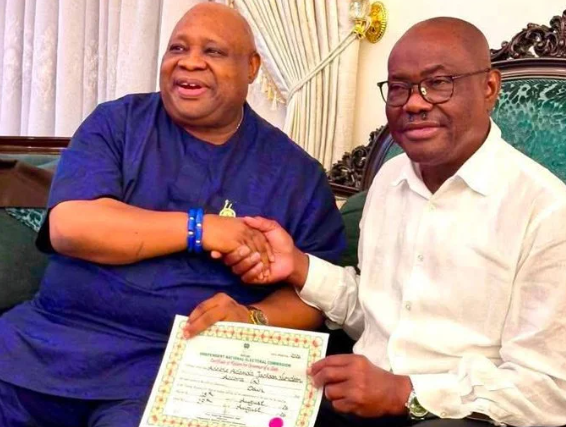
Wike disclosed that he personally instructed Adeleke to publicly reaffirm his support for President Bola Tinubu, thank the President for what he described as a free and fair election, and present his Certificate of Return to Tinubu.
The revelation, made during Wike’s media parley in Port Harcourt on Wednesday, has raised questions about whether Nigeria’s democracy is increasingly being shaped not only by voters and institutions, but also by political negotiations among powerful individuals.
Recounting his intervention, Wike said: “My concern: if Adeleke wins, will he still support Mr. President? And I called him, because that’s my own interest.”
He said he reminded Adeleke of an earlier commitment to support Tinubu.
“I called him, I said, ‘Listen, you have told me you’ll support Mr. President. Are you going to keep to it?’ He said he was going to keep to it. I said, ‘Okay.’ I wished him good luck. I didn’t need to go to Osun.”
Wike said his conversation with Adeleke continued after the election.
According to him, he called Adeleke while he was in Croatia and asked him to publicly reaffirm his support for Tinubu.
“Now you have won, issue a statement. Issue a statement that you still will support Mr. President, and thanking him for a free and fair election,” Wike said.
He added: “I also told him, ‘Adeleke, when you receive your Certificate of Return, go and present it to Mr. President.’”
Adeleke subsequently met Tinubu and presented his Certificate of Return.
But Wike’s explanation of why he made the intervention has generated even greater interest.
He described it as a deliberate political strategy aimed at preventing the African Democratic Congress, ADC, from gaining political advantage from Adeleke’s victory.
“What was that strategy? To knock off these people you call coalition coming to… curry favour. When Adeleke issued that statement, ADC withdrew,” Wike said.
The disclosure has consequently raised a fundamental question: when political actors negotiate relationships and alliances after voters have made their choice, where does the voter’s mandate end and political bargaining begin?
Political analyst and Director-General of the Centre for International Advanced and Professional Studies, CIAPS, Prof. Anthony Kila, said the development exposes a deeper institutional problem.
“It’s not a good optic,” Kila said, warning that the increasing personalisation of politics could weaken democratic values.
“I’m very worried that politics is being personalised, rather than being based on policies and programmes and ideas, not ideologies. That is a risk there,” he said.
Kila was also concerned by Wike’s claim that if Tinubu had sent him to Osun, the APC would have won.
“So clearly, the man sees himself in powers that are beyond democratic power,” he said.
The development has also generated reactions online, with Nigerians questioning why an elected governor would need to publicly reassure the President of his political allegiance after receiving a mandate from voters.
While some commentators see Adeleke’s action as political pragmatism, others view it as evidence of the growing influence of political alliances and powerful individuals over elected officials.
For some Nigerians, the controversy is particularly disturbing because of the widespread distrust surrounding electoral institutions and the judiciary. The argument is that political leaders may prefer negotiation and accommodation to risking their mandates in prolonged electoral litigation.
However, there is an important distinction. There is no evidence that the APC abandoned a court challenge because Adeleke complied with Wike’s request. After the election, Osun APC said it was reviewing the results and consulting its legal team before deciding whether to pursue legal action.
For Kila, however, the mere perception that an elected governor might need political accommodation to protect his mandate is damaging enough.
“Those who see it as a political strategy for survival are right. They have reason to suspect that,” he said.
He argued that such perceptions reveal weaknesses within Nigeria’s democratic institutions.
“For us to even think that, that means that there’s an institutional deficit,” Kila said. “It tells you that people suspect that if you are not with the ruling party, you might have a rough ride.”
According to him, this represents “a deficiency in trust” and shows that Nigeria’s democracy is not yet strong enough.
Kila also blamed the opposition for failing to provide a sufficiently strong counterweight to the ruling party.
“If you have a vibrant, viable, solid opposition, they will be able to ensure that everybody is kept on their toes,” he said.
He argued that strong opposition parties should mobilise voters, scrutinise the government and compel institutions to perform their constitutional responsibilities.
“When the opposition is not visible, the government tends to abuse the system,” he said.
Ultimately, Kila believes Nigeria faces both a system problem and a character problem.
“We have a system problem and we have a country problem,” he said.
The Wike-Adeleke episode may therefore be bigger than the personalities involved. It raises questions about whether Nigeria’s democracy is strong enough to allow elected officials to disagree with those in power without fear, whether opposition parties can challenge governments effectively, and whether citizens can trust INEC and the courts to protect their votes.
Democracy is ultimately about the sovereignty of the people.
If voters cast their ballots in public, but political destinies are subsequently shaped through private negotiations, then the uncomfortable question remains: who really holds the power – the voter, the institution or the political negotiator behind the closed door?
Vanguard News
The post Did Adeleke comply with Wike’s orders to protect his victory? appeared first on Vanguard News.