

By Ikechukwu Nnochiri
ABUJA—The Inter-Governmental Action Group Against Money Laundering in West Africa (GIABA) has raised the alarm over what it describes as evolving threats related to money laundering, drug trafficking, and proliferation financing within the West African region.
GIABA is a specialised institution of the Economic Community of West African States, ECOWAS, responsible for facilitating the adoption and implementation of Anti-Money Laundering (AML) and Counter Financing of Terrorism (CFT) strategies within the region.
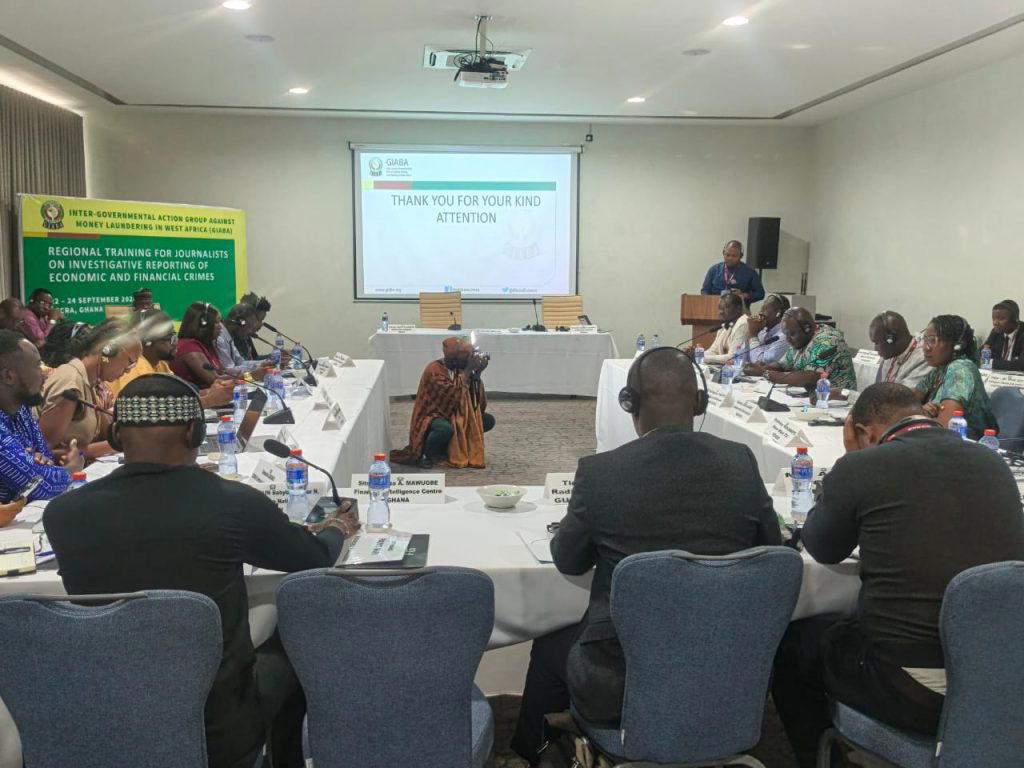
The Director General of the organisation, Mr. Mam Cherno Jallow, in an address he presented during the opening session of a training for journalists on Investigative Reporting of Economic and Financial Crimes, in Ghana, decried that the threats have continued to undermine the effective implementation of AML/CFT/CPF measures.
According to him, “the key vulnerabilities include high-level corruption resulting in illicit financial flows, largely from the extractive sector, the rise of terrorism-related activities, the misuse of virtual assets, drug trafficking, and the weak regulatory oversight of Designated Non-Financial Businesses and Professions (DNFBPs), among others.”
However, beyond the challenges, Mr. Jallow said GIABA is championing a major transformation in both the anti-money laundering fight and terrorism financing in West Africa.
“Indeed, this is a fight that requires serious awareness raising, citizen mobilization, and collective ownership of the fight.
“This is where your role as the media is extremely important. By supporting its member states, GIABA contributes to strengthening mechanisms to combat money laundering, terrorist financing, and the financing of the proliferation of weapons of mass destruction, as well as all forms of financial crime that weaken our economies.
“But more than that, GIABA is charting a course for the future: a safer future, a more resilient future, a more prosperous future for our member states and our people.
“As you may be aware, GIABA works through structured strategic plans — the 2023–2027 Strategic Plan, aligned with ECOWAS’ Vision 2050. This plan has enabled GIABA to achieve remarkable results.
“In the area of legal and institutional frameworks, GIABA has helped bring regulatory frameworks in line with FATF standards and has supported the creation of Financial Intelligence Units in almost all member states, most of which were non-existent at GIABA’s inception.
“GIABA remains firmly committed to continuing its efforts, in synergy with member states and the media, to build a region that is resilient to the threats of money laundering and terrorist financing. I would like to conclude by reiterating this truth:
“The fight against money laundering and terrorist financing will only be won if light prevails over darkness, and you, journalists, are one of our most powerful beacons,” Mr. Jallow, whose speech was read by the Acting Principal Officer, Communication and Advocacy, GIABA, Mr. Timothy Melaye, added.
In his welcome address, the Director of the Ghana Financial Intelligence Centre/National Correspondent of GIABA, Mr. Albert Kwadwo, said there was a need for collaborative efforts to tackle the scourge of economic and financial crimes.
He maintained that the fight requires the combined efforts of financial intelligence units, law enforcement agencies, regulators, prosecutors, the judiciary, the private sector, civil society, and, importantly, the media.
“The nature of economic and financial crime is changing rapidly. Criminals are exploiting technology, digital financial services, complex corporate structures, virtual assets, and cross-border transactions.
“Proceeds from fraud, corruption, tax offences, drug trafficking, and organised crime can cross several jurisdictions within a short time.
“At the same time, the methods used to conceal their origin, ownership, and destination are becoming more sophisticated. This presents a real challenge for journalists.
“The modern financial crime reporter must be able to follow the money. This requires an understanding of corporate structures and the ability to examine financial records, identify beneficial owners, analyse procurement information, connect seemingly unrelated transactions, and use open-source intelligence.
“Above all, it requires asking the right questions about who owns and moves assets.
“From the perspective of the Financial Intelligence Centre, information is at the heart of our work. Financial intelligence can reveal patterns that no single transaction shows.
“A series of apparently unrelated transactions may, when viewed together, expose a network. A company that appears legitimate on paper may conceal a complex ownership arrangement.
“An ordinary transaction may become significant when considered alongside other information.
“This is where you make an important contribution. You connect information, investigate matters of public interest, and explain complex financial issues in language the wider public can understand.
“You must always exercise that role with professionalism, accuracy, and respect for due process.
“Our goal should not simply be to produce more stories about financial crime. It should be to produce well-informed, evidence-based, and impactful journalism that explains how financial crime operates, how it affects our communities and economies, and what can be done about it,” Ghana’s intelligence chief, who was represented by the Director of Legal Affairs, Benjamin Ofori, added.
Participants at the capacity training workshop were drawn from the 12 member states of the ECOWAS.
The post Drug trafficking, money laundering pose evolving threats to West Africa — GIABA appeared first on Vanguard News.