

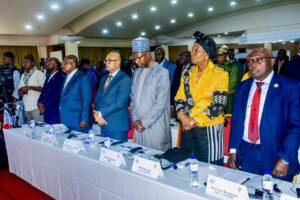
The ECOWAS Court of Justice has adopted far-reaching recommendations, including the establishment of an appellate chamber, as well as stronger judgment-compliance and enforcement mechanisms, confronting longstanding weaknesses threatening regional justice.
The recommendations are contained in a communique issued at the end of the Court’s 2026 International Conference in Dakar, Senegal, on Friday, which examined justice, innovation, human rights protection and regional integration.
The News Agency of Nigeria (NAN) reports that the conference was held under the theme: “ECOWAS Court of Justice at the Crossroads: Justice, Innovation, Human Rights Protection and the Future of Regional Integration in West Africa.”
“In light of the foregoing, the Conference adopted these recommendations, addressed to the Authority of Heads of State and Government, the Council of Ministers, the ECOWAS Commission and the ECOWAS Parliament,” the communique stated.
It recommended that establishing an Appeal Division for the Court would be done through institutional reforms, which would require amending its Revised Treaty and relevant instruments, with clearly defined jurisdiction and procedures.
The proposed framework would also determine standing, appealable decisions, grounds and time limits for appeals, judicial qualifications and the effect of appeals on judgment enforcement.
“There is a clear case for an appellate structure that would give effect to the right to a fair hearing, enable the correction of errors and guarantee jurisprudential consistency.
“Its creation will require treaty amendment, political consensus and adequate resources, and cannot of itself resolve the low rate of compliance with the Court’s judgments,” the communique said.
The conference also recommended a transparent, independent and non-political process for selecting appellate judges, alongside adequate financial and human resources.
A technical committee was also urged to consider the prospect of an appeal chamber sitting periodically rather than permanently, reflecting concerns over the financial implications of a permanent structure.
The appellate process, participants stressed, should correct errors and promote jurisprudential consistency without becoming a mechanism for delaying enforcement or increasing litigation costs.
Also at the centre of the Dakar deliberations was the Court’s limited capacity to ensure compliance with its binding decisions across ECOWAS Member States.
The communiqué disclosed that only about 18 to 22 per cent of the Court’s enforceable judgments are currently being implemented.
It said several Member States had failed to comply with a single judgment, identifying the compliance deficit as the Court’s most significant challenge.
“The low rate of compliance and enforcement of the Court’s judgments constitutes the most significant challenge to its effectiveness,” it noted.
Participants attributed the enforcement problem to the regional court’s limited coercive powers, failure to domesticate Community instruments and resistance from some national courts.
They also cited institutional weaknesses, including the designation of Ministries of Justice as competent national authorities for implementing judgments.
“This deficit is traceable to the Court’s lack of coercive power, the disregard of the principle of “pacta sunt servanda,” and the failure to domesticate Community instruments.
”Others include the designation of Ministries of Justice as competent national authorities, the resistance of certain national courts, and design deficiencies in the existing enforcement mechanism,” the communique said.
The communique also identified the intensification of diplomatic and political engagement with Member States as key to securing compliance and enforcement of the Court’s judgments.
It recommended that this was achievable “through a dedicated diplomatic channel for reporting non-compliance to the highest political authority and, where necessary, the application of political pressure, while preserving national dignity and regional stability.”
The conference further recommended establishing an official regional mechanism to monitor judgment execution, with supervisory responsibilities involving the Authority and Council of Ministers.
It also proposed a dedicated compliance-monitoring unit within the ECOWAS Commission and annual reporting by the Court on Member States’ implementation records.
The recommendations also call for clarification of available sanctions, including monetary penalties, and consideration of measures against persistent non-compliance.
A compensation fund for victims was proposed, potentially financed through agreed contributions from the Community levy, to strengthen remedies arising from Court judgments.
It urged Member States to honour binding Court decisions, domesticate Community laws and empower national human rights institutions to coordinate judgment implementation.
Beyond institutional reform, the communiqué addressed artificial intelligence, data protection, arbitration, environmental justice, refugees and forced displacement across West Africa.
It called for stronger digital-rights safeguards, responsible artificial intelligence governance, expanded environmental accountability and improved protection for refugees and displaced persons.
The conference also appealed to the Authority of Heads of State and Government to act resolutely against xenophobic attacks on fellow Africans and migrants within the Community.
The communiqué, which represents the Court’s broadest package of proposed institutional reforms since its creation, was moved for adoption by Dr Janet Gbam, seconded by Prof. Mohammed Ladan, and presented at the closing ceremony.
(NAN)
The post ECOWAS Court adopts plan to create Appeal Division appeared first on Vanguard News.