

By Adesina Wahab
LAGOS — The Federal Government has commenced steps to ensure that textbooks in Mathematics, English Language and other core subjects reach learners and are properly tracked and maintained as part of efforts to tackle learning poverty in Nigeria.
The initiative is being implemented through a series of workshops organised by the Universal Basic Education Commission (UBEC) in conjunction with the Federal Ministry of Education (FME) under the Human Capital Opportunities for Prosperity and Equity (HOPE-EDU) programme.
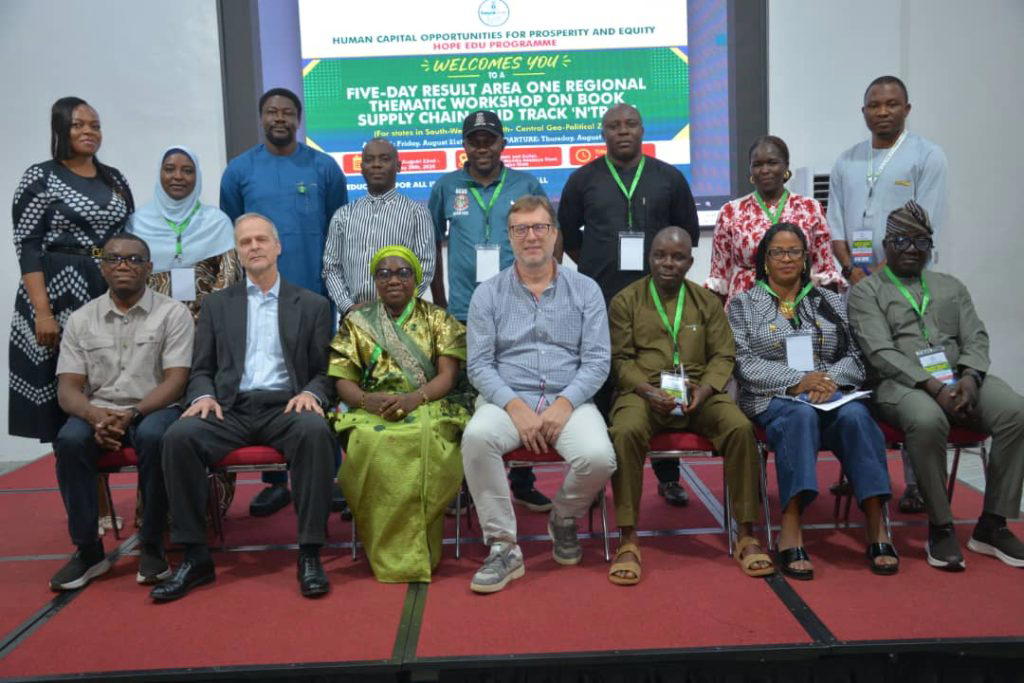
The latest workshop, titled “Five-day Result Area One Regional Thematic Workshop on Book Supply Chain and Track ‘N’ Trace,” commenced in Lagos at the weekend.
The workshop brought together education officers from Niger, Kogi, Kwara, Nasarawa, Benue, Plateau, Ekiti, Ondo, Ogun, Osun, Oyo and Lagos states, as well as the Federal Capital Territory (FCT), Abuja.
HOPE-EDU is a Federal Government initiative supported by the World Bank to strengthen foundational learning through improved systems, institutional capacity and technical support.
Under Results Area 1 (RA1), the programme is convening a series of regional thematic workshops on the Structured Pedagogy Package (SPP) Guidance and the Book Supply Chain and Track-and-Trace (BSC/TnT) System to strengthen the capacity of federal and state officials to support effective implementation.
In her address, the Executive Secretary of UBEC, Dr Aisha Garba, commended the Federal Government and the Federal Ministry of Education for supporting the commission in implementing the HOPE-EDU programme.
Garba said the workshops were designed to translate the programme’s objectives into practical support for states by equipping relevant federal and state officials with the knowledge, tools and systems required to strengthen implementation.
She said the workshops would also demonstrate the government’s commitment to improving the quality and availability of teaching and learning materials while building transparent and accountable systems for education service delivery.
“The engagement should therefore be positioned not simply as a technical workshop, but as an important step in translating HOPE-EDU’s investments and objectives into practical improvements at state and school levels, ultimately contributing to better teaching and learning outcomes for Nigerian children,” she said.
Garba further stressed the importance of the November 15, 2026 deadline for states to demonstrate readiness for the programme.
“By November 15, 2026, your states must demonstrate readiness. This is not negotiable. It is the gateway to unlocking the first round of programme disbursements and, more importantly, the future of our children,” she said.
She noted that the participation of directors responsible for academic services, teacher professional development, monitoring and evaluation, procurement, and planning, research and statistics/electronic management information systems reflected the whole-of-system approach required for successful implementation.
In her welcome remarks, the Programme Manager, Dr Aisha Abdul, said the HOPE-EDU programme became effective in February 2026, adding that implementation had focused on establishing the institutional, technical and operational foundations required to achieve its Programme Development Objective and Year 1 results.
According to her, with the support of the World Bank team, technical experts and consultants, the programme had worked closely with states to lay the groundwork for reforms that the workshop would translate into action.
Abdul said the Book Supply Chain and Track-and-Trace System was central to the programme’s commitment to ensuring that teaching and learning materials procured and financed through HOPE-EDU achieve a 1:1 pupil-to-book ratio in literacy and numeracy and reach classrooms intact and on time.
She urged state delegations to participate actively in the workshop, resolve outstanding issues and leave with clear and actionable implementation plans.
Abdul also drew participants’ attention to the November 15 deadline for submission of prerequisite evidence, urging states to use the workshop to resolve outstanding clarifications and avoid being caught unprepared.
A representative of the Federal Ministry of Education, Mr Abdulgafar Otunola, said the ministry would continue its efforts to reposition the education sector.
A World Bank consultant, Gerard Peart, said the bank was supporting HOPE-EDU within the context of the Universal Basic Education programme.
He identified quality, access and system strengthening as critical to making primary education functional, noting that learning poverty remained a major challenge in the sector.
“One of the major problems confronting primary education in Nigeria is learning poverty occasioned by overcrowded classrooms, lack of textbooks, teaching and learning materials. If we want to get more from basic education, textbooks must be available in the classrooms and in required quantity,” Peart said.
The post FG moves to ensure textbooks reach learners, tackles learning poverty appeared first on Vanguard News.