

—Says healthy soil key to sustainable agriculture, food security
By Christopher Ameh, Bauchi
The Federal Government has urged state governments and other stakeholders to take ownership of the Nigeria Farmers Soil Health Scheme and domesticate it to address soil degradation and improve agricultural productivity.
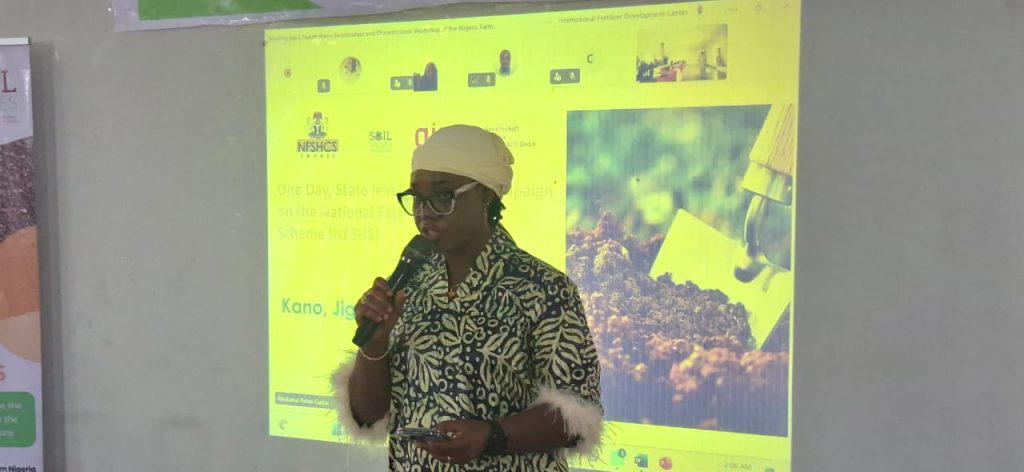
The Director, Agricultural Land and Climate Change Management Services, Federal Ministry of Agriculture and Food Security, Mr Olanipekun Oshadiya, represented by the Country Coordinator, Soil Values Programme, Mrs Medinah Ayuba Fagbemi, made the call on Thursday at a stakeholders’ workshop in Bauchi.
Oshadiya said healthy soil remained the foundation of sustainable agriculture and food security, stressing that Nigeria’s ability to produce sufficient food, improve farmers’ livelihoods and build resilient agricultural systems depended largely on the health and productive capacity of its soils.
He identified soil degradation, nutrient depletion, erosion, declining organic matter and the effects of climate change as major challenges threatening agricultural production.
According to him, the Nigeria Farmers Soil Health Scheme provides a platform for transforming soil fertility management through a scientific, farmer-centred and evidence-based approach.
He said soil testing and analysis should form the basis for fertiliser and soil amendment recommendations rather than relying on general fertiliser prescriptions.
“We must move away from a situation where farmers apply fertilizer simply because it is generally recommended, towards an approach where the specific needs of the soil and crop determine the appropriate nutrient application,” he said.
The director stressed the importance of ensuring that farmers apply the right nutrients, in the right quantity, at the right time and in the right place.
He added that reliable soil information was critical to improving fertiliser-use efficiency, guiding investment decisions and supporting evidence-based agricultural planning.
Oshadiya, however, said the success of the scheme would depend largely on its domestication at the sub-national level, given the diversity of Nigeria’s agro-ecological zones, soil types, crops and farming systems.
He urged states to take ownership of the national framework and translate it into practical interventions that reflect their specific local conditions.
The director also called on governments to integrate the scheme into their agricultural development programmes and strengthen collaboration among soil laboratories, research institutions, extension services, farmers’ organisations, development partners and the private sector.
He stressed the need to improve soil-testing infrastructure, laboratory capacity and quality assurance, while training technical personnel and making testing services accessible and affordable to smallholder farmers.
Oshadiya further emphasised that soil health went beyond the application of inorganic fertiliser, urging stakeholders to embrace integrated soil fertility management, organic matter improvement, composting, agro-ecology, agro-forestry, erosion control, conservation agriculture and other climate-smart practices.
He said the approaches were consistent with the objectives of the Africa Fertilizer and Soil Health Action Plan, which promotes improved soil health, efficient fertiliser use and sustainable agricultural productivity.
He challenged participants to move beyond sensitisation and develop concrete state-level action plans with clear commitments, responsibilities and timelines.
“This workshop should therefore not end with sensitisation alone. We must leave here with clear commitments, defined responsibilities, timelines and practical State-level action plans that will sustain the momentum beyond this meeting,” he said.
According to him, the ultimate measure of the scheme’s success would be reflected in the lives of farmers through healthier soils, improved crop yields, more efficient use of agricultural inputs, reduced production costs, increased incomes and greater resilience to climate change.
Oshadiya called on stakeholders to actively participate in the implementation process by sharing knowledge and experiences, identifying challenges and developing practical solutions.
He reaffirmed the Federal Ministry of Agriculture and Food Security’s commitment to working with stakeholders to ensure that the Nigeria Farmers Soil Health Scheme becomes a sustainable and impactful intervention across the country.
He urged stakeholders to make soil health a central pillar of Nigeria’s agricultural transformation agenda.
The post FG urges states to adopt Soil Health Scheme appeared first on Vanguard News.