

To deploy 160 new compactor trucks, five transfer stations by Q2 2027
By Olasunkanmi Akoni
LAGOS — Lagos State Governor, Babajide Sanwo-Olu, has declared a “state of emergency” on waste management in the state, citing mounting pressure on waste collection and the growing menace of indiscriminate dumping across the metropolis.
The governor, however, unveiled short-, medium- and long-term measures aimed at clearing the current backlog of waste and improving the state’s waste management system.
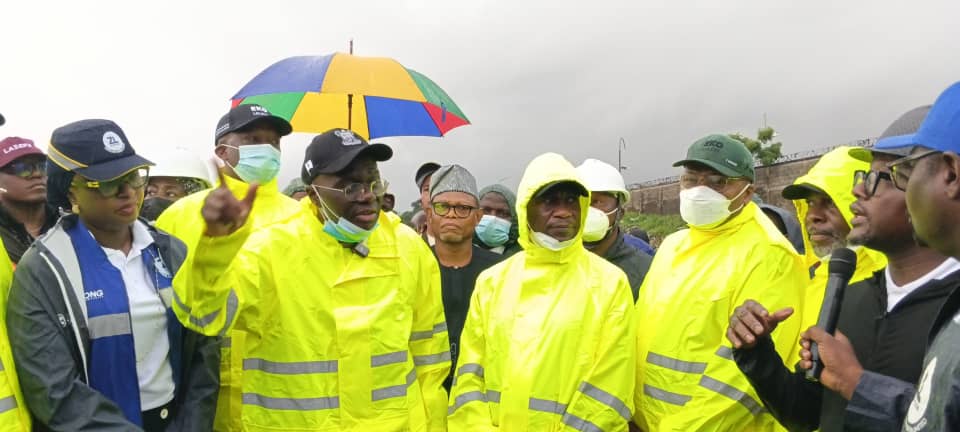
Sanwo-Olu, who spoke on Wednesday during an inspection tour of the Olusosun dump site in Ojota, Lagos, said the intervention became necessary following weeks of slow waste turnaround and what he described as uncoordinated advocacy.
The governor was accompanied by his deputy, Dr Obafemi Hamzat; Commissioner for the Environment and Water Resources, Tokunbo Wahab; and other senior government officials.
“What we are seeing at Olusosun is a typical sight of the challenge. We are here to see what the problem is and to clearly declare a small state of emergency so that we can get out of this very unpleasant situation,” Sanwo-Olu said.
He disclosed that the state government, in partnership with development partner Zoomlion, was constructing two new 2,400-metric-tonne Transfer Loading Stations at Olusosun and Solu 3 in Alimosho Local Government Area.
According to him, the facilities would receive compacted waste before transferring it to two Material Recovery Sites under construction at Oke Osho in Epe and Erikitte in Badagry.
“Each transfer station is designed to handle about 500 trucks per day. With the transfer loading stations, waste will be compacted and eventually taken to a material recovery site where it will be further sorted and broken into other uses,” he said.
Sanwo-Olu projected that physical development on the facilities would become visible by the end of the year, while full operations were expected between the first and second quarters of 2027.
For immediate relief, he said the state planned to increase the capacity of the Olusosun facility from between 250 and 350 trucks daily to between 350 and 450 trucks by increasing the number of tipping points from two or three to four or five.
He added that road stabilisation work was underway at Solu 3, with grading expected to be completed within two to three weeks to allow continued waste reception.
Similar stabilisation work, he said, was planned for Iwulepe in Ikorodu and Oke Osho in Epe.
“We are hoping that before the end of next month, or in another six weeks, we will have four active dump sites: Olusosun, Solu 3, Iwulepe, and Oke Osho in Epe. And also a fifth one in Badagry, Erikitte,” the governor said.
He explained that the additional disposal points would help reduce truck turnaround time, which could currently take as long as 12 hours, to only a few hours by providing closer disposal options.
160 new compactors coming
On waste collection, Sanwo-Olu disclosed that the state government had ordered 160 new compactor trucks, with shipment expected to commence soon.
“Landfill compactors for on-site compaction are also being procured,” he added.
The governor said Zoomlion and Private Sector Participants, PSPs, would also procure additional trucks, while the state government would work with the operators to develop financing models that would enable them to expand their operations sustainably.
The Chairman of the PSP Association, who joined the inspection tour, also agreed to a membership audit aimed at identifying inactive operators.
The state government said although about 800 PSPs were registered, only an estimated 400 were effectively operating.
“We don’t want to have 800 PSPs when it is actually only 400 that are effective,” an official said, adding that the exercise would create room for new investors.
Sanwo-Olu also appealed to residents and tenement occupiers to pay for waste collection services.
“Lagosians in particular, we just want service. We don’t want to pay for this service. I think this era has to stop. It’s so unfair to see people rendering service and people are not paying them,” he said.
He said the monthly sanitation exercise, launched four months ago, as well as ongoing advocacy campaigns, would be better coordinated.
According to the governor, the combination of new equipment, additional disposal sites, transfer stations and reforms in the PSP system was designed to address the state’s waste generation, disposal and conversion challenges in the long term.
Indiscriminate dumping
Sanwo-Olu also warned residents against indiscriminate disposal of refuse, announcing tougher enforcement measures against offenders.
He said environmental officers would monitor both PSP operators and residents, adding that offenders could face prosecution before mobile and public courts.
The governor said residents could not justify dumping refuse on roads, highways or drainage channels simply because a PSP operator failed to arrive at their homes within 24 hours.
He also disclosed plans to restructure and reinforce the operations of the Lagos Waste Management Authority, LAWMA, with a view to deploying more personnel to field operations.
“Waste is outside on the street; it’s not in their offices,” Sanwo-Olu said, insisting that the agency must become more operationally responsive.
The governor acknowledged the government’s responsibility for addressing the current challenges but noted that Lagos’ rapid population growth was putting increasing pressure on existing waste management infrastructure.
He said the volume of waste generated in the state continued to rise with its population, stressing that government, residents and waste operators all had roles to play in tackling the problem.
Sanwo-Olu assured residents that the government would continue to monitor the situation and implement measures aimed at restoring a cleaner and more efficient waste management system across Lagos.
The post Filth: Sanwo-Olu declares state of emergency on waste management appeared first on Vanguard News.