

By Chinedu Adonu
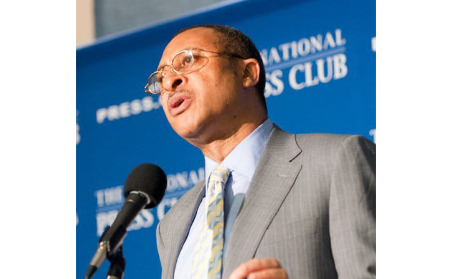
ENUGU — Former presidential candidate and political economist, Prof Patrick Utomi, has warned that Nigeria risks serious societal instability if its electoral process, institutions and legal framework continue to lose public credibility.
Utomi gave the warning while speaking at the ongoing 22nd Nigeria Guild of Editors (NGE) Conference in Enugu.
He said elections were critical to legitimising government, stressing that when citizens became convinced that elections were meaningless, the enormous resources deployed to conduct them would amount to waste.
Speaking to a gathering of lawyers, journalists and other stakeholders, Utomi said credible elections, strong institutions and precise laws were essential to preventing societal breakdown and promoting national development.
According to him, “If the people are convinced that there is no point, what is an election? Imagine the amount of money we waste to have elections that are totally meaningless because they do not legitimise anybody.”
Utomi said the value of elections went beyond choosing political office holders, describing them as an important component of institution-building.
He explained that countries that succeed economically could be distinguished from those that fail by examining the quality of their institutions.
“Institutions are simply boundaries that define behaviour. Within the boundaries, you can anticipate outcomes. Outside the boundaries, there are consequences.
“Because of it, uncertainty is reduced, transaction costs are lowered, and people can grow and make progress,” he said.
The economist, however, expressed concern over what he described as the normalisation of abnormal practices in Nigeria, saying it had increased the cost of doing business and weakened confidence in the country’s institutions.
“What has happened to us, unfortunately, is because the abnormal has become so accepted that the transaction costs of engaging in Nigeria are such that we are only heading in one direction — ultimate collapse,” he warned.
Utomi said unless there was a change in the country’s institutional and governance trajectory, Nigeria could face a serious crisis with potentially devastating consequences.
He also warned that when citizens believed they had no legitimate means of influencing their society, frustration could eventually manifest in destructive ways.
“If people realise that they can’t do anything about anything, they keep quiet. And today, they get angry enough, they destroy something,” he said.
Utomi cited the experiences of countries that had suffered institutional breakdown and violent conflict as warnings of the consequences of weakened governance structures.
He charged journalists and editors to recognise their responsibility as “gatekeepers” in protecting democratic institutions and holding leaders accountable.
According to him, the media has an important role to play in preventing institutional decay, while lawyers also have a critical responsibility because of the centrality of law to social order.
Utomi said laws must be precise because they are meant to provide certainty and help society determine the boundaries of acceptable conduct.
“If the law cannot show precision, it has no value because that’s what it does to help society order where it is going,” he said.
He commended the organisers for choosing the theme of the gathering, describing the issues discussed as critical to Nigeria’s future.
Utomi urged participants to ensure that the discussions translated into meaningful action, stressing that the country’s survival and progress depended on strengthening its institutions.
“Please, let us get value out of this. It matters,” he said.
The post Flawed Elections, weak institutions threaten Nigeria — Utomi appeared first on Vanguard News.