

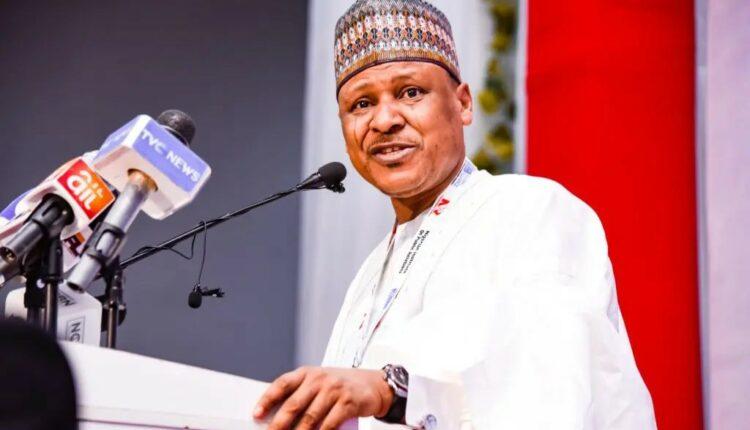
The Minister of Information and National Orientation, Mohammed Idris, has warned that any attempt to restore fuel subsidy would reverse the economic gains recorded since the removal of the subsidy by the administration of President Bola Tinubu.
Idris said the return of subsidy would recreate the fiscal pressures, distortions, fuel scarcity and incentives for arbitrage that made the policy unsustainable.
The minister stated this in an article titled “Restoring Fuel Subsidy Will Reverse Nigeria’s Economic Gains,” in which he defended the Federal Government’s economic reforms and urged Nigerians to consider the long-term benefits of the policies.
He recalled that Nigeria spent about $10 billion on fuel subsidies in 2022, at a time when the country was grappling with declining oil production and weak revenues.
According to him, the World Bank had warned that the subsidy was consuming resources that could otherwise have been channelled into education, healthcare, infrastructure and social protection.
Idris cited the Federal Government’s “Nigeria’s Reform Scorecard: The Benefits, Costs and Harms Prevented,” presented by the Minister of Finance and Coordinating Minister of the Economy, Dr Taiwo Oyedele, which showed that subsidy savings mobilised N15.8 trillion for the Federation between June 2023 and December 2025.
He said N5.43 trillion of the amount accrued to the Federal Government, while states received N6.52 trillion and local governments N3.88 trillion.
The minister, however, clarified that the N15.8 trillion did not represent money sitting in a separate government account, but resources released within the Federation’s wider fiscal system and made available to the three tiers of government.
Idris said the additional resources had strengthened the capacity of states and local governments to meet salary and pension obligations and invest in primary healthcare, education, roads and other essential services.
He added that the broader fiscal space created by the reforms had supported federal investments in strategic infrastructure, noting that the Reform Scorecard recorded about N6.47 trillion in additional expenditure on transport, housing, agriculture, security and other projects.
Among the projects, he listed the Lagos-Calabar Coastal Highway, Sokoto-Badagry Superhighway and Trans-Sahara Superhighway.
The minister also said the reforms had expanded government’s capacity to support human capital development and social interventions.
According to him, more than 10 million Nigerian households have benefited from social transfers, while more than N400 billion had been committed to initiatives including the Nigerian Education Loan Fund, NELFUND; MOFI Real Estate Investment Fund, MREIF; and Nigerian Consumer Credit Corporation, CREDICORP.
Idris further argued that the reforms had contributed to renewed investor confidence, increased oil production and stronger foreign reserves.
He said Nigeria was also entering a new phase in the petroleum sector through increased domestic refining capacity, warning that reversing the subsidy reform could undermine investment and energy security.
He said the country was already carrying a second energy subsidy through electricity, which cost N3.14 trillion between June 2023 and December 2025.
“Reintroducing a petrol consumption subsidy on top of this would deal a double blow to Nigeria’s fiscal position,” he warned.
Idris said the reforms had also helped avert deeper economic problems, including a possible return of petrol scarcity, which could have pushed prices above N3,000 per litre on the black market.
He said the inherited Ways and Means financing, which stood at about N30 trillion in May 2023, could have doubled to N60 trillion or more without the reforms.
The minister acknowledged that Nigerians were facing difficulties arising from the reforms but maintained that reversing them was not the solution.
“We are not claiming that the reforms have solved all of Nigeria’s economic challenges; there is indeed still much work to be done to translate improved fiscal capacity into better services, jobs, infrastructure and living standards,” he said.
According to him, the government’s focus should be on accelerating the benefits of the reforms rather than returning to an unsustainable subsidy regime.
The post Fuel subsidy: Return to old regime will worsen economic crisis — Min of Information, Idris appeared first on Vanguard News.