

By James Ogunnaike, Abeokuta
For more about two months, a troubling environmental mystery has cast a shadow over Ijebu-Ode and neighbouring communities in Ogun State. It has turned classrooms into scenes of panic, leaving parents, teachers and government officials searching for answers.
Read Also: Ogun relocates students of Ijebu-Ode School over methane gas pollution
What began as an isolated incident at a secondary school in April has evolved into a recurring public health concern, affecting hundreds of students across multiple schools and raising urgent questions about environmental safety in one of Ogun State’s most important educational hubs.
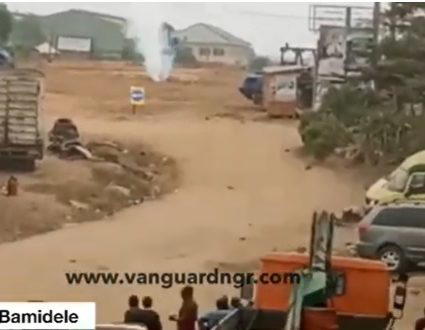
At the heart of the crisis is a series of unexplained gas emissions, now believed to contain significant concentrations of methane. These leaks have repeatedly triggered episodes of dizziness, nausea, breathing difficulties and fainting among students and teachers.
While no deaths have been recorded, the repeated nature of the incidents has heightened anxiety and sparked fears that a larger geological phenomenon may be unfolding beneath the ancient town.
Panic in classrooms
The first major incident occurred on April 1 at Our Lady of Apostles Secondary School, located in the Old Epe Garage area of Ijebu-Ode.
What began as a normal school day quickly descended into confusion and panic when students and staff noticed an unusual odour spreading across the school premises. Within minutes, several students reportedly began coughing, gasping for breath and vomiting. Some collapsed.
Emergency responders rushed dozens of affected students and a teacher to the General Hospital, Ijebu-Ode, where medical personnel worked to stabilise them.
Fortunately, all victims recovered and were discharged after treatment.
At the time, many believed the episode was a one-off occurrence. Some speculated that chemical fumes from a laboratory practical examination might have triggered the reaction. But others pointed to nearby bushes or surrounding communities.
School authorities, however, quickly dismissed reports of any explosion or laboratory accident.
“It was not an explosion,” a school official explained. “We simply perceived a strange smell within the premises and some students began vomiting and fainting.”
Few could have anticipated that the incident would mark the beginning of a much larger crisis.
A disturbing pattern emerges
Within weeks, similar gas leaks began occurring across other schools in Ijebu-Ode and neighbouring communities.
A second outbreak reportedly affected more than 100 students, while another wave of gas leak in recent weeks sent scores of additional students and teachers to hospital.
Schools affected include Our Lady of Apostles Secondary School, Anglican Girls Grammar School, Titilayo Agbaje Comprehensive High School, Ifesowapo Comprehensive High School, St. Peter’s Anglican Primary School, Orphanage Primary School and St. Anthony Grammar School in Esure, Ijebu-Imushin.
In total, more than 200 students and staff members are believed to have been affected during the three separate episodes recorded between April and June.
For residents, the recurring nature of the incidents has transformed concern into fear.
“The government has to get to the root of this terrible incident,” said Mr. Adewale Adewunmi, a resident of the area. “This is the third time in two months that we are experiencing this hazardous gas leak. Something must be done before it is too late.”
Parents have become increasingly apprehensive about sending their children to school, while community leaders have demanded greater transparency regarding the ongoing investigations.
Investigation takes new turn
As environmental experts expanded their inquiry, initial theories linking the gas leaks to school laboratories, industrial activities or sabotage gradually began to lose ground.
According to the Ogun State Commissioner for Environment, Ola Oresanya, investigators have now narrowed their focus to a far more complex possibility: geological activity beneath the earth’s surface.
Oresanya disclosed that scientific investigations have identified a striking pattern connecting all the affected locations.
Experts, he said, discovered that schools and communities where the gas emissions have been detected appear to lie along a linear underground alignment, suggesting the existence of a shared subsurface pathway.
Investigators now believe the gases may be escaping through fractures deep within the earth’s crust.
“We have succeeded in eliminating several possible sources and have zeroed in on the fact that the gas may actually be coming from the earth’s crust,” Oresanya explained.
The Commissioner said geological assessments, field investigations and sensor readings increasingly point towards tectonic activity or underground disturbances capable of releasing trapped gases to the surface.
The revelation has shifted the investigation from a conventional environmental inquiry into one involving geology, seismology and earth sciences.
Methane and Hydrogen Sulphide detected
Preliminary analysis conducted by environmental experts has identified methane as the dominant gas present in the emissions, with traces of hydrogen sulphide also detected.
Methane is naturally occurring and commonly found underground. Although colourless and odourless, high concentrations can displace oxygen and create breathing difficulties, particularly in enclosed or poorly ventilated spaces.
Hydrogen sulphide, often recognised by its characteristic rotten-egg smell, can also pose health risks depending on concentration levels.
Environmental officials explained that both gases can occur naturally beneath the earth in oxygen-deficient conditions.
According to Oresanya, methane readings recorded during one of the incidents reached levels considered significant enough to warrant concern and continuous monitoring.
The discovery prompted authorities to order the temporary suspension of gas pipeline operations within the affected axis as a precautionary measure.
Officials emphasised that the shutdown does not indicate a confirmed pipeline failure but forms part of efforts to eliminate all possible sources.
Could quarry activities be contributing?
Another aspect of the investigation focuses on quarry and mining operations within the wider Ijebu-Ode area.
Experts are examining whether vibrations generated by blasting activities may have opened underground fractures or widened existing fault lines, thereby creating pathways for gases trapped beneath the surface.
While no direct link has been established, the government says quarry operations remain under close scrutiny.
“If investigations show quarry activities are contributing to the problem, government will not hesitate to take decisive action,” Oresanya stated.
Earthquake question
Perhaps the most unsettling aspect of the investigation is the emerging discussion about possible geological instability beneath the region.
Oresanya referenced an inaugural lecture delivered earlier this year by a professor of Solid Earth Physics at Tai Solarin University of Education.
According to the Commissioner, the lecture examined geological structures within the area and suggested the possibility of seismic activity in the future.
Although experts have cautioned against drawing premature conclusions, the reference has inevitably heightened public anxiety.
For many residents, the prospect that the gas leaks may be linked to underground earth movements raises concerns that extend far beyond air quality and public health.
Scientists involved in the investigation insist that further studies are required before any connection can be established between the current gas emissions and potential seismic events.
Government intensifies response
Faced with growing public concern, the Ogun State government has significantly expanded its response measures.
Gas detection equipment has been installed in schools and public locations to provide real-time monitoring of emissions.
Security agencies, including the Department of State Services and Amotekun Corps, have also participated in investigations to rule out sabotage or deliberate attacks.
Authorities have cleared surrounding vegetation, deployed ambulances and medical teams to vulnerable schools and established emergency response protocols to ensure rapid intervention should another incident occur.
Some students have been temporarily relocated to alternative schools, while candidates preparing for external examinations have been moved to safer locations to minimise disruption to academic activities.
Despite repeated incidents, government officials maintain that there is currently no justification for shutting down schools across the affected area.
Health experts raise concerns
Although all hospitalised students have recovered, public health experts warn that recurring exposure to methane and associated gases should not be taken lightly.
Professor Tanimola Akande, a public health specialist, notes that children are particularly vulnerable to environmental pollutants because their lungs and immune systems are still developing.
Repeated exposure to poor air quality, he warns, can increase the risk of respiratory illnesses such as asthma, bronchitis and other long-term complications.
Children also breathe more rapidly than adults, making them more susceptible to inhaling larger quantities of airborne pollutants relative to their body weight.
Experts caution that if emissions continue unchecked, the impact may extend beyond schools to nearby homes, healthcare facilities and businesses.
Waiting for answers
For now, residents of Ijebu-Ode remain caught between reassurance and uncertainty.
Reassurance because no lives have been lost despite multiple incidents of gas leaks, uncertainty because the exact source of the emissions remains under investigation.
Parents continue to worry each morning as their children head to school. Teachers remain vigilant for unusual odours. Community leaders are demanding faster answers and stronger safeguards.
The crisis has exposed broader concerns about environmental monitoring, emergency preparedness and public safety in rapidly expanding urban communities.
While officials insist progress is being made, many residents believe confidence can only be restored when investigators definitively identify the source of the emissions and implement a permanent solution.
Until then, the mystery beneath Ijebu-Ode continues to haunt classrooms and neighbourhoods alike, serving as a reminder that environmental threats can emerge unexpectedly and that science, transparency and swift action remain society’s strongest tools for confronting them.
As experts probe deeper into the earth beneath the historic town, the hope shared by residents is simple: that the answers arrive before another generation of students is forced to flee their classrooms in fear.
Meanwhile, Ogun State government has temporarily relocated students of Our Lady of Apostles Girls Grammar School, Ijebu-Ode, to an alternative location as investigations into the recent gas leak progress.
He said: “The students have been moved out temporarily. Until we are satisfied that the environment is completely safe and conducive for learning, they will not return.”
The post Gas from lab, earthquake, quarry? – Recurring leaks trigger panic in Ijebu-Ode schools appeared first on Vanguard News.