

By Matthew Johnson
The National Agency for the Prohibition of Trafficking in Persons (NAPTIP), the Economic Community of West African States (ECOWAS) and the International Centre for Migration Policy Development (ICMPD) have called for stronger collaboration among aviation stakeholders to prevent human trafficking through Nigerian airports.
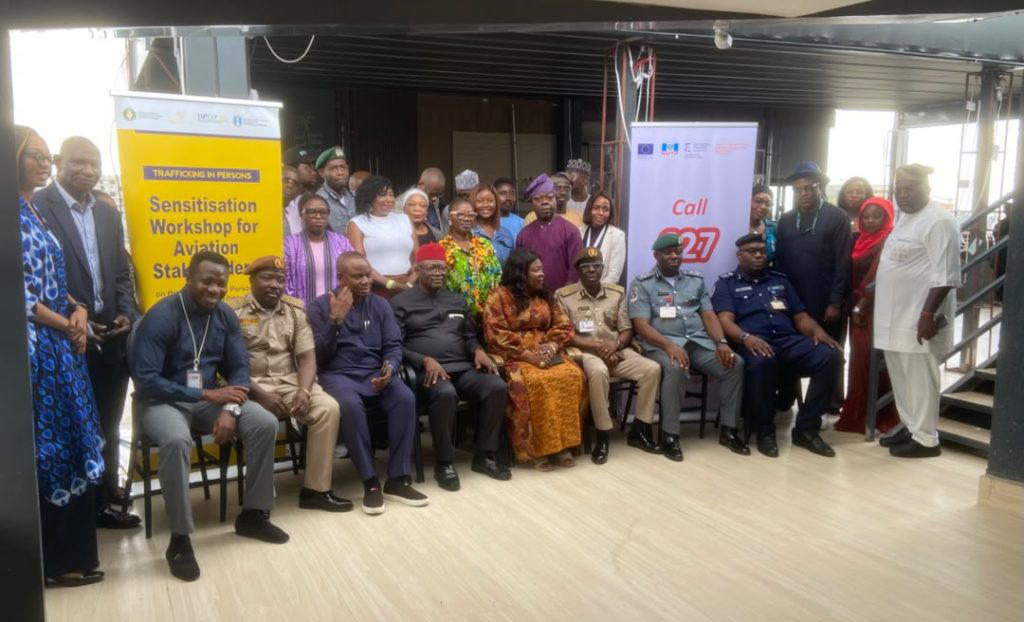
The call was made on Tuesday, October 13, 2026, at a three-day awareness and sensitisation workshop for aviation stakeholders in Lagos. The workshop aimed to strengthen the implementation of the Trafficking in Persons (Control of Activities of Organisations and Centres) Regulations, 2019, and improve inter-agency cooperation in the fight against human trafficking.
Speaking at the workshop, NAPTIP’s Director of Intelligence in charge of Research and Programme Development, Mr Josiah Emerole, who represented the agency’s Director-General, Binta Bello, said many stakeholders operating at airports did not fully understand their responsibilities under existing anti-trafficking laws.
Emerole said the workshop was organised to equip airport personnel, labour recruiters, civil society organisations and other migration-sector actors with the knowledge needed to identify suspected trafficking victims and report suspicious activities.
He explained that traffickers often presented their victims as ordinary passengers with apparently valid travel documents, making it necessary for frontline personnel to look beyond documentation and examine the circumstances surrounding their journeys.
According to him, officers should be alert to inconsistencies in passengers’ travel plans, financial circumstances, destinations and explanations for travelling, as these could indicate possible exploitation.
He said, “It is not just about looking at the person’s documents. It is a question of talking to the person, using some psychological and emotional strategies for the person to tell the truth.”
Emerole noted that some victims were unaware of the exploitation awaiting them at their destinations, adding that timely intervention by airport personnel could prevent them from falling into the hands of traffickers.
He said that although traffickers continued to exploit international airports, increased surveillance and awareness had contributed to a reduction in the use of Nigerian airports by some criminal networks, forcing them to explore alternative routes through other countries.
He, however, stressed the need for sustained training and stronger cooperation among agencies to close existing gaps.
Emerole disclosed that NAPTIP would establish a working group involving relevant stakeholders to coordinate activities and monitor progress through reports from agencies operating at different airports and other relevant data.
He said, “I will say immigration officers, aviation personnel, labour recruiters and other stakeholders should understand their responsibilities under the Trafficking in Persons (Prohibition), Enforcement and Administration Act, 2015, and the 2019 regulations.”
Also speaking, the Project Manager at ICMPD, Mr Matthias Esene, said the organisation was supporting Nigeria and other West African countries in strengthening migration management and preventing trafficking while protecting the right to freedom of movement.
Esene, who represented the head of the organisation’s Nigeria office, said the workshop was supported through regional migration initiatives, including the Free Movement of Persons and Migration project, organised by ICMPD in collaboration with NAPTIP and funded by the European Union and the Kingdom of Denmark.
He explained that ICMPD worked with government institutions and civil society organisations to improve their capacity to respond to migration-related challenges and strengthen cooperation among agencies responsible for protecting migrants.
According to him, the 2019 regulations provide a framework for identifying trafficking-related indicators, referring suspected victims to appropriate services and providing psychosocial support.
He said the challenge was to ensure that stakeholders understood and implemented the provisions effectively, particularly those relating to their individual responsibilities and cooperation with other agencies.
He added that frontline officials were responsible for identifying vulnerable persons and suspected trafficking victims without unnecessarily restricting the movement of legitimate travellers.
“Freedom of movement remains a right under the ECOWAS Protocol. Efforts to prevent trafficking should not undermine legitimate migration.
“Freedom of movement is a right. Human trafficking is not something we appreciate,” Esene said.
In his remarks, the ECOWAS Commission’s expert on anti-trafficking in persons and migration, Mr Osandu Ekeh, said trafficking remained a significant challenge in Nigeria and across West Africa, with criminal networks increasingly exploiting legitimate transport systems and travel services.
Ekeh, who delivered remarks on behalf of the Acting Director of Humanitarian and Social Affairs at the ECOWAS Commission, Dr Mohamed Ibrahim, said the aviation sector was strategically positioned to help prevent, detect and report trafficking-related activities.
He said the commission had been coordinating regional anti-trafficking interventions through its regional action plan covering 2018 to 2027.
Ekeh explained that ECOWAS, its member states and ICMPD had also worked on initiatives to strengthen prevention, particularly in protecting women, children and other vulnerable groups from trafficking and related crimes.
He said the commission had supported assistance programmes for trafficking victims, including medical care, psychological support, reintegration and vocational training.
Ekeh emphasised that effective implementation of the 2019 regulations required greater awareness and cooperation among immigration officers, aviation personnel, travel agencies, labour recruiters, maritime regulators and other frontline actors.
He urged participants to move beyond awareness creation and develop practical mechanisms for sharing information, identifying suspected cases and supporting victims.
Similarly, Bamidele Jomole called for strict enforcement of the regulations and closer cooperation among aviation authorities, immigration, customs, labour and justice officials, as well as civil society organisations.
Jomole said the participation of controllers from the country’s three international airports was a significant development in efforts to strengthen the fight against trafficking.
He urged relevant authorities to verify that licensed labour recruitment agencies had the appropriate NAPTIP clearances and ensure that recruitment and travel arrangements complied with existing regulations.
“The workshop should produce concrete commitments and a communiqué that would guide participating institutions in identifying loopholes exploited by traffickers and coordinating measures to close them,” Jomole said.
Earlier, an ICMPD representative, Ifeoluwa Sinkaiye, said the workshop was designed to strengthen stakeholders’ understanding of trafficking trends, risk indicators and their respective obligations under existing laws.
Sinkaiye said participants would examine relevant legal frameworks, discuss emerging trafficking methods and undertake practical exercises to improve coordination in responding to suspected cases.
She explained that the programme would also produce recommendations and a communiqué to guide future interventions, while an evaluation would assess participants’ knowledge and readiness to apply what they had learnt.
Sinkaiye urged stakeholders to translate the knowledge gained into practical action in their daily duties, noting that effective collaboration among agencies was essential to preventing trafficking and protecting vulnerable persons.
The workshop brought together representatives of relevant government agencies, airport operators, labour recruitment organisations and other stakeholders from Lagos, Abuja, Kano, Ghana and other locations.
The post Human trafficking: NAPTIP, ICMPD, ECOWAS move to tighten airport surveillance appeared first on Vanguard News.