

By Iyabo Aina
An Angolan court has just sent two men to prison for terrorism, on the strength of paid social media posts, cultivated political contacts and a disinformation campaign allegedly designed to shake a government ahead of an election. In doing so, the court has quietly answered a question African legal systems have circled for years without confronting head-on, can words, money and narrative manipulation amount to terrorism in the same way that violence does?
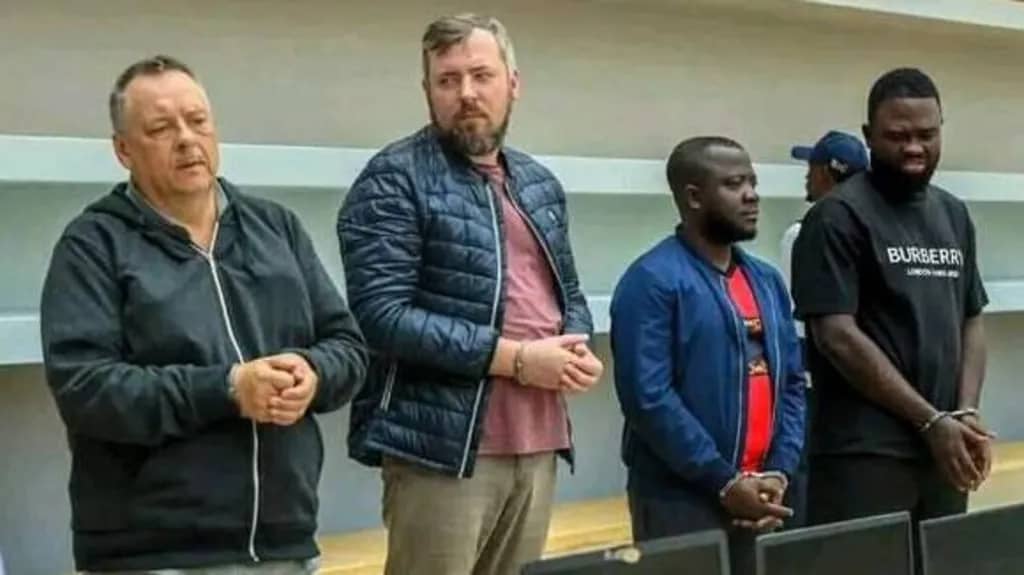
The case itself reads less like an act of war and more like a case study in modern political sabotage. Angolan prosecutors say Igor Ratchin and Lev Lakshtanov, allegedly tied to a Russian network described as a successor to the Wagner mercenary group, directed more than $24,000 to Angolan journalists and analysts to produce pro-Russian, anti-government content ahead of next year’s presidential vote, while simultaneously building quiet relationships with figures in both the ruling,Popular Movement for the Liberation of Angola (MPLA) and the opposition National Union for the Total Independence of Angola, (UNITA) parties. The court convicted both men of criminal association, spying and terrorism, sentencing Ratchin to eleven years and Lakshtanov to eight. Two Angolan co-defendants fared very differently, one walking away with a suspended sentence, the other acquitted outright, a split verdict that suggests the judges were drawing a deliberate line between the foreign hand allegedly directing events and the local actors caught in its orbit.
That distinction matters enormously for how this verdict should be read. Angola has not simply criminalised “fake news” or dissenting opinion. It has, in effect, argued that when a foreign actor uses covert payments, coordinated messaging and clandestine political contacts to manufacture unrest and interfere with an election, the harm is indistinguishable in kind from other forms of hybrid warfare the state is entitled to defend itself against. Whether one agrees with the verdict or not, the legal theory behind it deserves serious attention, because it will not stay confined to Angola.
Nigeria, and indeed most of the continent, sits at a similar juncture. Coordinated false behaviour, foreign-funded influence networks and covert payment-for-content schemes are not hypothetical risks here; they are documented features of recent election cycles across West Africa. Security services in Nigeria’s seat of power and elsewhere will be watching the Angolan verdict closely, and some will be tempted to reach for counter-terrorism statutes the next time they detect a foreign hand stirring domestic unrest. The appeal of doing so is obvious. Terrorism laws typically carry lower evidentiary thresholds for pre-trial detention, harsher sentencing ranges, and a political vocabulary that mobilises public alarm faster than an ordinary fraud or election-offences charge ever could.
But this is precisely where the danger lies. The line between “foreign-orchestrated disinformation” and “organic domestic protest” is not always as clean as prosecutors would like it to be, and Angola’s own trial exposed that tension. Many Angolan activists have pushed back hard against the state’s core claim that the 2025 unrest did not emerge organically, arguing that real grievances, not Russian rubles, drove people into the streets. If that objection has merit, then a legal framework built to catch foreign saboteurs could just as easily be repurposed to recast legitimate domestic dissent as an extension of a foreign plot, stripping activists of the political protections that would normally apply to protest and criticism of government.
The procedural irregularities that shadowed the Angolan trial only sharpen this concern. A prosecutor’s refusal to read the indictment aloud in open court, a defence complaint that the charges rested more on inference than hard evidence, and reported factual errors in the indictment itself are not minor administrative footnotes. In a case establishing precedent for treating information operations as terrorism, due process is not a technicality; it is the entire safeguard against abuse. Other African governments considering similar prosecutions should treat these irregularities as a cautionary checklist, not an inconvenient footnote to an otherwise useful verdict.
None of this means African states should simply shrug at foreign influence operations. The evidence of organised, funded, covert political interference is a legitimate security concern, and treating it seriously is not inherently authoritarian. The more honest framing is that disinformation and hybrid warfare probably do belong somewhere in the national security conversation, but the tools used to fight them need their own carefully bounded legal architecture; specific cyber and foreign-interference statutes with clear evidentiary standards, rather than the blunt instrument of terrorism law, which was built for violence, not narratives.
Angola has opened a door that the rest of the continent will now have to decide whether to walk through. The Luanda verdict may prove a genuine advance in defending democratic sovereignty from covert foreign manipulation, or it may become the template future governments cite when they want to silence inconvenient voices under a more fashionable name. Which outcome prevails will depend less on the verdict itself than on whether the due-process guardrails that were so visibly strained in this trial get reinforced, or quietly discarded, in the prosecutions that follow.
The post Information Warfare as “Terrorism”: A New Legal Frontier in Africa appeared first on Vanguard News.