

By Victor Ahiuma-Young
THE call for the revival of the Labour and Civil Society Coalition, LASCO, and a renewed push for political change took centre stage at the first anniversary commemoration of the death of renowned labour and pro-democracy activist, Abiodun Aremu, as labour leaders and civil society organisations, CSOs, called for a united front to challenge Nigeria’s prevailing political and economic order.
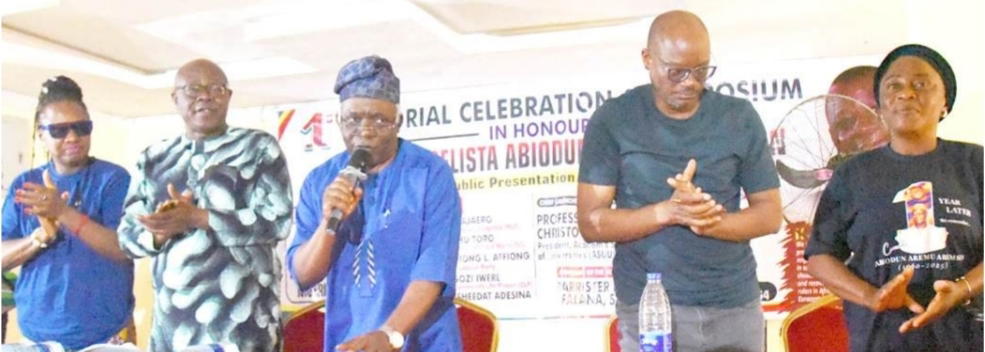
The gathering, which brought together prominent figures from the labour movement and the radical civil society, transcended a mere remembrance of the late activist, and became a platform for soul-searching, renewed commitment and a frank assessment of the challenges confronting the Nigeria left.
Speakers, including Nigeria Labour Congress, NLC, President, Joe Ajaero; human rights lawyer, Femi Falana, SAN; President of the Academic Staff Union of Universities, ASUU, Prof. Christopher Piwuna; and other labour and civil society leaders, stressed the need to move beyond rhetoric, fragmented struggles and periodic protests towards building a formidable mass movement capable of effecting fundamental political and economic transformation.
At the heart of the deliberations was the need to rebuild LASCO, an alliance of trade unions and pro-labour civil society organisations under the umbrella of the Joint Action Front, JAF, of which the late Aremu was secretary.
The coalition played a prominent role in mobilising resistance against policies perceived as inimical to the interests of workers and ordinary Nigerians.
Participants also underscored the urgency of linking workplace struggles with the broader quest for political power, with proposals for a new revolutionary political party, stronger grassroots mobilisation and sustained mass action emerging as key elements of the way forward.
Against the backdrop of the 2027 general elections, the memorial became more than an occasion to honour Aremu’s legacy; it was also a renewed challenge to the labour movement and the Nigerian left to overcome internal divisions, reclaim their political initiative and translate years of agitation into an organised force for change.
Way forward
Speaking, Ajaero, who was represented by NLC’s Acting General Secretary, Benson Upah, argued that a united front, mass mobilisation and the establishment of alternative institutions were critical to advancing the struggle for political and economic transformation.
According to him: “The way forward requires building a united front to overcome the fragmentation of the Nigerian left and labour movement, forging a common platform through honest debate. We must escalate our struggle beyond ultimatums, mobilising millions of workers, students, and community members.
“We must build alternative institutions; our own media, research bodies, educational programmes, and cooperative enterprises; to counter the ruling class’ control of the state, media, and universities.
“We must link the economic struggle to the political struggle, demanding not just lower fuel prices but a fundamental restructuring of the economy to serve the many, not the few, and organising around the 2027 general elections.
“Finally, we must be internationalist, building solidarity with workers and oppressed peoples worldwide and opposing imperialism in all its forms.
“Only through such a comprehensive strategy can the working class and masses challenge the neo-liberal order and advance toward genuine liberation. The task is formidable, but the alternative; continued immiseration, repression, and despair; is unacceptable. United, organised, and determined, we can build a movement capable of winning.”
A new movement coming
Similarly, Falana, SAN, announced plans to launch a movement that could eventually evolve into a revolutionary political party capable of contesting and winning political power in Nigeria.
“Let me also announce that, following the challenges we confronted last year after the passing of our comrade, the burial committee has continued to meet and reflect on the state of the nation.
“A movement will soon be formally launched. The objective is to develop this movement into a revolutionary political party capable of contesting and winning political power in Nigeria.
“We can organise countless symposia, rallies and demonstrations, but we must also address the question of how political power is acquired and exercised.
“The ruling class understands that power cannot be won through social media alone. It must be built through organisation, collective action and sustained engagement with the people.”
LP failed to deliver change
On his part, the ASUU president, Prof. Christopher Piwuna, questioned whether the objectives Aremu pursued during his lifetime had been achieved, arguing that the struggle for systemic change remained far from its goal.
He queried: “I have often wondered whether, over the past year, Comrade Aremu’s objectives have been achieved and whether we have fulfilled the promises we made after his passing.
“After listening to earlier speakers, I am convinced that we still have a great deal of work to do.
“Comrade Aremu wanted the system to change. He advocated, struggled and devoted his life to that objective.
“From what we have heard today, we have not even succeeded in changing our own political party.
“The Labour Party, LP, was supposed to be the vehicle through which we would challenge the existing system. We must ask ourselves whether we have effectively resisted the forces oppressing the Nigerian people through mass action. All of us must accept responsibility for the party’s failure.
“Every day, new political leaders emerge who reproduce the same patterns of oppression. We continue to see more people who behave like Tinubu and more who follow the political patterns associated with Peter Obi.
“We have gathered here not merely to lament but to renew our commitment to the struggle. The system has not changed, and the mass action required to transform it has not yet reached the scale necessary to achieve our objectives.”
Revival of LASCO
In the same vein, Rashidat Adesina of JAF called for the revival of LASCO as an organised platform for cooperation between trade unions and radical, pro-labour civil society organisations.
She said: “We previously had the Labour and Civil Society Coalition, known as LASCO. It provided a platform for cooperation between trade unions and radical, pro-labour civil society organisations. What has happened to that coalition?
“It was an important instrument of resistance. Although meetings have taken place, there has been insufficient concrete action to rebuild it. We must revive LASCO, not as a ceremonial alliance, but as an organised force rooted in trade unions and working-class communities.
“We must also confront the influence of ethnic and regional politics within the labour movement. When political support is based on personality, ethnicity or regional affiliation, it becomes easier for the ruling class to divide workers.
“President Bola Tinubu, Atiku Abubakar and Peter Obi may have differences during election campaigns, but when mass movements threaten the interests of private capital, powerful interests can unite against those movements. Workers must therefore unite around their common interests.
The post LASCO revival tops discourse at Abiodun Aremu memorial appeared first on Vanguard News.