

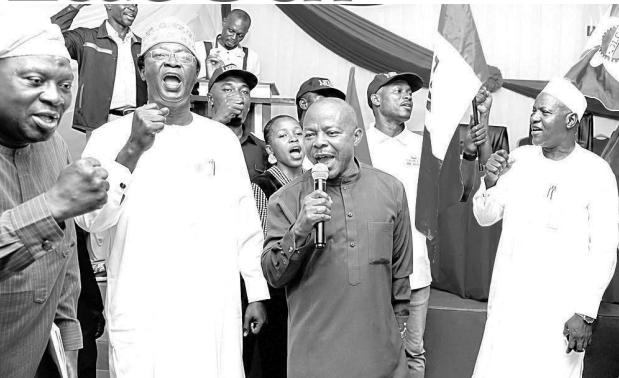
• Says fight for better Nigeria must be unwavering
By Victor Ahiuma-Young
As Nigeria inches closer to another round of national minimum wage negotiations and the 2027 general elections, the Nigeria Labour Congress, NLC, is expanding its agenda beyond the familiar struggle for higher wages.
It is positioning organised labour as a decisive political and social force capable of influencing not only workers’ welfare but also the direction of governance in Nigeria .
At its 2026 Rain School in Uyo, Akwa Ibom State, the Congress unveiled what amounted to a broad ideological roadmap for the labour movement, calling on workers to prepare simultaneously for battles over a living wage, stronger labour protections, democratic accountability and greater participation in shaping Nigeria’s political future.
Addressing participants including union leaders and labour activists from across the country, NLC President, Joe Ajaero, declared that the era of workers serving merely as voting blocs or passive spectators in Nigeria’s democracy must come to an end.
Instead, he urged organised labour to rediscover its collective strength and prepare to become what he described as the country’s “critical force for change.”
“The theme of this year’s school: The Working Class and the Politics of 2027, is deliberately chosen and profoundly strategic,” Ajaero said. “It declares that we, the producers of the nation’s wealth, refuse to be passive observers in the political process. We are the engine of the economy, the hands that build this nation, and we will not be treated as mere objects of political manipulation.”
Workers can shape 2027
For Ajaero, the political significance of Nigeria’s workforce extends far beyond election-day voting.
He argued that workers possess enormous industrial and political influence but have failed to deploy it effectively over the years.
According to him: “While many of us workers may feel overwhelmed by rising inflation, stagnant wages and worsening living conditions, we remain the country’s greatest organised force.
“When you look at your payslip and see a pittance that cannot feed your family, when you see the cost of food, accommodation, transportation and healthcare spiralling out of control, it is easy to feel powerless.
“But you are not insignificant. You are the lifeblood of this nation. You are the critical force that can force change.”
The NLC President insisted that if workers remained united and organised, they could significantly influence the outcome of the 2027 general elections.
“The industrial and political power of a nation does not reside in its treasury or in political party offices. It resides in the palms of your hands and in the collective strength of your solidarity.
“If we make up our minds and act unitedly, we will be in a position to define outcomes in the 2027 general elections.”
Living wage
Although the current national minimum wage stands at N70,000, Ajaero dismissed it as inadequate in the face of soaring inflation and the rising cost of living.
He said: “The battle for a living wage will soon begin in earnest. The paltry sum that currently passes for a wage can no longer be sustainable. It is a poverty wage.”
Rather than approaching negotiations from a position of weakness, he urged labour leaders to negotiate from a position of strength.
“We must not go to the negotiation table with a begging bowl. We must demand a wage that truly approximates a living wage—a wage that enables workers to feed, house, educate and care for their families with dignity,” Ajaero said.
He called on all NLC affiliates and state councils to begin mobilising immediately for what he described as one of labour’s defining struggles in the coming months.
Review of labour laws
Beyond wages, the Congress accused the Federal Government of deliberately delaying long-awaited labour reforms.
According to Ajaero, despite years of negotiations and consensus among government, employers and organised labour, the reviewed Labour Administration legislation has remained stalled for about six years without being transmitted to the National Assembly.
Ajaero said “We have laboured, we have negotiated, and we have reached consensus. Why the delay? This six-year delay is a deliberate strategy to maintain the status quo of impunity and exploitation.
“A modern labour administration law is not a luxury. It is a necessity for protecting Nigerian workers and aligning our labour system with international best practices.”
He lamented that Nigeria remains among the countries where workers’ rights are routinely violated through restrictions on union activities, collective bargaining and industrial action.
“They attack our right to organise, to bargain collectively and to strike. They criminalise our struggles and use the instruments of state power to suppress dissent.”
Beyond elections
Ajaero sounded a note of caution that labour’s mission extends beyond electoral contests.
He argued that the Congress must become a movement for democratic renewal and social justice.
“The struggle is bigger than elections. It is a struggle to preserve the soul of the nation. We must build a democratic, welfarist-inspired alternative that places the needs of the people above the profits of the few”, he insisted.
The NLC President did not spare his criticism for corruption, which he described as the principal reason workers continue to suffer despite Nigeria’s enormous wealth.
“No matter how much we earn as a nation, if illicit financial flows and kleptocrats continue feeding on our resources, workers will keep bleeding. Nigeria is not broke. The political class is saving the nation’s wealth in their private bank accounts”, he lamented.
The NLC President reminded participants that the Rain School was never intended to be merely an academic exercise.
Instead, he described it as a strategic mobilisation platform for the struggles ahead.
“This Rain School should not be a seminar. It should be a launchpad.
“Let the knowledge you gain here be your ammunition. Let the solidarity you build here be your shield. Let the action you take when you return be your sword.
“The future must be fought for. The future is not given to us. We must fight for it.bAnd we will win.
“A people united can never be defeated. Workers united can never be defeated.”
The post Living wage, 2027 elections: NLC rallies workers for tough battles ahead appeared first on Vanguard News.