

By Adeola Badru
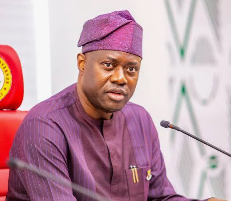
IBADAN — Oyo State Governor, ‘Seyi Makinde, and renowned historian, Professor Toyin Falola, have challenged Nigerian youths to reject despair, embrace innovation and take responsibility for national development, saying the future of Nigeria and Africa depends largely on the choices and contributions of their young populations.
They made the call on Wednesday during the commemoration of this year’s International Students’ Day at the International Conference Centre, University of Ibadan, where they urged students to translate their education into practical solutions to the country’s challenges and demand accountable leadership.
In his remarks, Makinde advocated a national reset that would create an environment where education translates into employment, enterprise and meaningful opportunities, while citizens enjoy security and freedom from discrimination.
He described Nigeria’s youthful population as a major opportunity for national development but noted that many young people were seeking education and employment opportunities abroad because of prevailing conditions at home.
The governor said his ambition was to build a country where migration would be a matter of personal choice rather than a decision driven by hopelessness.
“I understand why Nigeria means so much to some of us. Some people may even be surprised or angry when I speak nostalgically about the country. But the Nigeria I remember is one that many young people today may not recognise because they have never experienced it.
“That is why my agenda is to reset Nigeria and make it work for every Nigerian, especially you,” he said.
Makinde said he did not begrudge Nigerians who chose to live and work abroad but wanted the country to create conditions that would encourage them to return and build meaningful lives.
He illustrated the challenges facing young Nigerians with the experience of his daughter, who returned to the country to explore opportunities but eventually went back to the United States after spending about a year trying different ventures.
According to him, although he offered her advice and support, he declined to use his position to secure an unfair advantage for her over other young Nigerians.
The governor said the experience reflected the frustrations of young people seeking an environment where they could build their futures and enjoy opportunities alongside their peers.
On education, Makinde said his proposed reset would focus on making the entire system functional rather than relying solely on financial assistance to students.
He identified the Nigeria Education Loan Fund (NELFUND) as one of the policies of the present administration he would retain, but cautioned against making student loans a substitute for a functional economy and an education system that prepares graduates for employment.
“I said in an interview yesterday that if there is one policy I would retain from this administration, it is the student loan scheme, particularly the Nigeria Education Loan Fund (NELFUND).
“However, it should not simply be about distributing loans. It should be about making the entire system work so that not every student has to depend on a loan,” he said.
He argued that students who did not need financial assistance should not take loans, so that available resources could benefit those who genuinely required them.
Makinde said the country needed an economy where parents could earn enough to finance their children’s education and graduates could secure jobs to repay loans obtained to fund their studies.
He also advocated stronger links between education, employment and enterprise, saying graduates should acquire practical and industry-relevant skills before leaving school.
The governor recounted an experience involving ExxonMobil in the United States, which had approached him over a project in another African country and requested engineers.
He said he offered to provide two Nigerian engineers, Omotayo Giwa and Samuel Edelman, but the company explained that they would require about three months of training before becoming productive on the project.
According to Makinde, he sent the two engineers to the United States for the training, after which the company confirmed that they had become productive and could contribute meaningfully to the project.
He said the experience demonstrated the importance of involving employers and industry practitioners in designing educational curricula.
“Imagine a country where entrepreneurs and employers are involved in determining the skills required at every level, and educational curricula are designed to equip students with those skills before they graduate.
“Imagine graduates leaving school ready to work, without being told that they need four years of experience to qualify for an entry-level position. That is the Nigeria we intend to build,” he said.
Makinde added that young people should be prepared to become entrepreneurs not merely because they lacked other options but because they possessed the skills and opportunities to realise their potential.
On security, the governor called for a country where citizens could move freely without fear of harassment or violence, particularly from security personnel.
He advocated better coordination between federal and state policing institutions, stressing that Nigerians should feel safe wherever they lived.
Makinde said students studying far away from home should not have to live in constant fear of receiving distressing reports about the safety of their families.
He described his vision as achievable through collective action and a shared commitment to national development.
“This is why I describe myself as a resetter. A resetter believes that things can be better and is prepared to work towards making them better,” he said.
The governor urged students to participate actively in the political process by obtaining their Permanent Voter Cards (PVCs), encouraging their friends and mobilising their parents and other family members to register and collect theirs.
He also cautioned them against allowing financial inducements to determine their voting decisions, urging them to support leaders committed to national development.
He further encouraged students to establish reset groups in their institutions, organise awareness walks and conduct voter education campaigns.
In his keynote address, Falola urged students to understand the historical forces shaping Africa’s development and migration patterns, warning against explanations that attributed the continent’s economic challenges solely to internal failures.
The historian said Africa had repeatedly been subjected to negative descriptions, from being portrayed as a continent without history to one lacking modernisation, good governance and democracy.
He traced some of the continent’s economic difficulties to conditions attached to loans obtained from international financial institutions during the Structural Adjustment Programme era.
According to him, the economic difficulties that contributed to migration from Africa in the 1980s were influenced not only by domestic conditions but also by policies associated with the Bretton Woods institutions.
“Of course, we must acknowledge that we have our own leadership challenges and internal crises. But we must also recognise the external dimensions of migration,” he said.
Falola urged Africans to challenge narratives that portrayed migration as a problem created exclusively by the continent, noting that migration had historically involved movements in different directions, including from Europe to Africa.
He also recalled predictions that Africa would descend into widespread conflict and instability, arguing that the continent had continued to demonstrate resilience despite its challenges.
He said Africa’s youthful population and abundant resources offered enormous opportunities, but warned that the continent must address the contradictions preventing it from realising its potential.
The professor challenged students to examine these contradictions and determine their roles in resolving them.
“I want you to listen carefully and repeat after me: Resources without development. Religion without God. Education without knowledge. Certificates without jobs. Work without wages. Laboratories without scientists.
“These are some of the contradictions confronting our society. We possess certain resources and institutions, yet their expected benefits are often absent,” he said.
Falola said youth empowerment must go beyond rhetoric, stressing the need to support young people and women to develop their talents and contribute meaningfully to national development.
He cited the Nigerian entertainment and creative industries, including Nollywood, Afrobeats and fashion, as examples of sectors where young people had demonstrated their capacity to create opportunities and achieve success.
He urged teachers and university lecturers to concentrate on equipping students with relevant knowledge rather than attempting to determine their future.
“When students come to you to learn engineering, teach them engineering. Do not attempt to determine their destinies,” he said.
Falola also identified intellectual development and integrity as essential values young Nigerians must embrace, warning that abandoning ethical standards could undermine the country’s future.
He urged students to take their education seriously and avoid examination malpractice and other forms of dishonesty.
“Even if others are cheating, do not join them. Your intellectual capacity is needed by this country,” he said.
The historian lamented what he described as the decline of traditional values that once promoted accountability and discouraged dishonesty in communities.
He recalled writing in his first memoir, A Mouth Sweeter Than Salt, about a traditional festival during which young people publicly identified individuals who had behaved badly in their communities.
Falola said the practice provided an avenue for community accountability but regretted that people who acquired wealth through questionable means were sometimes celebrated rather than held accountable.
He also warned against dishonesty among people seeking financial assistance, saying false claims about relatives being hospitalised undermined public trust and made it difficult for those with genuine needs to receive help.
On leadership and foresight, Falola cited literary icon Chinua Achebe, who wrote Things Fall Apart while still a young student, as well as former Head of State, General Yakubu Gowon, and former Biafran leader, Chukwuemeka Odumegwu Ojukwu, as examples of Nigerians who made significant contributions at relatively young ages.
He said their experiences demonstrated that young people could make meaningful contributions to society when given opportunities.
Falola further urged students to embrace innovation, technological literacy and emotional intelligence, stressing that technical skills alone were insufficient without the ability to work effectively with others.
He called on state governments and universities to establish innovation incubators where young people could develop ideas, receive support and transform their innovations into viable products and businesses.
He also advocated stronger partnerships among universities, governments and private companies to promote innovation and create commercial value from students’ ideas.
The professor cautioned students against using mobile phones and other digital devices solely for entertainment, urging them to take advantage of technology to acquire knowledge, develop professional skills and build careers.
He said young people could obtain professional certifications from organisations such as Microsoft and Google, irrespective of their locations, to strengthen their skills and improve their employment prospects.
Falola also urged students to develop a pan-Nigerian and pan-African consciousness, warning against ethnic and religious divisions.
He encouraged them to resist attempts to draw them into violence and instead promote unity, collaboration and peaceful conflict resolution.
He stressed that democracy must be accompanied by accountability, urging young Nigerians to demand transparency and responsibility from those entrusted with public office.
“Leadership must be transparent, responsible and responsive to the needs of the people,” he said.
Falola further encouraged students to embrace collaboration, noting that technology had made it possible for people in different locations to exchange ideas, work together and develop businesses.
He urged them to understand their history and culture, learn from positive examples within their communities and remain committed to building a society founded on integrity, inclusiveness and resilience.
The post Makinde, Falola challenge Nigerian youths to drive national renewal appeared first on Vanguard News.