

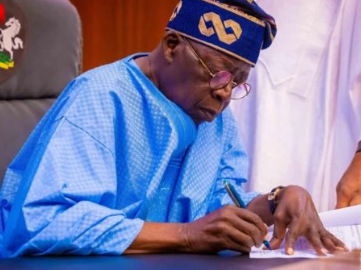
The Makinde-Daura Presidential Campaign Organisation (MDPCO) has criticised President Bola Tinubu’s plan to secure fresh foreign loans totalling about $20.5 billion and €1.04 billion, warning that continued borrowing could increase Nigeria’s debt burden and constrain future generations.
In a press statement dated October 28, 2026, signed by Richard Nnanna Ihediwa, Director of Strategic Communications MDPCO, the organisation said it opposed the proposed loans, which it put at ₦27.52 trillion and ₦1.558 trillion, respectively.
The statement, signed by its Director of Strategic Communications, Richard Nnanna Ihediwa, questioned the timing of the borrowing request ahead of the 2027 general election and demanded that the President withdraw it.
The organisation also urged the National Assembly to reject the request, arguing that the government had yet to demonstrate how previous loans had translated into commensurate development or present a credible plan for repaying the country’s accumulated debt.
The MDPCO cited a public debt figure of ₦166.7 trillion, claiming that further borrowing would place additional pressure on Nigerians, particularly younger generations.
It also questioned the government’s explanations that successive loans were needed to finance infrastructure, critical projects and budget deficits, asking for greater transparency over the utilisation of borrowed funds.
To support its position, the organisation listed several loans secured or approved during the Tinubu administration.
It cited a $750 million World Bank loan obtained in June 2023 under the Power Sector Recovery Performance programme, intended to improve electricity supply, and a separate $500 million loan for institutional strengthening and women’s empowerment.
The group also referred to an $800 million loan secured in July 2023 for conditional cash transfers, followed by another $700 million in September of that year.
It further cited a $2.25 billion loan obtained in June 2024 for economic stabilisation and transformation, as well as a $1.57 billion borrowing plan in 2025 for healthcare, education and human-capital development. The organisation also mentioned a separate $500 million loan from the African Development Bank in 2025.
The MDPCO questioned the impact of the loans, particularly on electricity supply, economic stability and household welfare, arguing that Nigerians had yet to see results commensurate with the scale of borrowing.
It also referenced a borrowing plan approved by the Senate in 2025 involving $21.19 billion, €4 billion and ¥15 billion. According to the organisation, the plan included $3 billion for the Eastern Railway Corridor linking Port Harcourt to Maiduguri, which it claimed had yet to record tangible progress.
The group also cited Senate approvals in April 2026 for $6 billion to modernise the country’s ports and another $1.5 billion for early-childhood development and household prosperity.
The organisation compared Nigeria’s borrowing trajectory with Egypt under Khedive Isma’il, who ruled from 1863 to 1879. It argued that Egypt’s dependence on foreign loans and extravagant spending contributed to a debt crisis that undermined the country’s financial independence.
The MDPCO called on Tinubu to withdraw the latest borrowing request and urged the National Assembly to act in what it described as the national interest.
“Nigeria is nobody’s personal fiefdom!” the organisation declared.
It also called on Nigerians to support the Allied People’s Movement (APM) presidential candidate, Engr. Seyi Makinde, whose RESET NIGERIA Agenda it said offered an alternative approach to economic management, national self-sufficiency and sustainable development.
The organisation said its proposed administration would focus on restructuring, economic opportunities and prosperity, contrasting its stated objectives with what it described as the Tinubu administration’s debt-dependent economic policies.
The claims and criticisms contained in the statement represent the position of the MDPCO.
The post MDPCO warns against fresh $20.5bn foreign loan appeared first on Vanguard News.