

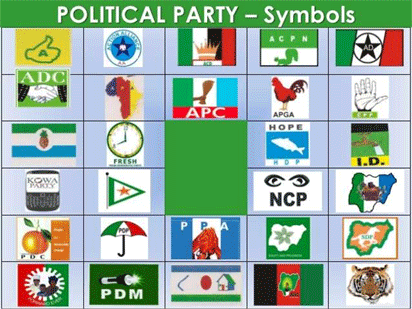
With the conclusion of party primaries ahead of the forthcoming elections, Nigeria’s political conversation has predictably centred on winners and losers, defections, grievances and celebrations. But beyond the immediate theatre of contests lies a deeper question: are our political parties becoming democratic institutions or do they remain vehicles for powerful individuals and vested interests?
The primaries suggest the latter. Across party lines familiar problems resurfaced: allegations of candidate imposition, manipulated delegate lists, opaque procedures, internal disputes and the excessive monetisation of politics. These recurring complaints cast a long shadow over the credibility of candidate selection and, by extension, the legitimacy of the electoral process.
Of particular concern is the rising cost of political participation. Many aspirants were required to pay enormous sums for nomination and expression-of-interest forms. Such financial barriers exclude competent and visionary citizens who lack deep pockets or reject corruptive politics but possess the capacity and commitment to serve. Politics should not be the preserve of the wealthy. Democracy flourishes when opportunities are open to all qualified citizens.
Turning public office into an expensive investment is corrosive. When contenders spend vast sums to secure party tickets, the temptation to treat office as a means to recoup costs — rather than as a duty of public service — grows. That mindset distorts policy incentives, weakens accountability and erodes public trust in governance. It also entrenches patronage networks: candidates beholden to sponsors are likelier to prioritise private returns over public interest.
Political parties are the foundation of representative democracy. They recruit leaders, develop policy, structure political debate and offer platforms for citizen participation. When parties are weak, undemocratic or effectively controlled by a handful of power brokers, the quality of governance inevitably suffers. Leaders who emerge through flawed internal processes often lack legitimacy and may feel more beholden to godfathers than to the electorate.
Reform is urgent and must be practical. Parties should adopt transparent nomination procedures, credible and verifiable delegate selection, and impartial internal dispute-resolution mechanisms with published outcomes. Financial barriers must be reduced: nomination fees ought to be proportionate and capped where possible, with exemptions or support for bona fide low-income aspirants. Internal codes of conduct should be enforced, with sanctions that are swift and public.
Institutions beyond the parties have roles to play. The Independent National Electoral Commission (INEC) must demand greater transparency in party primaries and exercise its regulatory remit firmly. Civil society and the media should continue to document malpractice and apply public pressure. But lasting change must come from within: party leaders must commit to placing institutional integrity above private advantage and to building parties defined by ideas and rules, not personalities.
Strong democracies are sustained by strong parties governed by rules, ideology and accountability. Until our parties embrace that reality, our democracy will remain backward.
The post Need to reform internal party democracy appeared first on Vanguard News.

 InformationNG
 Punch Nigeria
 Daily Post
 This Day
 Vanguard Nigeria
 The Guardian Nigeria