

There are three developments worth flagging today, but only one produces a clear state-map adjustment.
Zamfara: the APC losses now appear to be an ADC gain. Yesterday, the important fact was that a sizeable bloc of Zamfara State Assembly members had left the APC without a clearly established destination.
Today, Punch and ICIR report that nine lawmakers have moved to the ADC. Channels independently confirms that nine legislators have left the APC, although some earlier reports counted fewer members and did not identify their destination.

That changes the interpretation. This is no longer simply an APC cohesion problem: it potentially gives the ADC an identifiable elected-political bloc in Zamfara, only months after Governor Dauda Lawal and the rest of the Assembly had consolidated around the APC. The defectors cite insecurity, internal divisions and alleged unfair treatment.
There is an important caveat. Several of these lawmakers have been suspended from Assembly activities during a long-running dispute, so nine names should not automatically be equated with nine fully functioning legislative machines. Nor does their defection prove that their constituents will follow them.
Even so, for the North West map, we would now mark:
Zamfara APC organisational advantage reduced; ADC organisational strength materially up; voter movement still unproven.

The security dimension makes the split more consequential than an ordinary elite defection. If the ADC can turn the lawmakers’ constituency structures into polling unit organisation, it has acquired something more valuable than endorsements: an existing network across several LGAs.
Accord: presidential ticket restored by the Federal High Court
The Federal High Court in Abuja today ordered the Accord Party to recognise Gbenga Olawepo-Hashim as its presidential candidate and to submit his name to INEC. The court held that Accord breached Section 86 of the Electoral Act by refusing to forward his name after the disputed May 30 primary. INEC was ordered to accept and recognise the nomination once submitted.

This is a lower court judgment and can still be appealed, so I would not regard the ticket as beyond further litigation.
Accord matters more than its national polling history might suggest because it now controls Osun State after an INEC-run governorship election: Governor Ademola Adeleke won the August 15 poll on the Accord platform, defeating APC in a genuine INEC-administered statewide election. That provides evidence of real party machinery in one South West state, although Adeleke’s personal following was plainly a major component of that result.
The presidential implication should therefore be modest:
Osun/South-West Accord now has both a governorship base and, subject to appeal and INEC compliance, a presidential candidate.
But there is no evidence yet that Olawepo-Hashim will automatically inherit Adeleke’s Osun vote or significantly alter the national presidential balance.
Electoral Act: legal-risk issue becomes harder to escape
A second national development strengthens the importance of the candidate-eligibility disputes we have been tracking.
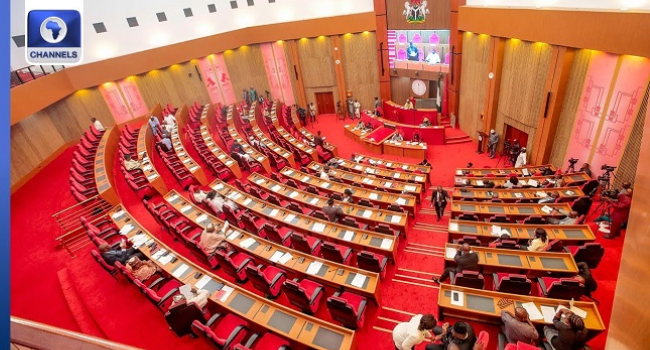
The Senate says there will be no further amendment of the Electoral Act 2026 before the 2027 elections, despite the Supreme Court’s restoration of the provisions governing party membership registers and nomination procedures. The stated position is that changing the Act now would amount to altering the rules while the election process is already under way.
Meanwhile, INEC says it is awaiting and reviewing the certified true copy of the Supreme Court judgment before deciding what, if anything, it means for individual candidates. The Commission is due to publish the final list of governorship and state-assembly candidates on October 10.
That means the Legal Risk indicator we introduced after the Gombe dispute should remain elevated nationally. It is particularly relevant to candidates whose party membership dates, waivers or nomination procedures are contested.
It does not mean such candidates including Pantami in Gombe are automatically disqualified. The next significant development will be how INEC applies the judgment and how the courts treat candidate-specific challenges.
One major INEC number but not yet a map change

INEC also announced today that Nigeria’s voter register has risen to more than 103 million, following the three-phase Continuous Voter Registration exercise, which produced about 10.77 million new registrations before biometric verification and cleanup. Nationwide PVC collection begins October 9. INEC says it has also acquired 57,000 additional BVAS devices.
That is electorally significant, but without a reliable state-by-state and demographic breakdown of the net additions, it would be premature to claim that the enlarged register favours APC, PDP, ADC, NDC, Labour or NNPP.
We found no new INEC-run bye-election or rerun, no state-electoral-commission local-government result, and no credible voter poll today that warrants a further map adjustment.
The Signal: Zamfara is the development to watch. What looked yesterday like an APC fracture is beginning to look like an ADC acquisition. If that bloc retains meaningful constituency organisation, one of the APC’s most dramatic 2026 state-level consolidations has begun to unwind only months before voting
The post Nigeria 2027 Election Watch appeared first on Channels Television.