

By Johnbosco Agbakwuru
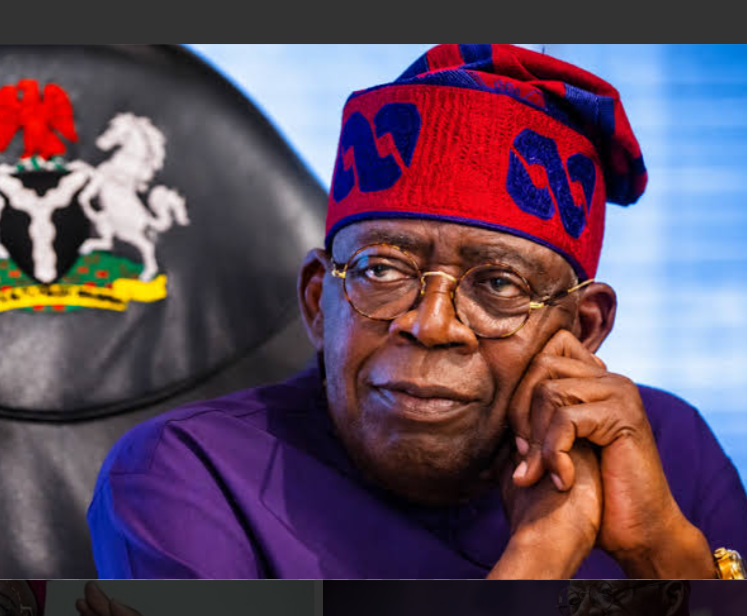
President Bola Tinubu on Thursday declared that Nigeria’s economy has moved “from stabilisation to shared prosperity,” citing non-oil exports above $6 billion, external reserves of about $55 billion, and a target of a $1 trillion economy by 2030.
Speaking at the public presentation of Economic Diversification and Structural Transformation in Nigeria: Past, Present and Future, authored by Honourable Abdulmumin Jibrin Kofa, Tinubu said the country had abandoned “cosmetic remedies” for what he called the “hard road of surgery.”
According to him: “For too long, Nigeria’s story was a song sung in a single note. We were a nation of boundless promise tied to a single product, our budget, our currency and the livelihoods of millions rising and falling with the tides of a distant oil market. We floated on the fragile illusion of oil wealth while the foundations beneath us crackborders.
”When I took the oath of office, I did not inherit a calm sea; I inherited a gathering storm: a collapsing naira, debt service that swallowed nearly all our revenue, depleted reserves, a fuel subsidy that bled our treasury dry, and factories falling silent as industries and jobs fled across our borders.”
The President said his administration inherited “a gathering storm,” including “a collapsing naira, debt service that swallowed nearly all our revenue, depleted reserves, a fuel subsidy that bled our treasury dry, and factories falling silent.”
“We chose reform over ruin. We removed the fuel subsidy. We unified the exchange rate. These were not easy decisions, and I know the weight they placed on every household. But they were necessary, and today the pain is yielding its promise.”
He stated that non-oil activities now account for about 96 per cent of Gross Domestic Product, while non-oil exports have crossed $6 billion, which he described as the highest in Nigeria’s history.
Tinubu also said external reserves had risen to about $55 billion, representing “more than fourteen months of import cover,” and that non-oil revenue had grown from ₦13.63 trillion in 2023 to ₦16.4 trillion in the first half of 2026.
The President said government alone cannot build a $1 trillion economy, adding that wealth must be created by enterprises that “invest, innovate, manufacture and export.”
“Our duty is to clear the path before them,” he said. “That is why our 2025 budget introduced a first-of-its-kind De-risking Framework to draw in private capital, which we expect to provide 86 per cent of the investment our 2030 goal demands.”
He said the administration was harmonising taxes and ending “the menace of multiple taxation.”
“We cannot tax our way into prosperity; we must produce our way there,” Tinubu said.
The President said the administration had “fought for Mambilla,” winning a $3.38 billion arbitration at the International Chamber of Commerce in Paris and freeing “a project held hostage for more than nine years.”
He added that Geregu Power is moving to raise its capacity to 1,300 megawatts, while the Port Harcourt and Warri refineries are “stirring back to life.”
On infrastructure, Tinubu listed the Kano–Katsina–Maradi railway, Lagos–Calabar Coastal Highway, Sokoto–Badagry Superhighway, Abuja–Kaduna–Kano Expressway, East–West Road, Ibadan–Ife–Ilesa Expressway, Port Harcourt–Enugu and Enugu–Onitsha expressways, and the restoration of Carter Bridge.
He said 52 per cent of legacy highway mileage is in the North and 48 per cent in the South.
“We are building fairly and deliberately, so that no zone is left behind and no citizen is a stranger to opportunity,” he said.
Tinubu said more than 10,000 homes are rising across 14 states and the Federal Capital Territory under the Renewed Hope Cities and Estates Programme.
He said the MOFI Real Estate Investment Fund had provided about ₦128 billion in mortgages to 1,859 families in 25 states, at a fixed rate of 9.75 per cent over 20 years.
“As this market grows, so must the confidence of those who invest in it,” he said. “I will therefore work hand in hand with the National Assembly and stakeholders to establish a strong regulatory authority for housing and real estate.”
The President also cited NELFUND, university solarisation, Bank of Industry loans and grants across all 774 local government areas, the 3MTT digital-skills programme, and 90,000 kilometres of fibre-optic infrastructure.
“Roads and power lines are the skeleton of a nation; its people are its life,” he said.
Tinubu commended Jibrin, the member representing Kiru/Bebeji Federal Constituency in Kano State, whose years as a lawmaker and chairman of key National Assembly committees, including Finance and Appropriations, “lend these pages the weight of experience.”
“This is the essence of the book we present today,” Tinubu said. “It looks back with honesty, looks around with clarity and looks ahead with courage.”
He said: “The days of hardship are temporary; the foundations we are laying are permanent. Let us keep building until the world looks upon Nigeria and sees not promise deferred, but promise fulfilled.”
The event was held at the State House Conference Centre in Abuja, with Governor Charles Soludo as keynote speaker, Alhaji Abdulsamad Isyaku Rabiu as book presenter and Dr Reuben Abati as reviewer.
The post Nigeria has left ’emergency ward,’ targets $1trn economy by 2030 – Tinubu appeared first on Vanguard News.