

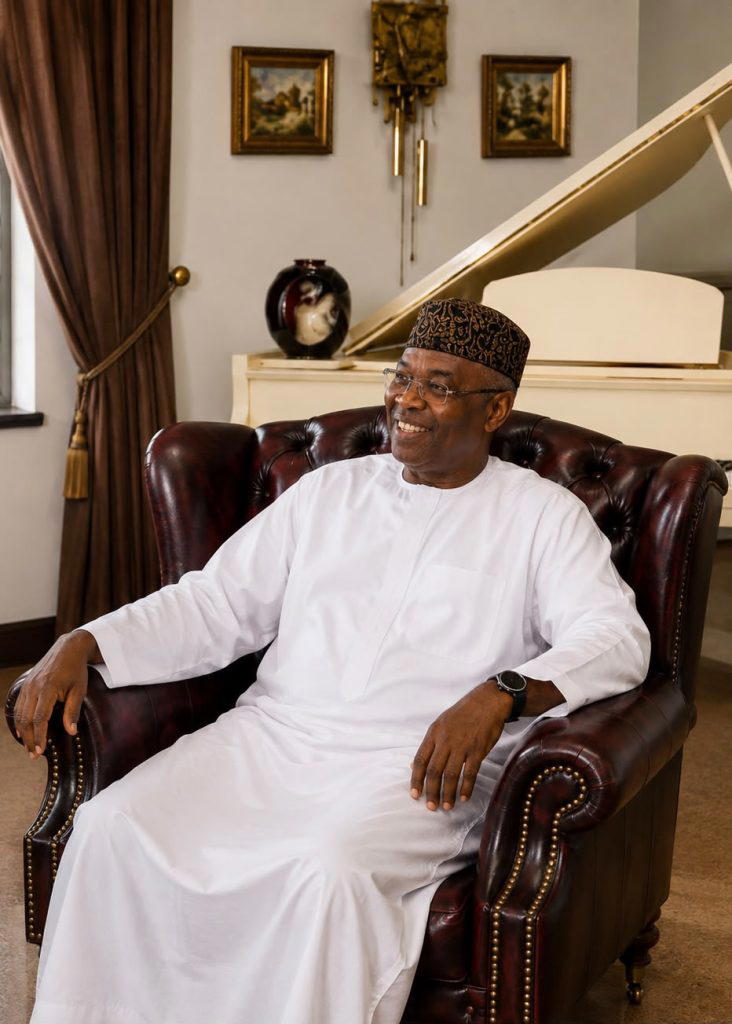
From his Lagos home, elder statesman and respected business leader, Chief F.E. Ojugbana, reflects on Nigeria’s economic direction with the perspective of a man who has witnessed several chapters of the nation’s political and economic history.
For Chief Ojugbana, the economic reforms of President Bola Ahmed Tinubu’s administration, though accompanied by significant adjustment pains, are beginning to lay foundations for a more productive, investment-driven and self-reliant Nigerian economy.
At the centre of this emerging industrial story, he argues, is the remarkable expansion of indigenous private enterprise, exemplified by Africa’s foremost industrialist, Aliko Dangote, and the Dangote Group.
‘Nigeria is laying a new economic foundation’
Speaking on the state of the economy, Chief Ojugbana acknowledged the difficulties facing ordinary Nigerians but maintained that the country must also recognise the progress being made in restoring macroeconomic stability and strengthening confidence in the Nigerian economy.
The Tinubu administration came into office confronting longstanding structural problems, including the enormous cost of fuel subsidies, foreign exchange distortions, weak government revenues and an economy heavily dependent on imported petroleum products.
Its reforms have been difficult, but international assessments increasingly point to improvements in some of Nigeria’s underlying economic indicators.
The International Monetary Fund, IMF, said in its 2026 assessment that reforms undertaken since 2023 have strengthened macroeconomic stability, rebuilt external buffers and improved the functioning of the foreign exchange market. The Fund estimated economic growth at 4.0 per cent in 2025 and projected 4.1 per cent growth in 2026. (IMF)
Similarly, the World Bank, in its April 2026 Nigeria Development Update, said Nigeria had made “meaningful progress” in restoring macroeconomic stability, noting stronger external and fiscal positions and resilient economic growth, even as it cautioned that household incomes had yet to recover fully and poverty remained high. (World Bank)
Chief Ojugbana believes this distinction is important.
Economic reform, he said, cannot ultimately be judged by statistics alone. Its success must eventually translate into employment, increased purchasing power, greater opportunities for young Nigerians and improved living standards.
But, in his assessment, rebuilding the fundamentals is an essential first step.
Tinubu’s reforms and renewed investor confidence
One of the positive developments under the current administration has been the effort to create a more market-oriented economy capable of attracting domestic and international capital.
The removal of costly subsidies, changes to the foreign exchange regime, greater fiscal discipline and efforts to improve government revenue have significantly altered Nigeria’s economic framework.
The IMF has noted that investor confidence strengthened following the reforms, with Nigeria returning successfully to the Eurobond market and recording renewed portfolio inflows. (IMF)
Nigeria’s external position has also shown improvement. According to the IMF, the country recorded a current-account surplus equivalent to 4.8 per cent of GDP in 2025, while gross international reserves rose from about $40 billion at the end of 2024 to $46 billion in 2025 and reached about $49 billion by the end of March 2026. (IMF eLibrary)
For Chief Ojugbana, these developments provide grounds for cautious optimism.
He stressed that government must now ensure that the improving macroeconomic picture reaches the marketplace, the household and the small business owner.’
Dangote: A Nigerian industrial success story
Perhaps nowhere is Nigeria’s potential for industrial transformation more visible than in the extraordinary strides being recorded by Aliko Dangote and Dangote Industries Limited.
Chief Ojugbana described Dangote’s industrial investments as a demonstration of what Nigerian enterprise can accomplish when ambition, capital, supportive policy and long-term commitment to the country come together.
The Dangote Petroleum Refinery represents a particularly important turning point.
For decades, Nigeria occupied the paradoxical position of being one of Africa’s major crude-oil producers while depending heavily on imported refined petroleum products. The emergence of large-scale domestic refining is helping to change that equation.
The IMF has estimated that the refinery could improve Nigeria’s current account by around $5.5 billion through import substitution and increased exports, assuming the value added remains onshore. Its analysis also projected that the refinery could contribute around 1.5 per cent to non-oil GDP by 2026 and cited roughly 150,000 direct and indirect jobs in connected sectors. (IMF eLibrary)
That represents more than a corporate achievement. It is potentially a major restructuring of Nigeria’s industrial economy.
From importer to producer and exporter
The implications are significant.
Instead of sending scarce foreign exchange abroad to import petroleum products produced from Nigerian crude, greater domestic refining means that more of the value chain can remain within Nigeria.
It can stimulate transportation, logistics, engineering, petrochemicals, manufacturing, storage and other associated industries.
Nigeria’s changing position is already becoming visible internationally. The IMF’s 2026 assessment noted that the sharp reduction in refined-fuel imports, as the Dangote Refinery increased production, had helped turn Nigeria into a net exporter of refined petroleum products. (IMF eLibrary)
The refinery’s ambitions are also expanding. In August 2026, Reuters reported plans for a major Nigerian public offering and an expansion that could ultimately double refining capacity to 1.4 million barrels per day within three years. (Reuters)
For Chief Ojugbana, this is the kind of private-sector confidence Nigeria must encourage.
The country, he argued, cannot build prosperity merely by consuming what other nations manufacture. Nigeria must produce, refine, manufacture, export and compete.
Partnership between government and enterprise
Chief Ojugbana sees an important lesson in the relationship between public policy and private enterprise.
Government does not have to own every factory or run every business. Its fundamental responsibility is to establish a stable environment in which entrepreneurs can invest, industries can expand and capital can be deployed with confidence.
The private sector, in turn, must demonstrate commitment to Nigeria through investment in productive assets, employment, technology, skills and exports.
In this respect, Dangote’s investments represent more than individual business success. They demonstrate the scale at which Nigerian capital can participate in transforming the nation’s economy.
The Dangote story also sends a message beyond Nigeria’s borders: African businesses can build world-scale industrial infrastructure on African soil.
Reforms must now touch ordinary Nigerians
Chief Ojugbana, however, cautioned against allowing positive macroeconomic figures to obscure the genuine hardship experienced by millions of citizens.
The Tinubu administration’s next major challenge, he said, is ensuring that the benefits of reform are felt by ordinary Nigerians.
This concern is also reflected in international assessments. While recognising Nigeria’s progress, both the IMF and World Bank continue to warn that poverty, food insecurity and pressures on household incomes remain serious challenges. (IMF)
The elder statesman therefore called for greater emphasis on agriculture and food production, electricity, infrastructure, employment, support for small and medium-sized businesses and policies capable of bringing down the cost of living.
Economic stability, he maintained, should be regarded not as the destination but as the platform from which broader prosperity must be built.
A moment of opportunity
From his Lagos residence, Chief F.E. Ojugbana’s message is ultimately one of confidence tempered by responsibility.
Nigeria, in his view, possesses the entrepreneurs, natural resources, population and market required to become one of the world’s significant emerging economies.
President Tinubu’s administration has embarked on reforms intended to correct longstanding structural weaknesses. Some measurable indicators have improved, and major indigenous investments such as the Dangote Refinery are demonstrating what a more productive Nigerian economy could look like.
But the work is far from complete.
The true test will be whether macroeconomic stability produces factories, whether investment creates jobs, whether domestic production reduces Nigeria’s dependence on imports and, above all, whether economic progress ultimately improves the lives of Nigerian families.
For Chief Ojugbana, the rise of Dangote and other Nigerian industrial champions should inspire a broader national ambition: Nigeria must become a country that produces what it consumes and exports what the world needs.
That, he believes, is the pathway towards a stronger naira, greater employment, deeper industrialisation and an economy capable of delivering lasting prosperity to its people.
The post Nigeria on the Path of Economic Renewal — Chief F.E. Ojugbana Hails Tinubu Reforms, Dangote’s Industrial Revolution appeared first on Vanguard News.