

By Chinedu Adonu
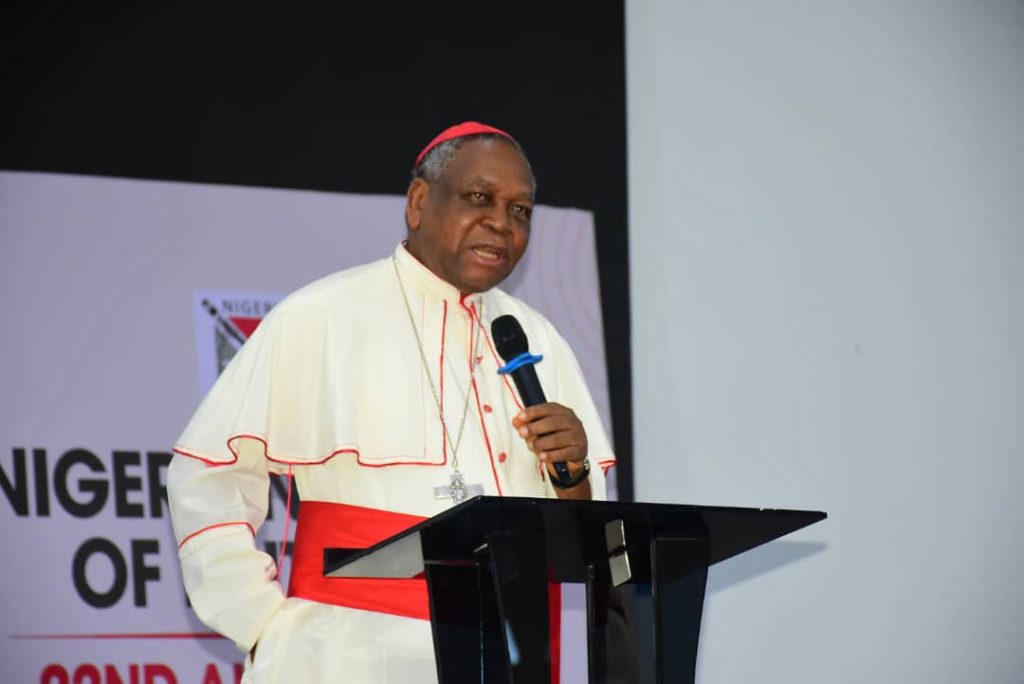
ENUGU — Archbishop Emeritus of Abuja, John Cardinal Onaiyekan, has called on political leaders, electoral institutions and the media to work towards a democratic system that genuinely serves Nigerians and promotes the common good.
Onaiyekan spoke on Thursday as keynote speaker at the 22nd All Nigeria Editors Conference (ANEC 2026), organised by the Nigerian Guild of Editors in Enugu.
The conference, holding September 24 and 25, is themed, “The Ballot, the Media and the Task of Keeping Democracy Alive,” with a sub-theme, “When Lies Look Real: Detecting and Debunking AI Disinformation Before, During and After Election.”
Onaiyekan said Nigeria’s democracy would remain fragile unless elections reflected the genuine wishes of citizens.
He said democracy remained attractive as a system of government but was difficult to achieve in practice, stressing that Nigeria should not accept poor democratic practices as inevitable.
According to him, the ultimate objective should be “a government that is freely chosen by the people and that works for the common good of the people.”
The Cardinal said elections in Nigeria had become increasingly problematic because politicians often approached them as “do-or-die” contests for power, wealth and influence, while ordinary citizens were reduced to pawns.
He also raised concerns about the independence of the Independent National Electoral Commission (INEC), arguing that the commission faced a structural challenge because it was established and funded by government while those in government were often contestants in elections.
He said the situation made it difficult for INEC to operate with the level of independence and transparency expected of an electoral umpire.
Onaiyekan also criticised the use of government resources for partisan political activities, saying incumbents at the federal and state levels had struggled to provide a level playing field for political opponents.
“Where is the freedom of the people of the state to vote according to their individual consciences?” he queried, while expressing concern over situations where governors claim they can deliver all the votes in their states to preferred candidates.
The Cardinal also faulted the heavy deployment of security personnel during elections, arguing that an overwhelming presence of armed security operatives could intimidate voters.
He compared the situation with his experience of elections in Italy, where, according to him, citizens went to polling stations, voted and returned to their normal activities without an atmosphere resembling a nation at war.
On judiciary, electoral reforms
Onaiyekan said election courts should adjudicate disputes rather than effectively determine who won elections.
He expressed concern over situations in which electoral contests were ultimately determined in court rather than at polling stations.
The Cardinal called for reforms to the electoral framework and proposed seven areas for consideration by the National Assembly ahead of the 2027 elections.
He advocated a new process for appointing the INEC chairman and commissioners to guarantee greater independence from the executive arm of government.
He also proposed the establishment of a special election tribunal with a strict timeframe for resolving electoral disputes.
Onaiyekan further called for ordinary voters to have the legal right to challenge election results, arguing that citizens whose votes were at stake should not be excluded from the judicial process.
He said major election petitions should ideally be concluded before the swearing-in of elected candidates.
The Archbishop Emeritus also advocated independent candidacy, particularly for local elections, to reduce what he described as the “tyranny of political parties and their ruthless godfathers.”
He proposed that a presidential candidate should secure at least 50 per cent of votes cast, with a run-off between the two leading candidates where no candidate meets the threshold.
He also called for stricter rules against legislators who cross-carpet from the political parties on whose platforms they were elected, proposing that such lawmakers should return to their constituencies to seek fresh mandates.
Media’s role
Turning to the media, Onaiyekan said journalists had a crucial responsibility to keep democracy alive by informing citizens about the true state of the nation and holding those in power accountable.
He urged journalists to report government policies fairly but critically where necessary, while maintaining professional independence from political, governmental and corporate interests.
“A free press is necessary for a genuine democracy,” he said, noting that Nigeria had a diverse media landscape comprising newspapers, radio, television and social media.
He, however, warned that emerging technologies, particularly artificial intelligence, presented both opportunities and dangers for the media and society.
The Cardinal urged Nigerian journalists to use the freedom available to them responsibly and professionally to strengthen democratic governance.
He also said the quality of leaders produced by the political system remained critical, stressing that those who emerged as leaders should possess values including honesty, commitment to the common good and respect for the rule of law.
Onaiyekan urged Christian and Muslim religious leaders to preach good governance rather than seek political patronage.
He said religion could serve as a positive force for democratic development if religious leaders prioritised values that promote justice, accountability and responsible governance.
“The ultimate objective is to install a government that is freely chosen by the people and that works for the common good of the people,” he said.
The post Nigeria’s democracy must serve people — Onaiyekan appeared first on Vanguard News.