

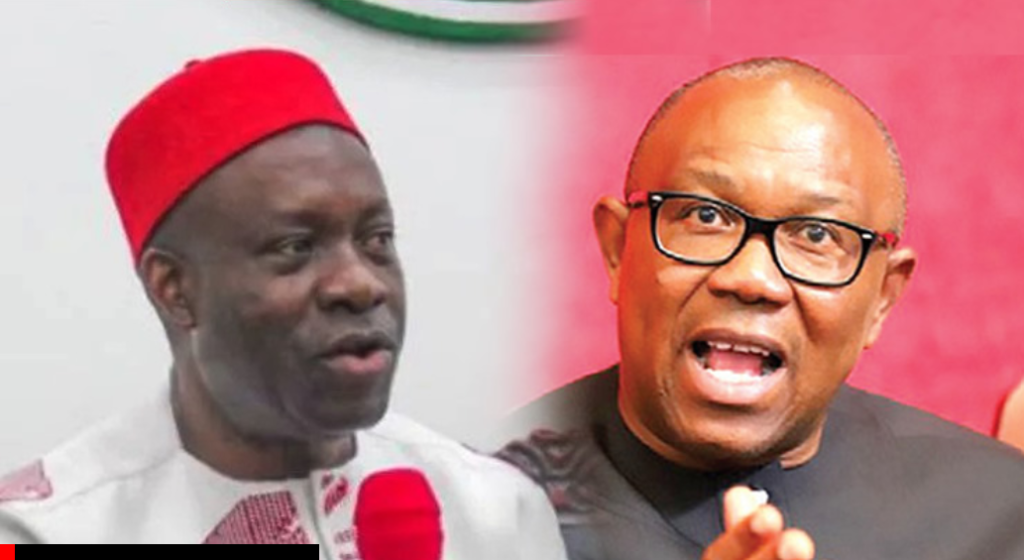
By Valentine Obienyem
Gov. Charles Soludo promised to release a second part of his essay on Obi. I am surprised many people are not aware that that was what he just released through Dr Law Mefor under the guise of a press release. After reading it, my first impulse is: is this what has caused him sleepless nights for almost four years?
Read Also: Peter Obi’s loans still being deducted from Anambra allocations — Commissioner
In public governance, nothing exposes intellectual bankruptcy quite like the weaponisation of revisionist history and economic illiteracy. The released press statement was a weak attempt to rewrite the financial legacy of former Governor Peter Obi. The intervention, cloaked in self-righteous appeals to transparency, is a poorly disguised exercise in political propaganda. It relies on manipulated metrics, profound category errors regarding multilateral development credits, and an absurd attempt to judge historical public expenditures through the prism of today’s inflated exchange rates, as well as many erroneous claims. We shall take them one after another.
I do not want to go into what they claimed Obi spent or did not spend, which they put at about $4.05 billion (equivalent to ₦5.4 trillion at the current exchange rate). Is this not madness? Would they tell us the cumulative budget size of Obi in eight years? This is the surest way towards appreciating the idiocy of this claim – $4.05 billion!
Another sure means of comparing what Obi received or did not receive was the statement by President Ahmed Tinubu that governors today receive four times more than what their predecessors received. Obi was not his predecessor; if we take it down to Obi’s era, they are probably receiving six times what Obi received. Yet, Soludo has not done up to 20% of what Obi did. We are not judging him yet, because his tenure is still running.
The bogus release reads: “No government will ever finish the work of development. HE Peter Obi still left a state without any functioning urban or rural water schemes; increasing insecurity and increased poverty, ostensibly dead public schools and dead public hospitals with grossly inadequate teachers and medical personnel (indeed 44% of all communities in Anambra, 78 out of 179) did not and still do not have any public primary schools (and this administration is only beginning to close the gap).”
‘Current Anambra govt’s agents’
It is amusing to watch the current administration, through agents like Dr Law Mefor, attempt to rewrite history and claim that Peter Obi left Anambra State without functioning water, education, health or urban infrastructure. The records starkly contradict these baseless assertions. In the water sector, while they claim zero infrastructure, Obi’s administration actively resuscitated dormant water schemes. I remember when Mr Mac Rae, the EU envoy to Nigeria, came to commission a water project in Nnewi.
Whenever the issue of education arises, I make one simple request: bring your record, and let us compare. Peter Obi’s investments in education as Governor of Anambra State remain the most comprehensive educational interventions by any Nigerian governor, laying a foundational block that spanned from primary schools to tertiary institutions.
His administration achieved made history by returning mission schools to their original proprietors, backed by over ₦2 billion in grants, constructing five-classroom blocks across all 177 communities, renovating hundreds of dilapidated schools, and installing boreholes in over 300 schools. Furthermore, he pioneered digital transformation by distributing around 40,000 computers, equipping 450 secondary schools with Microsoft Academies, connecting institutions to the internet, providing generators and libraries, and supplying two buses and sick bays to every public secondary school.
Teacher welfare and standards were similarly prioritised through the recruitment of thousands of teachers, with two years of upfront salaries secured, clearing pension and gratuity arrears, and restoring promotions, while higher education underwent an unprecedented overhaul, with massive infrastructure and multibillion-naira funding injected into Chukwuemeka Odumegwu Ojukwu University, Nwafor Orizu College of Education, the College of Agriculture, Mgbakwu, and the brand-new teaching hospital built from scratch. After him, no block has been added to the state’s higher institutions.
Education
Beyond government-owned schools, Obi extended crucial financial support to private tertiary institutions like Madonna, Paul, Tansian, and Peter Universities, while institutionalising a policy of rewarding academic excellence with ₦1 million for every Anambra indigene who graduated with a First Class degree.
Education under his watch was never measured by empty political speeches, but by measurable infrastructure, comprehensive teacher welfare, cutting-edge technology, and profound impacts on young people that even continued through his private philanthropic interventions long after leaving office.
The challenge, therefore, remains simple: bring your record on education and let us compare project for project, school for school, investment for investment, and impact for impact. Since he left, all schools in Anambra are complaining of things as basic as study aids and chalk. Obi gave money directly to schools for those things, but our professor, unmindful of “Nzamacolgy”, prefers acting through agents and those pliable to their terms.
They also talked about health. Peter Obi’s administration fundamentally transformed the healthcare sector in Anambra State through strategic investments, extensive institutional partnerships, and the provision of critical medical infrastructure.
Chukwuemeka Odumegwu Ojukwu University
Moving beyond rhetoric, his government built the Chukwuemeka Odumegwu Ojukwu University Teaching Hospital in Awka from scratch to full accreditation, established the Joseph Nwilo Heart Centre for open-heart surgeries at St Joseph’s Hospital, Adazi-Nnukwu, and installed the state’s first public dialysis machine at General Hospital, Onitsha.
By partnering with mission-owned institutions, his administration injected billions of naira into major health facilities- including Iyienu Hospital, Ogidi, now a teaching hospital; Our Lady of Lourdes Hospital, Ihiala, proposed as a teaching hospital; and St Charles Borromeo Hospital, Onitsha, now a teaching hospital, Amichi Diocesan Hospital, Holy Rosary, Waterside, Onitsha, St. Joseph, Adazi-Nnukwu – to upgrade them into centres of excellence. Though owned by missions, Obi’s argument has always been that they serve the people of the state.
Furthermore, effective collaboration with global partners like the Bill & Melinda Gates Foundation earned Anambra a $1 million grant in 2013 for excellence in polio eradication and immunisation, which was judiciously matched to construct ten maternal and child health centres that significantly expanded rural healthcare access.
He renovated many general hospitals and built new ones. Under him, 12 health institutions in the state gained accreditation, from none before him. Since he left, no new health institution has gained accreditation.
Beyond water, education and health, the administration’s legacy in urban development and security stands tall against Soludo’s revisionist claims. Instead of mere roads, which I do not have any reason to deny, even though their qualities are horrible, has he seen development more than that?
Obi partnered with UN-Habitat to craft comprehensive structure plans for Awka, Onitsha, and Nnewi, laying a solid foundation for modern urban regeneration. I was with him in Nairobi when he was engaging them. It was in response to, and implementation of, the structure plans that he, for example, started the three shopping malls in Onitsha, Awka, and Nnewi.
2010
In fact, in 2010, following the massive clean-up of Onitsha, the rehabilitation of roads, the wonders Obi did at the Second Niger Bridge, the development of Harbour Industrial Site and the return of many industries that had left the place, UN-Habitat chose the commercial city of Onitsha as one of the five fast-growing cities in the world whose photographs were formally displayed in Shanghai, China, in October during a World Exhibition to mark UN-Habitat Day. Again, I attended the programme.
It was Obi who opened up all parts of Anambra through access roads. On security, rather than leaving a vacuum, heavy investments in logistics and armoured personnel carriers earned the state public acclaim, famously leading the then Inspector-General of Police, Abubakar Mohammed, to name Anambra the safest state in the federation.
Former Commissioners of Police who served in the state, such as Amusa Bello, Philemon Leha and Usman Alkali Baba, similarly attested to how Obi’s prompt logistical funding, stakeholder engagement, and decisive support dismantled criminal syndicates like those entrenched in the notorious Akpaka Forest. As Retired Major General John Enenche noted regarding those efforts, Obi provided the strong political will and operational backing needed to restore peace.
Do you know that, till today, it was only Obi that bought Armoured Personnel Carriers and armoured patrol vehicles for security agencies in the state? Today, almost all the policies he brought out, such as the demolition of the houses of kidnappers, still remain the security blueprint of the state. Under him, criminal tenants did not occupy any part of the state, unlike today, where they are occupying 20 per cent of the state.
DMO records
The state government attempts to weaponise Debt Management Office (DMO) records by claiming that Anambra State inherited or left behind external debt obligations totalling $92,353,182.00 (or N127.37 billion as of 30 June 2026), while vaguely alleging cumulative borrowings. What we witnessed is mischaracterising concessionary multilateral credits as reckless borrowing.
Today, the former Director-General of the Debt Management Office, Dr. Abraham Nwankwo, will tell you that it was only Peter Obi who never visited him to lobby for state borrowings or bond issuances. When you look at the astronomical sums borrowed by his contemporaries – many of whom achieved far less – the contrast leaves you completely perplexed. By the same token, the former Managing Director of the Bank of Industry, Ms. Evelyn Oputu, can attest that Obi was the first governor who proactively visited her to discuss how the bank could support industrialists in the state, with many local entrepreneurs ultimately benefiting from that partnership.
Similarly, Dr. Ngozi Okonjo-Iweala will readily confirm that Obi was the lone governor who consistently championed fiscal savings and economic prudence during national meetings. The National Coordinator of NAPEP, Dr Magnus Kpakol, spoke about how Peter Obi was the first governor to visit his office to discuss how to fight poverty in his state. In 2010, he described Anambra as number one in the fight against poverty, based on his assessment of the state’s efforts. If you look closely, a familiar, admirable trajectory emerges: a leader who was always on the side of making disciplined sacrifices today to secure a prosperous tomorrow for the state.
The administration lists eight specific external borrowing programmes initiated under Peter Obi – including the Malaria Control Booster Project, Fadama III, Health System Development Project II, State Education Programme Investment Project (SEPIP), Community and Social Development Project (CSDP), NEWMAP, and the Value Chain Development Project – and paints them as reckless liabilities. Lumping multilateral development grants and concessionary credits together with commercial bonds or high-interest short-term loans is a fundamental category mistake.
Let it be noted that, regarding three of the projects—State Education Programme Investment Project (SEPIP), Community and Social Development Project (CSDP), and NEWMAP – Obi did not draw down on them until after he left. Was it not under SEPIP that teachers and ministry staff were junketing all over the globe, including Singapore under Obiano. The drawn down was between Obiano and Soludo. I challenge him to print the details and make them public, how the funds were drawn.
These eight programmes were not commercial loans strictly so called secured for overhead or political patronage. They were multilateral, highly concessionary development credits extended by global institutions like the World Bank/IDA and IFAD to the Federal Government, designed to inject vital developmental capital into critical human and infrastructure sectors. Furthermore, as official records prove, these agreements, many signed in late 2013, just months before Obi’s exit, were in their inception or upstream phases.
Nigeria Erosion and Watershed Management Project
Let’s take one example and see what happened. The political debate surrounding public debt in Anambra State has brought the Nigeria Erosion and Watershed Management Project (NEWMAP) to the forefront, exposing a glaring contradiction in Governor Charles Soludo’s narrative regarding former Governor Peter Obi.
While Soludo’s administration continues to benefit from and build upon this framework – most recently by approving and paying a N500 million counterpart fund for the European Investment Bank-assisted NEWMAP-EIB phase, matching the exact benchmark Obi set in 2013 – Soludo simultaneously labels these sovereign interventions as “loans” taken by Obi.
Since he himself has followed the same route, why does he insist that till today he has not taken a loan, while levelling and shamelessly publishing Obi’s own as a loan?
NEWMAP was born entirely from Peter Obi’s fierce determination as governor to combat an ecological emergency that threatened nearly 40 per cent of Anambra State’s landmass, as he relentlessly pressured the federal administration and international bodies to declare the South-East an ecological disaster region requiring special federal intervention, resulting in the Federal Government partnering with the World Bank to birth NEWMAP as a multi-sectoral framework to roll back catastrophic land degradation.
Characterising NEWMAP as a reckless commercial loan taken by Peter Obi distorts the reality of how multilateral development financing works, given that the financing was structured as an International Development Association (IDA) sovereign credit extended to the Federal Government of Nigeria rather than an independent commercial loan acquired by the state government, carrying exceptionally favourable terms, including a long-term moratorium period before principal repayment began and near-zero interest rates.
Meanwhile, Peter Obi did not spend a single kobo of the NEWMAP facility funds because, although his administration successfully lobbied for the programme and paid the initial ₦500 million counterpart fund, the funds remained unspent when he left office in March 2014, leaving the actual drawdown, massive fund disbursements, and physical execution to take place primarily during Governor Willie Obiano and Soludo’s administration to remediate critical gully erosion sites across the state, such as Nnewichi, Ideani, Nkpor, Abagana, Uruagu, and Oko/Umuchiana.
Governor Soludo has openly lauded the immense success of the first phase of NEWMAP and demonstrated true policy continuity by fulfilling statutory obligations to pay counterpart funding for the modern successor phase, yet his administration weaponises these multilateral federal-backed concessionary programmes in state debt-stock records as “loans taken by Peter Obi”, hiding behind a rigid political posture claiming he has “never taken any loan” while simultaneously leveraging concessionary external facilities and paying counterpart funds built entirely on the sturdy foundation laid by Peter Obi over a decade ago. If this is not hypocrisy fuelled by obsession, what is?
In the case of Community and Social Development Project (CSDP), let us see what happened. The project came in under Obi. Of course, all international agencies wanted to work with him because of his transparency. The project could not take place in Anambra because of a fundamental disagreement between the World Bank and Obi. It was the second part that the state participated in under Willie Obiano, yet Soludo named it.
Soludo further said: “HE Peter Obi owed verified salaries, gratuity, and pension to retired teachers and staff of Water Corporation.” This is a pure, unadulterated lie. I had to call the office of retirees in Anambra just yesterday, the 18th of September, to enquire once again about pension and gratuities. The man I spoke with said to me that “it is on record that Mr Peter Obi cleared all outstanding pensions and gratuities to the tune of ₦35 billion.” Thereafter, those who retired got their gratuities within two months. I think Willie Obiano continued but stopped paying in 2017.
So, if Soludo is writing on this, he should be unambiguous by mentioning which years’ arrears he cleared. If you remember, when Obi completed payment, former Governor Chimaroke Mbadinuju cried out that he was not paid. Obi, though he later paid him, said he was still pained that he could refer to retirees as dead wood and that he deserved to be treated as dead wood.
Water Corporation staff
Regarding the staff of the Water Corporation, Peter Obi did not withhold their salaries out of malice; rather, he refused to pay an unproductive agency that offered nothing in return. He even prodded them by asking them to submit a viable study on how to supply water, but they did nothing. Obi maintained that, in all honesty, he could not justify paying public funds to an agency that produced zero results—a logic that is fundamentally simple. One must ask: would Soludo pay people today to do nothing, or would he ever tolerate such a practice in his own private business? This exact type of permissive, unearned entitlement is the very mindset that historically led to the proliferation of ghost worker agencies at the federal level.
Meanwhile, Obi himself has declined to receive gratuity and pension after serving as governor, insisting that such a service to the people should not be compensated by one becoming a burden to the people he cared to have served.
On what he handed over when his tenure expired, Soludo’s eyes became blank; he could not see that one, hence he writes: “Finally, we do not wish to be drawn into the nebulous creative accounting that generated the phantom N75 billion ‘savings’ or ‘investment’ which the previous administration has vigorously disputed.”
So those bequeathals are not in Anambra’s account books? How can people make themselves look absolutely ridiculous.
Governor’s testimony
In his backpage column titled “The Triumph of Profligacy Over Prudence”, published in “THISDAY” on Monday, June 8, 2020, Dr Alex Otti – then the former Group Managing Director and CEO of Diamond Bank, and now Governor of Abia State – provided an authoritative, firsthand testimony that removed the issue from the realm of speculation.
Otti was neither a spectator nor a political surrogate; he was the chief executive of the financial institution that structured the transaction. He recounted how Governor Obi approached his office with a deliberate mandate: to insulate Anambra State’s accumulated fiscal surplus against the perennial ravages of inflation and domestic currency depreciation.
Rather than leaving surplus liquidity to languish in rapidly eroding naira accounts, Otti’s bank facilitated the conversion of state funds into $155 million, securing them in high-yielding, foreign-denominated assets. To mitigate counterparty risk and guarantee liquidity, the investment was prudently syndicated across three leading commercial banks: $50 million in Diamond Bank, $50 million in Access Bank, and $55 million in Fidelity Bank.
These funds were locked into five-year Tier-2 capital instruments yielding up to 9 per cent per annum, accruing strictly to the credit of Anambra State. The arithmetic of that foresight was staggering. As Otti demonstrated, the original $155 million portfolio – valued at roughly ₦25 billion when deposited in early 2014 -had appreciated exponentially through currency realignments and compounding dollar coupons.
By mid-2020, the present value of that single portfolio had expanded to well over ₦95 billion. Otti’s intervention remains an unassailable piece of primary evidence: Peter Obi did not merely leave money behind; he demonstrated a masterclass in sovereign wealth management that defied Nigeria’s culture of administrative waste.
It is curious to note here that, in an attempt to hang debt on Obi by all means, they calculate the value of the contracts he awarded and call it debt to confuse people. Obi paid for all the portions of the contracts he awarded that were executed before leaving. He could not have paid for those not executed. If you apply the same calculations to his successor, who did not do 10 per cent of the contracts he awarded, he would be owing trillions.
The issue, therefore, is not whether Peter Obi’s administration was perfect. No government is. The issue is whether history should be reconstructed through inflated contemporary exchange rates, the indiscriminate classification of concessionary development programmes as reckless borrowing, and the dismissal of documented investments in education, healthcare, security, infrastructure and savings.
Public records should be allowed to speak for themselves. If there are debts, let the specific debts be identified; if there are liabilities, let the dates, purposes, amounts and beneficiaries be stated; if there were unpaid obligations, let them be itemised and traced to the administration that incurred them. Equally, if there were savings, investments, completed projects and development programmes, they should not be erased because they complicate a convenient political narrative.
After all, history is not rewritten by repetition. It is established by records, evidence and the truth. And that is precisely why these claims deserve to be deconstructed, one after another.
Vanguard News
The post Obi vs Soludo: Deconstructing the Anambra debt claims – Revisionist history appeared first on Vanguard News.