

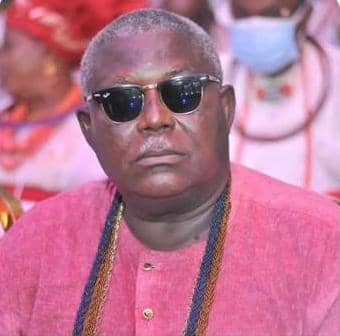
Prince Emmanuel Okotie-Eboh, son of Nigeria’s first Minister of Finance has criticised opposition parties over their reactions to the recent reduction in petrol pump prices, insisting that President Bola Ahmed Tinubu’s economic reforms and achievements should be assessed objectively rather than politicised.
Okotie-Eboh, who made his position known while speaking on the development, argued that the reduction in fuel prices should not be dismissed as a political move or attributed to pressure from opposition figures. He maintained that the development should be considered alongside the broader economic policies and reforms introduced by the Tinubu administration since assuming office on May 29, 2023.
According to him, President Tinubu came into office with the Renewed Hope Agenda, which seeks to reform Nigeria’s economy, strengthen public revenue, attract investment and improve the country’s long-term economic prospects.
He identified the removal of the petrol subsidy on the President’s first day in office and the unification of the foreign exchange market as two major policy decisions aimed at addressing longstanding structural challenges in the economy.
Okotie-Eboh explained that the removal of the petrol subsidy was intended to reduce the financial burden of subsidy payments on the government and allow more resources to flow into the Federation Account for distribution among the federal, state and local governments.
He also noted that the foreign exchange reforms were designed to reduce market distortions, discourage arbitrage and create a more transparent environment for investors, although the policies have also brought significant adjustment costs for households and businesses.
He further pointed to figures attributed to the World Bank’s October 2026 Nigeria Development Update, which reportedly highlighted improvements in economic growth, government revenue and the country’s external position. The report, titled Beyond the Federal Purse:
How Higher Revenues Reshaped State Priorities, was cited as evidence of how increased public revenues could influence spending priorities across the federation. The report’s figures and publication details should be confirmed against the original document before publication.
Among the economic indicators highlighted were an increase in economic growth to 4.2 per cent in the first half of 2026, compared with 3.9 per cent during the corresponding period in 2025. The figures supplied also indicated that inflation declined from 27.6 per cent in January 2025 to 15.2 per cent in December 2025, with further easing projected over the coming years. These indicators, if confirmed, would provide important context for assessing the effects of the administration’s economic policies on the wider economy.
On the country’s external position, Okotie-Eboh cited figures indicating that Nigeria’s current account surplus rose to $12 billion, representing 7 per cent of gross domestic product, in the first half of 2026. He also highlighted an increase in gross external reserves to $53.8 billion by the end of August 2026, compared with $45.5 billion at the end of 2025.
He argued that stronger external reserves and improved foreign exchange conditions could help strengthen economic confidence, while acknowledging that the benefits must translate into better living conditions for ordinary Nigerians.
He also drew attention to the reported increase in Federation revenues, stating that higher revenues could give state governments greater capacity to invest in infrastructure and public services.
Figures provided for the report indicated that Federation revenues increased by 69 per cent in real terms between 2023 and 2025, while state governments increased capital expenditure by 151 per cent in real terms, particularly in roads, transportation, agriculture, energy and housing. He maintained that the impact of increased revenue would ultimately depend on transparency, responsible spending and the quality of projects delivered to citizens.
Beyond the economic reforms, Okotie-Eboh highlighted other initiatives associated with the Tinubu administration, including the Nigerian Education Loan Fund (NELFUND), the review of the national minimum wage, the introduction of compressed natural gas-powered buses to support more affordable transportation, and efforts to strengthen local government financial autonomy.
He also cited the distribution of fertilisers, agricultural loans and tractors to support food production, as well as reported non-oil export revenues exceeding $6 billion in 2025. According to him, these measures demonstrate the administration’s efforts to address challenges in education, transportation, agriculture, employment and economic diversification.
He urged opposition parties to engage in constructive criticism and present alternative policies rather than politicising every economic development, including the reduction in fuel prices. Okotie-Eboh maintained that while Nigerians have every right to demand better living conditions, the government’s performance should be assessed through its policies, measurable results and their practical impact on citizens.
He stressed that the ultimate test of the Renewed Hope Agenda would be its ability to reduce economic hardship, create jobs, improve purchasing power and deliver sustainable development across the country.
The post Okotie-Eboh hits opposition over Tinubu’s fuel price reduction appeared first on Vanguard News.