

By Enitan Abdultawa
Orodata Science has flagged persistent infrastructure, water supply, staffing and accessibility challenges affecting primary healthcare centres across Nigeria, particularly facilities located in hard to reach communities.
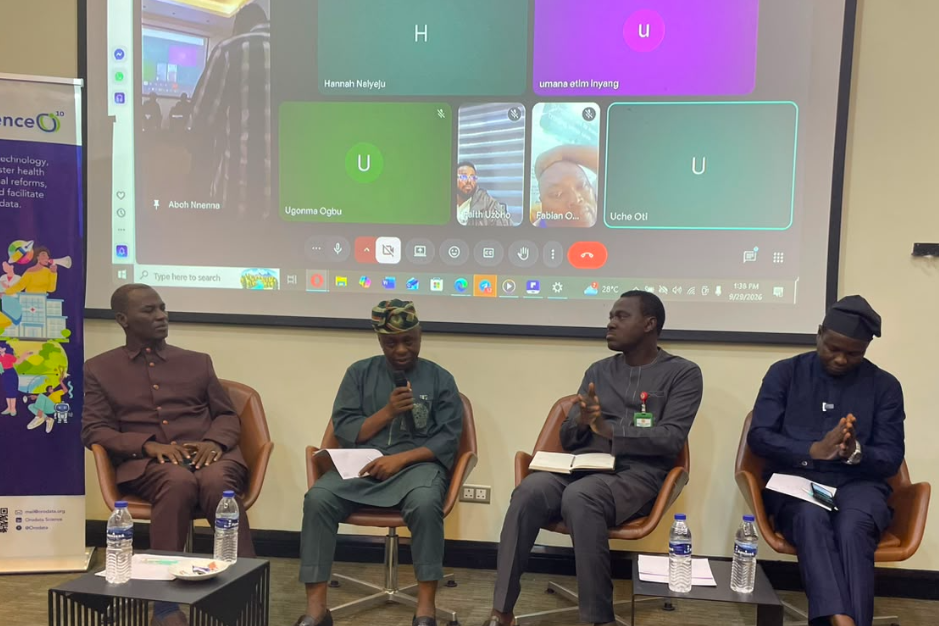
The Country Director of Orodata Science, John Eromosele, raised the concerns at a town hall meeting on primary healthcare service delivery in Lagos, organised by Orodata Science in partnership with Africa Data Hub, where the PHC Operational Capability Report 2026 was discussed.
Eromosele said infrastructure remained one of the major challenges uncovered during the organisation’s field assessments.
“There is infrastructural decay and we have been the loudest voice in Nigeria calling for revitalisation since the past three years,” he said.
Giving an example of the conditions encountered during field visits, Eromosele said some facilities lacked basic amenities expected in functional primary healthcare centres.
He recalled a PHC where the toilet facility was so poor that participants initially struggled to identify what they were looking at when its picture was displayed during the meeting.
“This is a toilet facility that even the PHC, the community health extension workers and midwives were expected to use,” he said.
Eromosele said the poor condition of some facilities could also affect the willingness of health workers to remain in the communities where they are posted.
“It also accounts for why most of the healthcare workers don’t even want to reside in the community. They don’t want to stay. They go to town, they come back. At times you don’t meet some healthcare workers at the primary healthcare centres. You meet silence,” he said.
He also raised concerns about access to some facilities, particularly in remote communities.
“There is a scenario where one of our enumerators had to go through seven rivers,” Eromosele said, questioning how medical supplies could reach communities where healthcare workers and patients face such difficult terrain.
“So imagine, how would medical supplies even get to places like that?” he asked.
Water supply was another major concern highlighted by the Orodata director, who said some PHCs depend on unsafe or unreliable sources because they lack boreholes.
“Most of them don’t have boreholes. They rely on other water sources, rainwater, stream water,” he said.
Eromosele recalled visiting a PHC in Cross River State where the surrounding community relied on stream water.
“The entire community, they don’t even sell pure water there. They rely on stream water,” he said.
He said Orodata was not seeking to attack individual states with its findings but wanted to draw attention to conditions that could remain hidden in remote communities.
“We’re not attacking any state. That’s not the goal,” Eromosele said.
“We’re talking about places we have gone to, places that we have engaged with. And why we are bringing this out, because it’s in a hard to reach area. These are not things in urban areas that you easily see.”
He also defended the credibility of the organisation’s field data, saying its researchers were subjected to verification and quality control processes.
“We have a data validation system. We have a quality control system,” he said. “No enumerator can tell us that or give us images or pictures from the moon or somewhere else.”
Eromosele urged government and other stakeholders to see the findings as an opportunity to address problems in communities rather than as an attack.
“If the government sees a story like that and instead of feeling that he’s being attacked and saying, what is the solution? What do we do?” he said.
“That’s why we are here, to ensure that these things are brought to light.”
Responding to the concerns, the Permanent Secretary of the Lagos State Primary Healthcare Board, Ibrahim Mustafa, said the state had recorded improvements in PHC infrastructure while acknowledging that challenges remained.
“Some years ago, everybody knows that the primary healthcare setting has a significant infrastructure gap,” Mustafa said.
“But since the inception of the current administration in the last seven to eight years, there has been significant improvement in the infrastructure at the primary healthcare level.”
He said Lagos renovated no fewer than 72 PHCs in 2025, adding that further work was ongoing across the state.
“Last year alone, we renovated not less than 72 PHCs in Lagos State,” he said.
“And this is open for scrutiny by the public. You can go across the five divisions of Lagos where you attend to go to the primary healthcare centre and you will see that these primary healthcare centres are now more welcoming and more infrastructurally pleasing for the patients to visit.”
On staffing, Mustafa said human resources remained a major challenge across the country, but Lagos had introduced measures to replace workers who leave the service.
“Human resource for health is a significant problem across the country,” he said.
He added that the state had empowered managers to replace departing workers without waiting for separate approval from the governor.
“If a staff leaves, let’s say a doctor leaves, we have as the managers at that level to immediately replace that staff that has already left the system,” Mustafa said.
“Without waiting for the governor’s approval. That is something very novel that is not happening in many parts of the country.”
Mustafa said Lagos also recruited at least 970 healthcare workers for its primary healthcare system last year.
“At the primary healthcare level we employed not less than 970 staff,” he said, adding that the recruitment covered doctors, nurses, pharmacists, environmental officers and community health officers.
He said the state was also establishing the Lagos State University of Medicine to increase the number of healthcare professionals available to serve the growing population.
On welfare, Mustafa said the government was continuing to improve the conditions of health workers.
“I can tell you now, as of today, the doctors in Lagos earn more than their federal counterparts,” he said.
He added that healthcare workers could also access housing and car loans, while the government continued discussions with health workers’ unions on welfare issues.
On affordability, Mustafa pointed to the ILERA EKO health insurance scheme, saying it was designed to make healthcare more accessible to residents.
“ILERA EKO, which is our social health insurance scheme in Lagos, is able to make you pay a certain amount of money, which is very, very affordable for anyone to pay,” he said.
“And you do this, once you do this, you have access to free service delivery at our PHC, the one closest to you.”
He said the state also had provisions for vulnerable residents who could not afford the insurance premium.
“Unfortunately, despite all the advertisements and the noise we are making in the media for people to subscribe to ILERA EKO, the subscription is still not as much as we would have expected,” Mustafa said.
The town hall brought together healthcare stakeholders to examine the findings of the PHC assessment and discuss measures for improving primary healthcare delivery, accountability and public reporting across Nigeria.
The post Orodata raises alarm over infrastructure, staffing gaps in Nigeria’s PHCs appeared first on Vanguard News.