

•It’s a time we celebrate our ‘god’ of fertility — Verere
•No cult killings during festival — Gabriel
By Jimitota Onoyume, Assistant News Editor
Ogba—Urhie Festival this year was very colorful. Christian songs in Urhobo language opened the gathering, followed by prayers to the Almighty God through Jesus Christ for a peaceful celebration. The foregoing reflected the bond between christianity and tradition in the kingdom.
Vanguard gathered that the festival is a time when sons and daughters of the ancient town of Otughievwen kingdom in Ughelli South Local Government Area of Delta State gather to celebrate their ancestry and offer gratitude to the God of fertility in the kingdom.
Literary icon Professor Chief Godini Gabriel Darah, the Ogberianrien of Ughievwen Kingdom, whose title means Giant of Knowledge as chairman of the festival and of the Urhobo Arts Heritage Company Limited,HC, a major promoter of Urhobo arts and culture , immediately after the opening prayer took over the task to pray over the traditional kolanuts.
In what sounded like his brief remarks even though he was praying over the kolanuts, he charged Urhobo leaders to guard the cultural heritage fiercely and teach its values to children yet unborn. He also demanded an end to gas flaring across Ughievwen, an oil and gas-producing community and the Niger-Delta region.
Darah described Ogba-Urhie, which means The Mighty Power of the Waterways, as a cultural institution through which the Ughievwen people reconnect with their origins.
After blessing the kolanuts they were sliced into smaller units and shared with guests, family representatives and neighbouring communities.
Darah in a research work earlier on the festival that was sent via Whatsapp, recounted how their ancestors journeyed on wooden rafts during the early flood season, when tides swept toward the Atlantic, navigating dangerous creeks from Ogobiri in present-day Bayelsa State, to their settlement at Otughievwen centuries ago. Mysterious marine forces, he said, were believed to have guided them to safety, a story that embodies the courage, resourcefulness and deep spirituality of the people; noting that the people had continued to celebrate their ancestry and history in the Ogba-Urhie festival.
Meanwhile, at the festival ground with the traditional drum beats to the sway of Udje dancers, music from Urhobo musicians and the Ike-li-ke dancers, the celebration became a living reminder that culture is not a museum piece but a breathing inheritance, passed from hand to hand and heart to heart across generations.
Less than a hundred meters from the dancers was the Ogba-Urhie shrine depicting the spirituality of the festival. Worshippers offered thanksgiving, some presented rams and food items. White powder and native chalk on faces and shoulders added quiet symbolism to the day. According to a native, Verere: “ We celebrate Ogba-Urhie for his blessings in the land and the people. You see the powder and lines of white on our faces and heads, are all in celebration and gratitude to the God of fertility”.
A small market that sprang up that day specifically to sell traditional spiritual items near the shrine displayed indigenous items, including beads, native chalk and raffia palms. Many who came for the event bought some and headed to the shrine for prayers and to be blessed by the Chief priest.
Traditional pageantry
Traditional pageantry by Ughievwen maidens offered another striking highlight, celebrating the beauty, dignity and place of women in the community’s cultural life.
Exhibition of ghwre-pha, hand woven mat in British museum
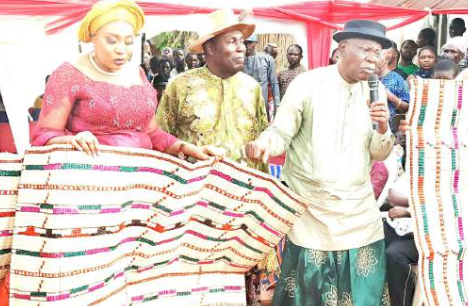
Perhaps the most revealing exhibition was ghwre-pha, a hand-woven craft traditionally used to decorate special rooms for female virgins known as Opha after their circumcision rites.
Prof. Darah led Mama Akpaunuse Kelue, who weaved the mats to the centre stage. Participants contributed money to appreciate her skill and encourage her to keep the craftsmanship alive.
Darah revealed that he had taken the hand-crafted mat to the British Museum in London for documentation, along with historical accounts of its significance, and that scholars around the world continue to express interest in its cultural value.
The celebration drew prominent figures from the Urhobo intellectual, professional and cultural enthusiasts. They included Professor Christopher Orubo, Engr. Alex Neyin, a key player in the Petroleum sector, Felix Kporhotor, Mrs Judith Omojevwe Nwachukwu, Mr Okejoto Gochua, Engr. Abraham Mrakpor, Mr Ochuko Arodovwe, Chief Odo Tadafe, Moses Ughakpotehrin, Godwin Moguan, Okejoto Gochua,Charles Utuama, Matthew Ofioguma and Engr. Gari Uwedjojevwe.
Vanguard stayed at the venue till about 8pm to see if there would be any atmosphere of chaos or cult related crises like the one witnessed in a community festival recently in the state where three youths were brutally murdered but nothing like that happened this time. The youths were just enjoying the music by an Urhobo musician while the oldies were seen sipping their beer and nodding to the beautiful traditional tunes from the live band.
“Our annual festival is always peaceful, no cult clashes. It’s a day we express gratitude to our community shrine for blessing us with rich harvest and fertility in the land; not a day to kill our young ones, “ one of the celebrants, Gabriel said.
The post Otughievwen Festival: Where waterways still speak to Ughievwen Kingdom appeared first on Vanguard News.