

By Ikechukwu Nnochiri, Abuja
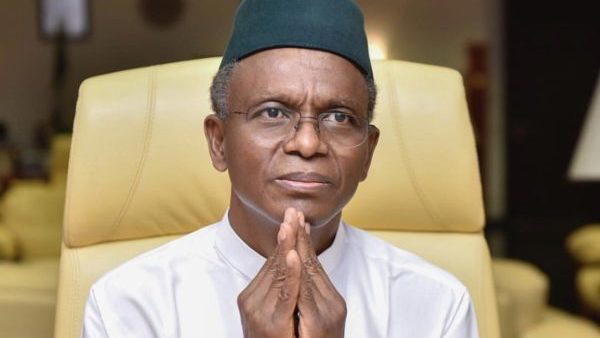
The detained former Kaduna State governor, Mallam Nasir El-Rufai, on Wednesday mounted the witness box to open his defence to the five-count amended charge that the Federal Government preferred against him through the Department of State Services (DSS).
El-Rufai, who was alleged to have unlawfully intercepted the phone communications of the National Security Adviser (NSA), Nuhu Ribadu, denied the allegation while testifying in his own defence before the Federal High Court in Abuja.
Led in evidence by his lawyer, Mr Paul Erokoro, SAN, he denied that he committed a crime capable of breaching national security.
Following permission by the trial judge, Justice Joyce Abdulmalik, a clip of the television interview that precipitated the charge against the former governor was played in open court.
The prosecution counsel, Mr Oluwole Aladedoye, did not oppose the request for the video evidence to be played before the court.
The court had on October 26 ordered the embattled former governor to open his defence to the allegation against him, even as it declined to terminate the trial.
Justice Abdulmalik dismissed as lacking in merit a no-case submission the defendant filed seeking to be discharged and acquitted of the charge against him.
El-Rufai, who was governor between 2015 and 2023 and also served as Minister of the Federal Capital Territory (FCT) under former President Olusegun Obasanjo’s administration, is facing trial over comments he made when he appeared as a guest on Arise Television on February 13.
It was alleged that, during his appearance on Arise TV’s Prime Time programme in Abuja, he admitted that he knew and was associated with an individual who had illegally intercepted the NSA’s telephone communications.
Aside from the allegation that his actions breached national security and public safety, an offence punishable under Section 12(1) of the Cybercrimes (Prohibition, Prevention, etc.) (Amendment) Act, 2024, the former governor was also charged with failing to report the crime to the relevant security agencies.
The defendant had, during the TV interview, reacted to what he described as an attempt by DSS operatives to “abduct” him at Nnamdi Azikiwe International Airport in Abuja on February 12, 2026, upon his return from Cairo.
He insisted that the security agency was being instigated by the ICPC, which he said had received a directive from the NSA, Ribadu, to detain him.
The former governor claimed the information reached him through someone who had listened in on the NSA’s telephone conversations.
Meanwhile, after the prosecution closed its case with the evidence of two witnesses who testified before the court, the defendant applied to be discharged and acquitted.
El-Rufai insisted that the prosecution had failed to establish a prima facie case to warrant the court compelling him to enter a defence to the charge, which he described as incompetent.
In her ruling on the matter, Justice Abdulmalik said the court was satisfied that the evidence led by the prosecution was strong enough to warrant explanations from the defendant.
Even though the court had yet to ascertain the defendant’s culpability or otherwise, it dismissed the no-case submission and ordered him to open his defence to the charge.
It will be recalled that shortly after being accused of admitting that he used “technical equipment” to illegally intercept the NSA’s calls, El-Rufai filed a motion to stop his trial.
He gave 17 reasons why the charge, marked FHC/ABJ/CR/99/2026, should be quashed by the court.
He argued that the charge was incompetent and legally defective, insisting that the DSS had no legal basis to elevate a “casual remark” he made during a television interview into “a confession” that he had indeed tapped the NSA’s telephone line, as alleged.
He argued that the statement he made on Arise TV did not constitute a confessional statement in law, saying that for a statement to be admissible as a confession, it must be made under caution and voluntarily and in circumstances that satisfy the judges’ rules.
El-Rufai maintained that the statements he made during his television interview were made without caution or warning, in a voluntary public discussion, and without the protections afforded to suspects in custody.
“A casual remark on a television programme cannot be elevated to a judicial confession,” he further argued.
However, the court declined to quash the charge and ordered an accelerated hearing of the case.
El-Rufai, who has been in detention since February, is standing trial before courts in both Abuja and Kaduna State.
Justice Abdulmalik had on July 23 dismissed as lacking in merit an application that the former governor filed for the variation of his bail conditions, which he described as very stringent and difficult to fulfil.
According to El-Rufai’s lawyer, the bail conditions sought to be varied included the requirement that the defendant produce level 17 civil servants with properties in Maitama or Asokoro, as well as verification and attestation letters from the Kaduna State traditional council.
The prosecution opposed the variation request, insisting that qualified public officers who could meet the conditions existed and could easily be secured by the defendant.
It persuaded the court to reject the application.
The post Phone-tapping charge: El-Rufai denies FG’s allegations appeared first on Vanguard News.