

By Efe Onodjae, LAGOS
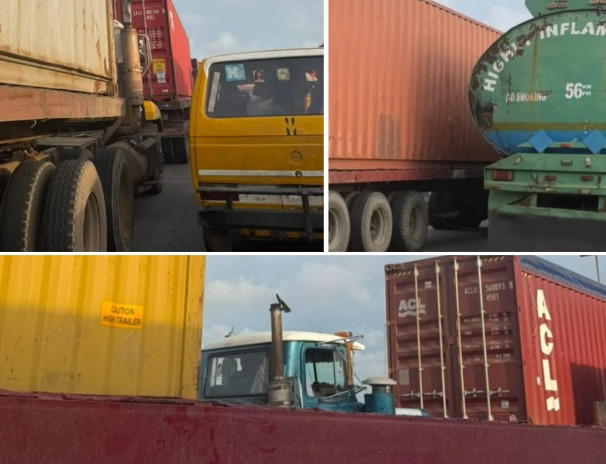
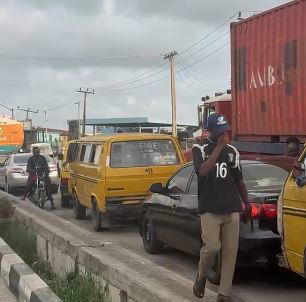
Commuters, residents and business owners were stranded for hours on Thursday as hundreds of articulated trucks took over the Mile 2-Wharf-Apapa corridor, bringing traffic to a standstill and disrupting commercial activities along the busy route.
Meanwhile, Customs agents blamed the Nigerian Ports Authority, NPA, for the persistent traffic gridlock along the Tin Can Port access road.
Their leader, Lucky Amiwero, told Vanguard that the affected roads are designated port access routes under the management of the NPA, stressing that the authority should be held accountable for the congestion.
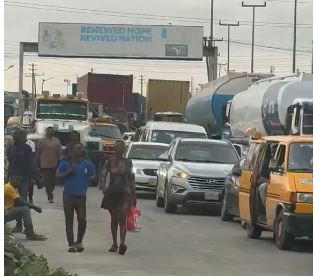
Meanwhile, it has emerged that inadequate parking bays by tank farms operating at the ports also contribute immensely to the perennial gridlock on the corridor.
The gridlock, which extended from the Berger/Kirikiri axis towards Apapa, forced many motorists to abandon their journeys, while others turned back after spending several hours in traffic.
Residents and road users blamed the worsening congestion on the growing number of container terminals operating along the Berger/Kirikiri corridor, alleging that trucks conveying empty containers to the facilities have effectively taken over the road.
They lamented that despite the persistent traffic chaos, relevant government agencies, including the Nigerian Ports Authority (NPA), the Nigeria Customs Service, the Police, as well as traffic management agencies, have yet to implement lasting measures to address the situation.
According to them, the terminals have attracted a steady influx of articulated vehicles, making smooth movement along the corridor increasingly difficult.
Container terminals to blame – Motorists
A motorist, who spoke on condition of anonymity, said the traffic challenge became more pronounced after the establishment of the container terminals opposite the Catholic Church along the Berger/Kirikiri road.
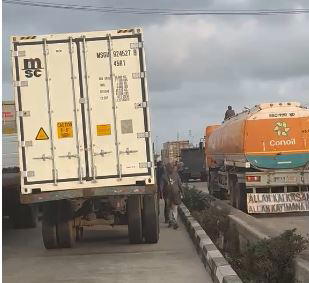
“There is nothing else causing this traffic other than the terminals opposite the Catholic Church. Before they came here, this road was free. Today, you have three different terminals receiving containers and all the trucks are heading there,” he said.
The road user explained that long queues of trucks waiting to access the terminals routinely occupy major sections of the expressway, creating bottlenecks that stretch for several kilometres.
He added that although officials of the Nigerian Navy, Lagos State Traffic Management Authority (LASTMA), Federal Road Safety Corps (FRSC) and other security agencies are regularly deployed to manage traffic, the situation has remained largely unchanged because of the volume of trucks accessing the terminals.
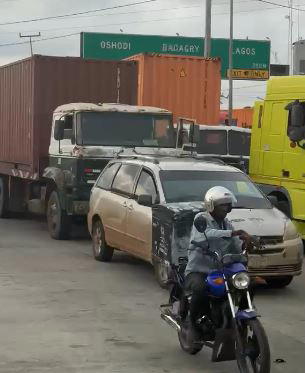
Many of the affected residents expressed disappointment that the Nigeria Customs Service, the Nigerian Ports Authority (NPA) and the Police, whose operations are closely linked to activities within the port corridor, have yet to take decisive action to tackle the recurring congestion, leaving motorists and businesses to bear the brunt of the crisis.
Custom agents blame NPA for TinCan traffic
Reacting to the situation, National Council of Managing Directors of Licensed Customs Agents (NCMDLCA) has blamed the Nigerian Ports Authority (NPA) for the persistent traffic gridlock along the Tin Can Port access road.
The President of the Council, Lucky Amiwero, in an interview with Vanguard, said the affected roads are designated port access routes under the management of the NPA, stressing that the authority should be held accountable for the congestion.
According to him, the NPA is responsible for coordinating activities along the port corridor and ensuring that access roads remain free of obstruction. He maintained that the current situation points to a failure in the management of the port access routes, insisting that the authority should take immediate steps to restore order.
Meanwhile, the Association of Maritime Truck Owners (AMATO), in a telephone interview with Vanguard, raised concerns over the worsening traffic congestion around the Tin Can Port corridor, saying the situation has disrupted business activities and forced some businesses to shut down.
The General Secretary of the association, Sani Mohammed, who was also stuck in the traffic at the time of the interview, said tankers heading to the port have abandoned the single-lane arrangement and now occupy multiple lanes, preventing other trucks and road users from accessing the port corridor.
He said the gridlock has disrupted the supply chain and port operations, while commuters are finding it difficult to move in and out of Apapa.
According to him, transport fares have also increased significantly due to the congestion, as commercial buses now spend more time navigating the traffic. Mohammed appealed to the Federal Government and the Lagos State Government to urgently intervene and restore sanity to the port access roads.
‘Petroleum tanker not part of electronic call-up system’
When contacted, the General Manager, Corporate and Strategic Communications, of Traffic Transit Point (TTP), Nancy Nnamdi, said petroleum tankers are not part of the current electronic call-up system.
She explained that although TTP has advocated for the inclusion of tankers in the electronic call-up platform, implementation depends on government approval and enforcement.
She noted that while discussions have been held on bringing tankers into the system, TTP cannot regulate their movement without the necessary government backing. She added that the absence of enforcement limits the company’s ability to manage tanker traffic, stressing that the current gridlock cannot be attributed to the electronic call-up system.
Meanwhile, the management of the Nigerian Ports Authority had earlier stated that it is working with stakeholders to ensure the situation is resolved.
The post Photos: Trucks take over Mile 2-Wharf-Apapa Corridor; Customs, NPA, Police look on appeared first on Vanguard News.

 Daily Post
 Premium TImes
 Vanguard Nigeria
 Channels TV
 The Standard Kenyan
 Modern Ghana
 Punch Nigeria
 Watchdog Uganda
 This Day