

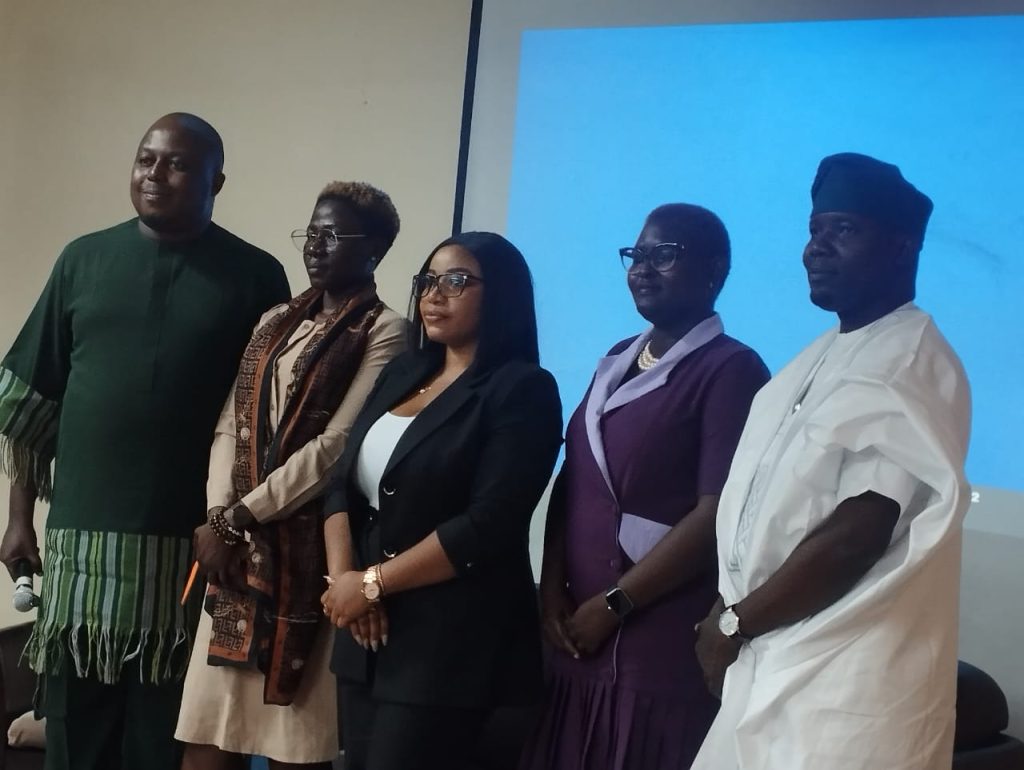
By Esther Onyegbula
Professionals and business leaders have been urged to move beyond mere activities and translate their ideas and efforts into measurable results through accountability, continuous learning and effective systems.
The convener of the High Impact Professionals Seminar, HIPS, and founder of the TALK Office, Njuara Njama, gave the charge at the fourth edition of the seminar, stressing the need for professionals to become more intentional, adaptable and results-oriented in the workplace.
Njama, a legal practitioner, human capital and organisational development strategist, said the 2026 edition of the seminar, themed “Impact That Scales,” was designed to address the growing gap in strategic conversations around the workplace and help professionals navigate challenges confronting employees and employers.
She said: “The reality is that less and lesser strategic conversation is happening within the workspace. And I say this because it looks like entrepreneurship is the main thing. Wherever you go people are doing business this, business that, business this. And nobody’s focusing on the workplace. People who are actually moving those businesses forward.”
According to her, the seminar was conceived to provide a platform where employers and employees could discuss workplace challenges without resorting to the blame game.
“There’s always this contradiction between who is to be blamed for the problems that we have at work. Is it the employer? Is it the employee? Or is it the country at large?
“And so I thought, instead of us continuing to play this blame game, why don’t we come to a forum where we can understand each other? And that’s how the conversation started.
“From the first year to this year, our goal is simple. There are challenges that we have in the workplace. Why don’t we pick a topic and discuss those challenges within that topic by giving us perspective, clarity, direction, connection, and hopefully a system that we can move from one place to another.”
Njama said the impact of the seminar could be measured by the testimonies of participants who had translated lessons from previous editions into concrete actions.
She recalled the testimony of a participant who attended the first edition in Lagos and said some of the activities at the event encouraged her to take steps towards achieving goals she had documented.
“If you were in the session when I just finished speaking on execution intelligence, there was somebody who gave a testimonial that she was at our first edition in Lagos. And some of the activities that we did encouraged her, motivated her to begin to take steps. And the things she wrote down are the things that she has already succeeded at,” she said.
Explaining how professionals could turn ideas into results, Njama said many people were engaged in numerous activities without producing tangible evidence of progress.
“The truth is that a lot of people are doing a lot of activity, but those activities are not producing any kind of evidence,” she said.
“So the goal is for us to move from activity to motion and from motion to result. And how do we do it? We’re doing this by creating a system that empowers us to take action.”
She identified accountability as one of the critical tools required to transform ideas into action, warning that individuals who failed to establish systems to hold themselves accountable could struggle to turn their ambitions into reality.
“You cannot just wake up and say you want to change the world and you’re not holding yourself accountable. Nobody’s holding you accountable. You don’t have any tools or systems that support your accountability. You don’t write things down. You don’t have the right conversation.
“You just want to change the world in your mind. I’m sorry to announce to you, it’s just going to end in your mind.”
Njama also urged professionals to overcome the fear of imperfection and begin from where they were, using the resources available to them.
“As somebody wise once said that, the graveyard is the richest place because it dies with people who never took action. So the next thing is action. And for many of us, action is a problem because we think that we have to be perfect, but that’s not what it is.
“Action is starting from where you are, starting with what you have. Just start.”
She said the growth of HIPS itself demonstrated the value of taking action despite uncertainty, noting that the organisers initially planned to hold the event only in Abuja.
“When I started HIPS, I never thought that it’s going to be like this. We just started, or we just wanted to have one Hibbs in Abuja. And four years later, we’re having Abuja and Lagos consecutively every year. And I can tell you that I am still learning as I grow.”
On overcoming fear, she said: “There’s always going to be fear. As long as you’re building something that is bigger than you, the fear is there.”
She, however, encouraged professionals to see results not only as conventional success but also as lessons gained from actions taken.
“Results might not always be success in the traditional way that we define success. But results means you have now learned something that maybe works or maybe does not work.”
On the need for professionals to combine expertise with versatility, Njama urged workers to develop both vertical and horizontal competencies.
She said the traditional perception that being a “Jack of all trades” was necessarily negative no longer reflected the demands of many modern workplaces.
“Before now, they used to make us feel like Jack of all trade, master of none was the problem. But if you see the kind of people that organizations are looking for, they are looking for people who are probably a seven, seven, seven, seven in different places.
“They’re not looking for somebody who is a 10 in one thing and just one thing alone. But in this other place, you can be a seven, seven, seven. What that means is that you are vertical and horizontal at the same time.”
She added that professionals needed technical competence as well as social and emotional intelligence because workplace challenges were not limited to technical issues.
“There are people’s challenges. So if you do not have social skill or emotional intelligence, you will lose out on the people side. So that’s my advocacy.
“Be balanced. Don’t focus on just one thing and you’re doing it though and every other thing is no. Have multiple things that are complementary that make you function well in the workplace.”
Njama also spoke about the challenges she encountered while building the seminar, saying one of the biggest was translating her personal vision to other people.
“One of the interesting things, challenges that I faced was how to get people to see a vision that was just my vision. It’s easy for me to tell myself that, oh, this is going to work and it’s going to work well.
“But how do I translate my vision exactly as I’m seeing it to the people that I’m interacting with? So that was a real issue for me.”
She said continuous learning and understanding the behaviour of people involved in the initiative helped her address the challenge.
“I started learning the behavior of employees, employers, people, speakers, panelists, and all of that. And with that, I started incorporating it into the development of what we’re doing. We’re not there yet, but I assure you, we’re going to soon know where we start.”
Speaking on “Systems Thinking,” the guest speaker, Dr Oludare Akinlaja, called for greater reliance on data, systems and processes in business and professional practice.
Akinlaja said businesses and professionals should move away from approaches driven largely by sensationalism and adopt more structured and scientific methods.
“I was trying to bring people back to saying that, let’s be big on science, let’s be big on data, let’s be big on system, let’s be big on processes.
“Let’s not just be sensational, and design the process of anything goes. Whatever it is, whatever we be, we be, right? We can’t have that kind of thinking. We have to be more process-oriented, more data-driven, and a bit more scientific.”
He said stronger systems and data-driven approaches could improve the ability of small businesses to survive, grow, employ workers and contribute to economic activity.
“Small businesses are literally the backbone of any economy, and if we are more data-driven, more intentional, more systems-thinking, these small businesses can employ people, right? It can make people more, we earn daily.”
Also speaking, development consultant at Lustrefeel Economic Empowerment Foundation, David Lawal, urged young professionals to begin preparing for leadership and the changing demands of the future workplace.
Lawal, who spoke on building future professionals and leaders, said leadership should not be regarded as something reserved for people already occupying prominent positions.
“There are a lot of young leaders today, young professionals today, who don’t see leadership as a thing to aspire to be, right? They think leadership is far-fetched.
“Leadership is something that is far away from them. You know, from the spaces that we all occupy, everyone can be a leader, right? But there’s a level of information, there’s a level of skill that’s required, there’s a level of preparedness, there’s a level of professionalism that is required for you to emerge as a leader.”
He urged young people to anticipate changes in the labour market and acquire skills that would keep them relevant.
“What’s the future of work like? How can you stay relevant as a leader in the future of work that we’re looking at? Shifts are happening, right? We have a lot of jobs now that we didn’t have a couple of years back, many years back.
“We didn’t have robotic engineers like 10 years ago. We didn’t have drone pilots like 10 years ago. We didn’t have social media managers like 10 years ago, right, but most of those jobs are coming on now.”
Lawal said young professionals should prepare ahead of emerging opportunities rather than wait until the opportunities became available.
“The opportunities of those times will be available to those that are prepared now. So it’s best that young people begin to prepare now, rather than spending time on social media. Even social media can be used productively.”
He said social media could also serve as a platform for leadership, creativity and positive social impact.
Similarly, the Lead Consultant and Managing Director, Cordless Consulting Limited, Tosin Gbadebo, urged professionals to maintain professionalism and separate emotions from their responsibilities at work.
Gbadebo, who spoke on “The Execution Gap: Taking Life from Effort to Professionalism,” said the focus should be on developing structures that would make individuals more effective in their daily activities, businesses and professional engagements.
“Professionalism is the hallmark of success,” he said, adding that his participation in the seminar over three editions had exposed him to useful insights and experiences.
“I have been on the three occasions and I have been at the ends of planning and also execution. And I’ve come to realize that it’s a very, very important event, that people who are looking to scale their impacts professionally should attend because words will come out, insights will be shared, experiences would also be shared that would pave the way for you to become that person you want to be from the person who you are right now.”
Gbadebo, who identified himself as an HR expert and manager, advised workers to remain professional irrespective of workplace pressures.
“One of the things I would always say is stay professional, stay professional, just stay professional. Always know how to devise sentiments and emotions from work. Do your work as you’re supposed to do it and you will get the reward as you’re supposed to get it.”
On workplace politics, he said its prevalence could be influenced by leadership structures and organisational culture.
“Workplace politics comes with leadership. How you structure your organization would depict how the politics would either exist or be minimized or subsidized. It’s everywhere, everywhere, everywhere.
“But again, it’s back to human resources because these people who play politics are human beings, right? So it’s back to human resources, knowing the problem, solving the problem.”
He advocated healthy workplace cultures supported by sound policies, saying, “Having a healthy culture starts with healthy policies where you can build healthy policies in workplaces.”
The post Scaling impact requires action, systems, accountability — Njama appeared first on Vanguard News.