

….Ningi, Yahaya Abdullahi fault drafting, omnibus nature, non-circulation
By Henry Umoru
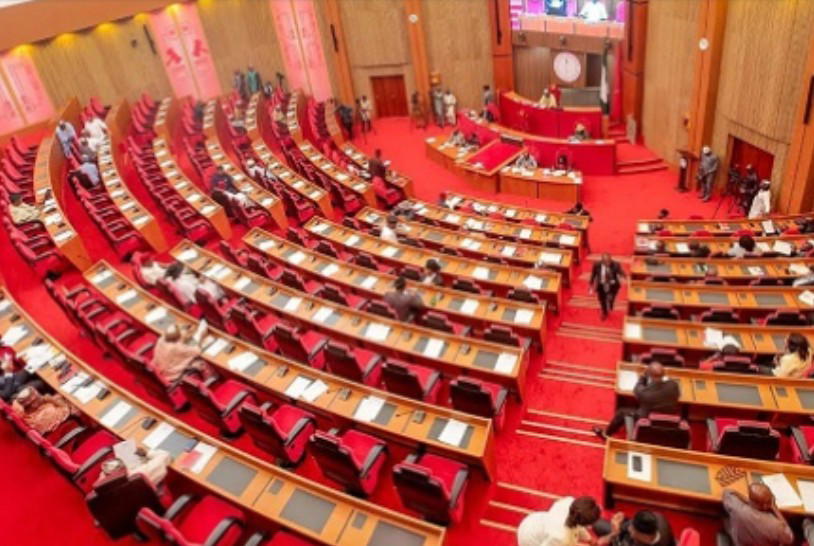
ABUJA — The Senate on Tuesday stepped down the proposed Agricultural Revolution Bill, 2026, following a heated debate over its drafting, scope and failure to circulate printed copies to senators.
The bill, sponsored by the Deputy President of the Senate, Senator Jibrin Barau (APC, Kano North), failed to scale second reading after several lawmakers raised concerns about its content and compliance with legislative procedures.
Titled “A Bill for an Act to Provide a Comprehensive Legal Framework for Transformation and Modernisation of Agriculture in Nigeria, Promote Food Security, Agricultural Productivity, Mechanisation, Irrigation, Agricultural Financing, Agro-industrialisation, Rural Development and Climate-resilient Farming and for Related Matters,” the proposed legislation seeks to establish a framework for the transformation and sustainable development of the agricultural sector.
Presenting its general principles on behalf of Barau, the Senate Whip, Senator Mohammed Tahir Monguno (APC, Borno North), said the legislation was necessary to address Nigeria’s food security challenges.
Monguno said agriculture provided livelihoods for millions of Nigerians, accounting for about 70 per cent of employment and 40 per cent of the country’s Gross Domestic Product.
He identified low productivity, inadequate mechanisation, limited irrigation infrastructure, high post-harvest losses, poor access to affordable financing, insecurity in farming communities and weak agricultural value chains as major challenges confronting the sector.
According to him, the challenges had contributed to food insecurity, inflation and rising poverty, making it necessary to move beyond fragmented interventions towards a coordinated legal framework.
He said the bill sought to reposition Nigerian agriculture from subsistence production to modern, technology-driven and commercially viable farming through mechanisation, improved seeds, agricultural research, extension services and irrigation development.
It also proposed measures to strengthen the agricultural value chain through storage facilities, cold-chain infrastructure, agro-processing and improved market access.
Seconding the bill, Senator Adamu Aliero (APC, Kebbi Central) said agriculture remained central to Nigeria’s economic diversification efforts and should be developed as a commercial venture rather than largely subsistence activity.
He called for massive investment in mechanisation, research and development to improve agricultural productivity and increase farmers’ yields per hectare.
Trouble, however, started when Senator Abdul Ningi (Bauchi Central) raised concerns about the bill’s drafting, although he described its objectives as timely and commendable.
Ningi argued that the document presented to the Senate appeared more like a motion than a properly developed legislative proposal.
He said Nigerian farmers recorded average yields of between two and three tonnes per hectare, compared with eight to 10 tonnes in other countries, stressing that the gap required substantial investment in mechanisation and agricultural research.
While commending the Federal Government’s agreement to import agricultural machinery from Brazil, he said the proposed legislation lacked sufficient details on how its objectives would be achieved.
He questioned the need for a new legal framework when existing agencies were already responsible for areas such as irrigation and agricultural mechanisation.
“The spirit of this bill is excellent; it is fantastic, and it is also equally timeous. But when you bring a bill that has subsisting agencies in place, existing to take care of irrigation and mechanisation, what you ought to do is to first bring the bill; let’s see the bill.
“This looks like a motion. This bill did not say it is creating an agency, this bill did not say it is amending existing agencies that you and everybody knows and are actually meant to take care of certain things.
“This is a brilliant idea, but a lot of work has not been done to capture what the Deputy Senate President intends to achieve,” Ningi said.
He urged the Senate to step down the bill to allow its sponsor to properly develop its provisions before bringing it back for consideration.
Also opposing the proposed legislation, former Senate Leader, Senator Yahaya Abdullahi (APC, Kebbi North), warned against passing what he described as an overly broad law covering the entire agricultural sector.
Abdullahi, who said he had taught agricultural science at a university for more than 25 years before joining the Senate, argued that agriculture was too broad to be effectively regulated under a single omnibus legislation.
“Let me be frank. I have been an agricultural teacher in an Agricultural University for more than 25 years before I came to the Senate. Agriculture is too wide and omnibus in human endeavour for it to be covered effectively and efficiently under one single bill or a law,” he said.
He argued that issues such as subsidies, mechanisation and irrigation were distinct areas requiring specific legislative attention.
He advised lawmakers to identify the particular challenges requiring legislative intervention rather than attempting to address the entire agricultural sector through one law.
“Let’s look into the content of our agriculture and identify those areas of constraint where legislation is required and address those particular areas, but to make an omnibus law covering the entire field of agriculture, with due respect, we may be making a fool of ourselves,” he added.
In defence of the bill, Monguno explained that the Senate had agreed that proposed legislation should be gazetted and uploaded on its digital platform, while printed copies would be distributed ahead of clause-by-clause consideration.
He, however, conceded that if the bill had not been gazetted, its sponsor should be encouraged to withdraw it until the required procedures were completed.
Senate President Godswill Akpabio subsequently invited Barau to consider stepping down the bill to address the concerns raised.
The Senate Leader, Senator Opeyemi Bamidele (APC, Ekiti Central), also appealed for the bill to be allowed to proceed to second reading, arguing that concerns about its detailed provisions could be addressed during subsequent legislative scrutiny with input from experts.
However, Ningi cited Order 77(3) and (4) of the Senate Standing Orders, which provides for the distribution of printed copies of bills to every senator as soon as possible.
He insisted that the issue was procedural and not personal.
Following the objections, Barau agreed to withdraw the bill temporarily, promising to ensure that printed copies were made available to senators before reintroducing it.
“Since that’s what you want, I will get it done. Forget about the fact that it has been placed on the platform. As we agreed, we are going to give you and others who have not gotten it, in compliance with the rules.
“I am the Deputy Senate President, I will always want to please anyone to the best of my ability. I don’t think we should belabour ourselves talking about this. I will find time, give it to him, redistribute it and then represent the bill,” he said.
Akpabio subsequently acknowledged the withdrawal, bringing the consideration of the proposed legislation to an end for the day.
The post Senate steps down Barau’s Agricultural Revolution Bill appeared first on Vanguard News.