

…Orders probe of prolonged aircraft holding during VIP movements
By Henry Umoru
ABUJA — The Senate has directed its Committee on Aviation to convene an urgent stakeholders’ meeting with relevant aviation authorities over prolonged aircraft holding in the air during Very Important Persons (VIPs) movements and other security-related operations at Nigerian airports.
The Senate mandated the committee, chaired by Senator Abdulfatai Buhari (APC, Oyo North), to engage the Nigerian Civil Aviation Authority (NCAA), Nigerian Airspace Management Agency (NAMA), Federal Airports Authority of Nigeria (FAAN) and Nigerian Safety Investigation Bureau (NSIB) to address the disruptions and recommend measures to prevent their recurrence.
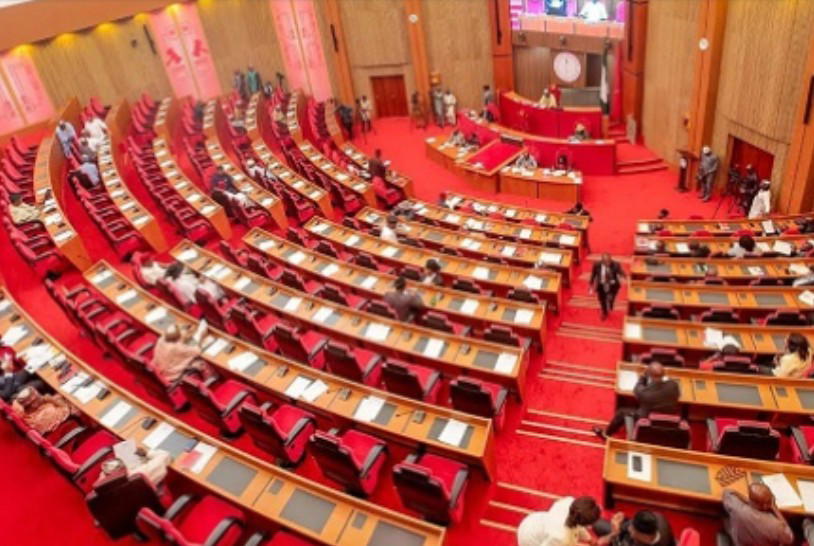
The directive followed the adoption of an urgent motion sponsored by Senator Isah Jibrin (APC, Kogi East) during plenary on Tuesday, raising concerns over the safety implications of keeping commercial aircraft airborne for extended periods while awaiting clearance to land.
The Senate amended the motion to include the NSIB among the agencies to be engaged and directed the committee to report back within two weeks.
Jibrin, who moved the motion under Orders 41 and 51 of the Senate Standing Orders, drew attention to reported instances in which commercial aircraft scheduled to land at Nigerian airports were forced to remain in holding patterns for over an hour because landing operations had been temporarily suspended to accommodate VIP movements.
He also noted that some international flights had been diverted to alternative airports within the country when access to their intended destinations was temporarily restricted.
While acknowledging the legitimate security considerations surrounding VIP movements, the senator warned that such operations should not compromise aviation safety or unnecessarily disrupt commercial flight schedules.
He expressed concern that prolonged airborne holding could increase fuel consumption, deplete operational reserves and expose aircraft to additional risks, including adverse weather conditions, air traffic congestion, diversion challenges and crew duty-time limitations.
According to him, commercial aviation depends on coordinated schedules covering departure and arrival slots, fuel planning, crew duty hours, passenger connections, airport operations and air traffic management.
He argued that where airport restrictions arising from VIP movements or other security operations were foreseeable, relevant authorities should coordinate ground delays, revised departure slots and flight sequencing rather than allow aircraft to take off and subsequently remain airborne awaiting clearance.
The senator further maintained that information about anticipated airport restrictions should guide decisions on departure clearance and the management of arriving aircraft.
The Senate expressed concern that prolonged holding could create fuel-related emergencies, particularly where several aircraft were simultaneously awaiting clearance to land.
It also urged aviation authorities to ensure that aircraft affected by temporary airport closures were diverted to alternative airports where necessary instead of being kept airborne for extended periods.
The upper chamber further sought clarification on the categories of VIPs whose movements warranted temporary airport closures and the procedures guiding such restrictions.
It stressed that security arrangements for VIP movements must be managed in a manner that protects passengers and crew without unnecessarily disrupting commercial aviation operations.
Contributing to the debate, Senator Diket Plang said prolonged aircraft holding could create serious operational challenges for airlines and compromise passenger safety.
He called for improved coordination among aviation agencies to ensure that VIP movements did not unnecessarily interfere with commercial flight operations.
Similarly, Senator Abdul Ningi (Bauchi Central) recounted an experience involving a flight from Kano that was expected to last about 40 minutes but reportedly took approximately two and a half hours.
He said such delays caused inconvenience to passengers and could expose aircraft to avoidable operational risks.
In his remarks, Senate President Godswill Akpabio expressed concern over what he described as poor coordination among relevant authorities and called for a lasting solution to the problem.
The Senate consequently mandated its Committee on Aviation to engage the relevant agencies, examine the circumstances surrounding the disruptions and recommend measures to ensure that security operations do not expose commercial flights to avoidable safety risks.
The post Senate summons aviation agencies over flight delays, safety risks appeared first on Vanguard News.