

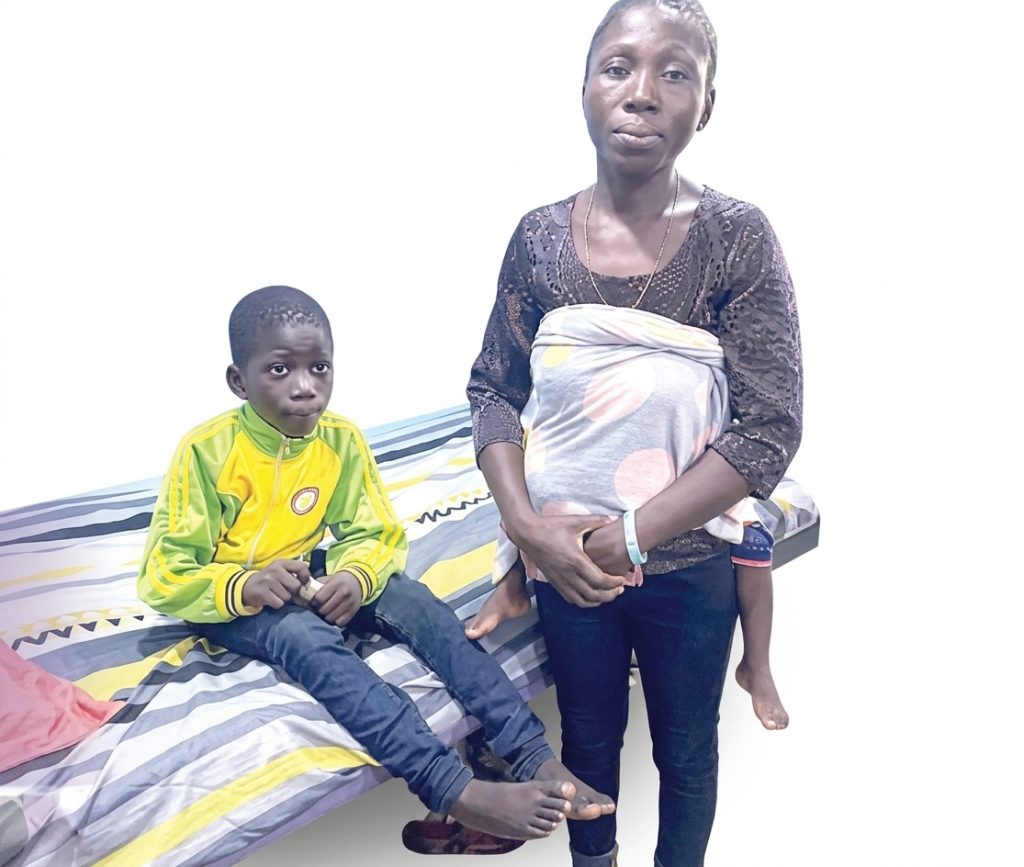
After years of hospital visits and an unaffordable ₦250,000 surgery bill, Emmanuel Godwin finally receives treatment through a partnership between Fajip Hospital and Helpster Charity. The initiative supports indigent children, young people and pregnant women, but its organisers say sustained funding and government backing are crucial to expanding access to care.
By Chioma Obinna
At just over one year old, Emmanuel Godwin was too young to explain what was wrong. But his mother, Mrs Ogunbola Oluwatosin, knew something was amiss and sought medical help.
Emmanuel had hypospadias, a congenital condition in which the opening of the urethra is located somewhere other than the tip of the penis. What began as a mother’s search for treatment became seven years of waiting and frustration.
Repeated appointments at a public hospital yielded no treatment, while private care proved unaffordable. A teacher and mother of five, Oluwatosin struggled to meet her son’s medical needs.
By the time Emmanuel turned eight, he was still awaiting surgery. A private hospital had quoted ₦250,000 for the procedure.
“I didn’t have the capacity,” she recalled.
Help eventually came through a partnership between Fajip Hospital and Helpster Charity, which supports the medical bills of indigent patients. Emmanuel underwent surgery without his mother paying for the treatment or follow-up check-up.
“I am here for my son’s surgery. I am very grateful that they helped me. They supported me with the treatment and the surgery,” she said.
“I am so grateful, and may God bless them.”
“We didn’t pay for anything. It is free,” she added.
Emmanuel spent two days in hospital. For his family, the intervention ended years of uncertainty. His experience raises a wider question: how many children remain untreated because their parents cannot afford private healthcare or struggle to obtain timely care in public hospitals?
Fajip, Helpster bridge the healthcare gap
Dr Benjamin Olowojebutu, Medical Director of Fajip Hospital, said the partnership was already making a difference, with about 10 surgeries performed within its first two weeks.
“We just onboarded about two weeks ago, and in those two weeks, we have done about 10 surgeries already. We are doing more because we are very proactive. It is what we love to do,” he said.
He urged the public to refer indigent children and young people needing medical attention, particularly those in rural and underserved communities.
The programme covers patients aged zero to 21 with conditions including hernias, lipomas, breast lumps, limb deformities, infections, malnutrition and other medical disorders.
“If you know anybody between zero and 21 years who is very poor and indigent, living in rural communities, and has hernias, lipomas, breast lumps, bad legs, infections, malnutrition or any kind of disorder, bring them to us. We will support and help them,” he said.
Olowojebutu said the team had also followed up on patients identified during earlier outreach exercises in Mile 12 and Makoko. Three patients were on admission during the visit, while about four others had previously received treatment.
The initiative also supports pregnant women with serious complications requiring admission or surgery, including breech presentation, hypertension and diabetes in pregnancy.
However, Olowojebutu said expansion would require additional funding and stronger partnerships.
“We are trying to reach more donors and get more partnership with the government because, for sustainability, we can’t do it on our own,” he said.
‘No child should die for lack of care’
Helpster Charity founder Nikita Kuzmin thanked local doctors and volunteers for helping identify vulnerable families and deliver treatment.
“Without local people, without local presence, nothing of this would happen,” he said.
Dr Matilda Carey, the charity’s manager, said Helpster focuses on children and young people from birth to 21 years, as well as pregnant women with qualifying serious medical conditions.
“We believe that no child should die because they can’t access healthcare, and that’s why we exist,” she said.
The charity works through partner hospitals, identifying families through community outreach while healthcare facilities provide treatment.
Carey said Helpster had reached more than 5,000 families and was targeting 10,000 children in Nigeria during the year. It also operates in Kenya and Bangladesh, with a global ambition of saving one million lives.
Reaching remote communities remains difficult because poor roads and waterways complicate outreach.
“Sometimes we have to take boats across, and then we have to ensure that the whole team is safe,” she said.
Funding remains another challenge, prompting calls for greater government involvement.
“We still need the partnership of government to ensure that the project and the programmes we do in every country become sustainable and are integrated into the healthcare system,” Carey said.
Beyond charity: Making treatment accessible
Emmanuel’s experience illustrates the gap between identifying a medical condition and obtaining treatment. His mother sought help when he was barely a toddler, yet years passed before surgery became possible.
Her account does not establish why the public hospital repeatedly scheduled appointments without performing the procedure. However, the delay and the cost of private care left her unable to secure timely treatment.
For low-income families, surgery, medicines, investigations and transport can turn treatable conditions into prolonged financial burdens.
The Fajip Hospital-Helpster Charity partnership offers a lifeline, but its organisers acknowledge that sustained funding and government support are essential to expanding its reach.
Charity can transform individual lives, but it cannot replace a healthcare system in which children receive necessary treatment without depending on whether a charitable intervention becomes available.
For Oluwatosin, her son’s surgery brought relief after years of uncertainty. For Emmanuel, it meant finally receiving treatment for a condition identified early in childhood.
His story leaves a pressing question: how many more children must wait before affordable, timely healthcare becomes a reality rather than a stroke of luck?
The post Seven Years of Waiting: Charity gives eight-year-old boy new lease of life appeared first on Vanguard News.