

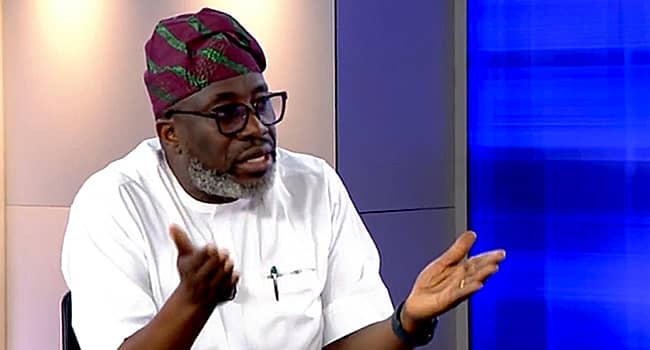
By James Ogunnaike, Abeokuta
The Convener of the Alternative Movement, Otunba Segun Showunmi has reaffirmed his commitment to Nigeria’s unity, democratic development and the ideals for which the late Chief Moshood Kashimawo Olawale (MKO) Abiola sacrificed his life, insisting that the struggle to actualise the June 12, 1993 presidential election mandate remains a defining moment in his political journey.
Showunmi, in a statement titled “My Scar from MKO Abiola, My Sacrifice for Democracy, and My Unwavering Pan-Nigerian Conviction,” said the circumstances surrounding Abiola’s death and the annulment of the historic election had left an indelible mark on his life and political convictions.
He also cautioned political actors against actions capable of undermining national stability, particularly the premature or unauthorised announcement of election results in ways that could trigger political tension and plunge the country into chaos.
“The scar in my heart from the loss of Chief Moshood Kashimawo Olawale Abiola has not fully healed,” Showunmi said, adding that he would neither trivialise Abiola’s sacrifice nor pretend to be unfamiliar with the painful experiences that shaped Nigeria’s democratic struggle.
He stressed that his remarks on the country’s political history had been misunderstood by some people, insisting that his intention was to caution against political conduct that could endanger peace, violate the law or destabilise the nation.
Showunmi said his reference to the political events of 1992 was intended to illustrate the consequences of abandoning caution, restraint and respect for the law in the pursuit of political power.
“I invoked the events of 1992 to illustrate how political situations can spiral out of control when caution, restraint and respect for the law are abandoned,” he said.
He maintained that his intervention was intended as a warning about the potential consequences of political decisions, not an endorsement of reckless conduct.
“My intervention was a warning about consequences, not an invitation to recklessness, and I will not permit reactionary forces to turn my counsel into something it was never intended to be,” he stated.
According to him, political advice should be offered in the national interest, while individuals must ultimately decide whether to heed such counsel.
He urged political contestants to consider the wider implications of their actions, warning that decisions taken without regard for the law and national stability could have far-reaching consequences for the country.
Reaffirming his commitment to national unity, Showunmi declared that his political convictions were not driven by ethnic considerations and rejected any suggestion that he subscribed to the superiority of one ethnic group over another.
“I must also state, unequivocally, that I am a Pan-Nigerian through and through. I have no interest in promoting the idea that one ethnic group is superior to another,” he said.
He explained that his political philosophy was rooted in the collective dignity, security and prosperity of Nigerians, irrespective of their ethnic or regional backgrounds.
Showunmi urged Yoruba activists and others who might disagree with his position to consider his statements within the broader context of his commitment to Nigeria’s unity.
“My words and actions must be understood within the framework of my commitment to the Nigerian nation. I will not subordinate that commitment to ethnic sentiment, sectional advantage or the politics of exclusion,” he said.
He added that his preference for national cohesion should not be interpreted as a lack of personal conviction or an inadequate understanding of the country’s political history.
On Nigeria’s political future, Showunmi reiterated his support for a power-sharing arrangement under which the presidency would rotate between the northern and southern parts of the country.
He argued that a predictable and mutually respected understanding of power rotation could help reduce political suspicion, strengthen national cohesion and promote democratic stability.
“I have long expressed the view that Nigeria should manage political power through a pendulum arrangement between the Northern and Southern parts of the country,” he said.
“In my considered opinion, a predictable and mutually respected understanding of power rotation offers a framework for reducing suspicion, strengthening national cohesion and sustaining our democratic journey.”
He described the proposal as part of the broader need for political maturity, mutual understanding and an inclusive approach to managing Nigeria’s diversity.
Paying tribute to Abiola, the presumed winner of the June 12, 1993 presidential election, which was annulled by the military government, Showunmi said the late politician’s legacy remained inseparable from Nigeria’s struggle for democratic governance.
He prayed that Abiola’s sacrifice would continue to inspire Nigerians to work towards a more stable, just and enduring democracy.
“May your supreme sacrifice continue to guide Nigeria towards a more stable, just and enduring democracy. May the promise for which you paid such a terrible price never be betrayed,” he said.
Showunmi also disclosed that he intended to speak more extensively in the future about his personal contributions to the pro-democracy struggle and how the events surrounding Abiola shaped his political trajectory.
“One day, God willing, I will speak more fully about my own contributions to the struggle for democracy,” he said.
According to him, the experiences surrounding Abiola and the struggle to reclaim the June 12 mandate influenced his political outlook and redirected the course of his life, setting in motion developments whose consequences he said were still unfolding.
He also acknowledged the role played by media entrepreneur and publisher Dele Momodu during that period, describing his contribution as significant to that chapter of Nigeria’s political history.
“I must also acknowledge Dele Momodu. May God spare his life. He played a key and pivotal role in that chapter of our history, and his contribution deserves to be remembered,” Showunmi said.
Showunmi warned against interpreting his restraint as a lack of knowledge of Nigeria’s democratic history or mistaking his commitment to national unity for an absence of personal convictions.
“Finally, let nobody mistake my restraint for ignorance of history or my commitment to national unity for an absence of personal conviction,” he said.
He added: “My commitment is to Nigeria. My loyalty is to the democratic ideal. My respect for MKO Abiola’s sacrifice is enduring. And my conviction that Nigeria must survive, mature and prosper remains unshaken.”
“May God bless Nigeria and all who genuinely labour for her progress,” he said.
The post Showunmi reaffirms commitment to Abiola’s legacy, national unity appeared first on Vanguard News.