

By Prisca Sam-Duru
Nigeria grows more cassava than any other country in the world. Yet factories that need cassava to make starch, flour, sweeteners and ethanol still struggle to get steady supply.
That contradiction was the focus of an Operators’ Roundtable convened in August 2026 by the Nigeria Cassava Investment Accelerator (NCIA), which brought together processors, industrial buyers, regulators and investors to explain why scale at the farm has not translated into industrial supply. The answer, they said, is not one problem. There are many problems linked together.
The roundtable challenged the numbers. Nigeria’s production figures, participants argued, may reflect area cultivated and assumed yields, not roots actually harvested.
In reality, cassava is often left in the ground. When labour costs are high or soil is hard in the dry season, farmers simply do not harvest. One participant estimated that in some producing areas, up to 60 per cent of planted cassava remains unharvested.
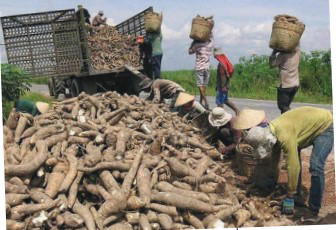
Even when roots are harvested, getting them to factories is another tough task. Fresh cassava is about 70 percent water and spoils within 48 hours.
Moving bulky, perishable roots over poor roads means high transport costs for weight that will never become finished product. Without efficient aggregation and coordination, roots rot before they reach the factory gate.
As one participant put it: reported production is not reliable industrial supply.
Competing With Food, With Low Yields
Cassava already feeds millions through garri and fufu. Industry is not just competing with imports; it is competing with the food market. Rather than diverting cassava from established food uses, participants emphasised the need to expand total supply by increasing farm productivity.
The World Bank Group’s 2025 Nigeria Country Private Sector Diagnostic puts Nigeria’s average yield at 8.2 tonnes per hectare in 2020, against a global average of 12.8 tonnes and 24 tonnes in Southeast Asia.
Participants linked the gap to three things: limited access to improved high-yield varieties, poor agronomic practices, and weak extension support. Research institutes have developed better varieties, but there is little capacity to multiply and distribute planting stems at scale. And even when farmers get improved stems, yields fall without proper spacing and agronomy.
Why Cassava Still Loses to Grain
The roundtable was blunt about costs. Harvesting is manual, laborious and more expensive in the dry season. Conversion at the factory is also costly. For starch – the starting point for sweeteners and bioethanol – roots must be washed, peeled, ground, extracted and dried. That takes equipment and power.
Grains, by contrast, have higher dry matter, store longer, and are cheaper to move.
Those economics mean cassava cannot win by trying to be a general substitute for everything. It has to win where it has a clear advantage. The Smart Way to Sell Cassava
Industrial adoption, participants agreed, will come from targeting specific applications where cassava derivatives meet technical, quality and commercial needs.
Three areas stood out: cassava-derived bioethanol, cassava-derived sweeteners, and cassava-wheat composite flour. Biscuits, for example, were highlighted as more promising than bread for composite flour, because biscuits depend less on gluten for structure.
There was good news on starch. One participant reported that locally produced cassava starch is now price-competitive with imported starch. The challenge is performance, not just lab results.
Buyers said cassava starch can behave differently from corn starch in actual use, even when specifications look similar. Concerns were also raised about inconsistent test results and contamination across supply chains.
Regulators pointed to existing standards and laboratory services, but participants called for neutral testing arrangements to resolve disputes and build buyer confidence. They also urged supplier development – where industrial buyers help processors understand specifications and validate performance in real applications.
What Investors Must Get Right
The central lesson from the roundtable is simple: a viable cassava project needs three things aligned at once – reliable feedstock supply, competitive processing costs, and proven buyer demand.
Higher farm output means little if roots cannot be delivered economically. More processing capacity means little if derivatives fail in the customer’s factory.
According to NCIA, these insights are now shaping its work in four areas: improving farmer productivity and feedstock supply; strengthening linkages among farmers, processors and industrial buyers; supporting processor development and quality assurance; and advancing application-led product development with buyers, regulators and researchers.
Nigeria does not have a cassava production problem. It has a cassava commercialization problem. Fixing it will determine whether the world’s largest producer can also become a competitive industrial supplier.
The post Stakeholders chart path to turn Cassava wealth into industrial growth appeared first on Vanguard News.