

By James Ogunnaike
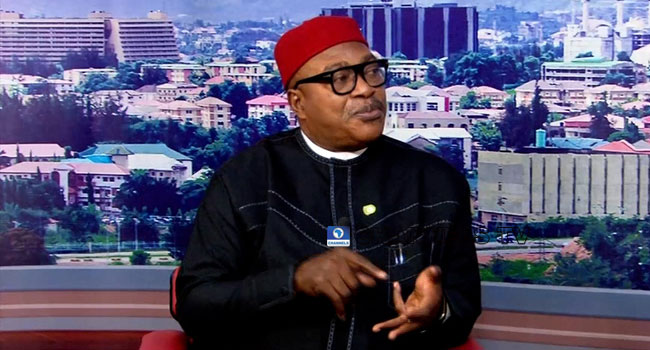
A Former Director of the Department of State Services (DSS), Mike Ejiofor, has renewed his call for the establishment of state police, insisting that the initiative remains one of the most effective solutions to Nigeria’s escalating security challenges.
Ejiofor also urged the Federal Government to diversify Nigeria’s defence procurement partnerships, warning against overreliance on a limited number of foreign allies for military equipment and security cooperation.
The former DSS director made the remarks on Monday during an interview on Frontline, a current affairs programme on Eagle 102.5 FM, Ilese-Ijebu, Ogun State.
Expressing concern over the delay in implementing state policing despite widespread support, Ejiofor said the initiative enjoys the backing of President Bola Ahmed Tinubu, the National Assembly and state governors.
According to him, the continued postponement of the policy is becoming increasingly difficult to justify amid worsening insecurity across the country.
“Coordination will be more effective if we have state police created. I have been a very strong advocate of state police, and I don’t know why the Federal Government has been dragging its feet on this issue,” he said.
He added, “The President has bought into the idea, the National Assembly has bought into the idea, the governors have bought into it. Virtually everybody has agreed to it. So what has been delaying it?”
Ejiofor criticised what he described as the slow pace of security reforms compared to the speed with which political leaders approve other matters.
“When they want to take a loan, within 48 hours or even two hours it is passed. So what has been holding this? I think our politicians know what they are doing. If state police is established, more than half of our problems will be solved.”
The former DSS chief argued that state police officers, being locally recruited, would possess better knowledge of their communities, terrain and culture, making them more effective in combating crime.
He noted that most states already operate informal security structures under various names.
“There is virtually no state today without some form of state police in the name of vigilante groups or task forces. What remains is to formalise the system, recruit properly, provide leadership and make it operational.”
According to him, one of the major limitations facing local security outfits is inadequate weaponry.
“Bandits carry sophisticated weapons, but vigilantes do not. If properly equipped, they will have the confidence to move into forests and confront criminal elements.”
However, Ejiofor stressed that safeguards must be established to prevent abuse of the system and ensure professionalism.
“The recruitment process must be carefully handled so that politicians do not hijack it. Otherwise, we may end up compounding our security challenges.”
He further explained that while state police should focus primarily on intelligence gathering and local law enforcement, serious offences such as terrorism, insurgency and sabotage should remain under federal jurisdiction.
“There must be limits to their responsibilities. They should not handle terrorism or insurgency. Their role should be intelligence collection and collaboration with federal security agencies.”
Speaking on concerns over Nigeria’s access to military hardware amid ongoing global conflicts involving major powers, Ejiofor advised the government to explore alternative defence partnerships.
He noted that wars involving countries such as Russia, Ukraine, Israel, Iran and the United States could affect existing arms supply arrangements, but maintained that Nigeria still has several options.
“If there were orders already placed and those sources become constrained, we still have alternatives. We can go to Turkey, China and other countries that can assist us.”
The former intelligence chief said Nigeria must avoid depending on a narrow range of military partners and should adopt a broader strategy in sourcing defence equipment.
Ejiofor also questioned the visible impact of some of Nigeria’s international security collaborations, particularly with the United States.
While acknowledging the existence of bilateral partnerships, he said the country must evaluate whether such relationships are producing measurable gains in counterterrorism and intelligence operations.
“America has been partnering with us, but I do not seem to be seeing the effectiveness of that collaboration. We need to assess whether these partnerships are delivering the expected results.”
Ejiofor noted that insecurity cannot be addressed solely through the acquisition of weapons.
He argued that intelligence gathering, strategic planning and effective coordination among security agencies remain critical to defeating criminal groups and insurgents.
“The decisive thing is for us to acquire the necessary skills and intelligence capabilities to deal with these people and bring them to their knees.”
He rejected approaches that seek negotiations from a position of weakness.
“We should not be asking them to surrender first. We should deal decisively with them, force them to surrender and then allow the law to take its course.”
Ejiofor further noted that insecurity has become widespread and unpredictable, making vigilance necessary for all citizens regardless of status or position.
Recalling incidents involving prominent Nigerians who came under attack despite heavy security presence, he said the country requires broader systemic reforms rather than isolated protective measures.
“The most important thing is to bring these criminals to justice and curtail their activities. In the meantime, citizens must remain conscious of their environment, especially while travelling.”
The post State Police ‘ll solve over half of Nigeria’s security problems – Ex-DSS director, Ejiofor appeared first on Vanguard News.

 Punch Nigeria
 Modern Ghana
 Vanguard Nigeria
 This Day
 Business Day
 The Guardian Football
 The Standard Kenyan
 NairaMetrics
 Daily Post
 InformationNG
 Premium TImes
 Watchdog Uganda