

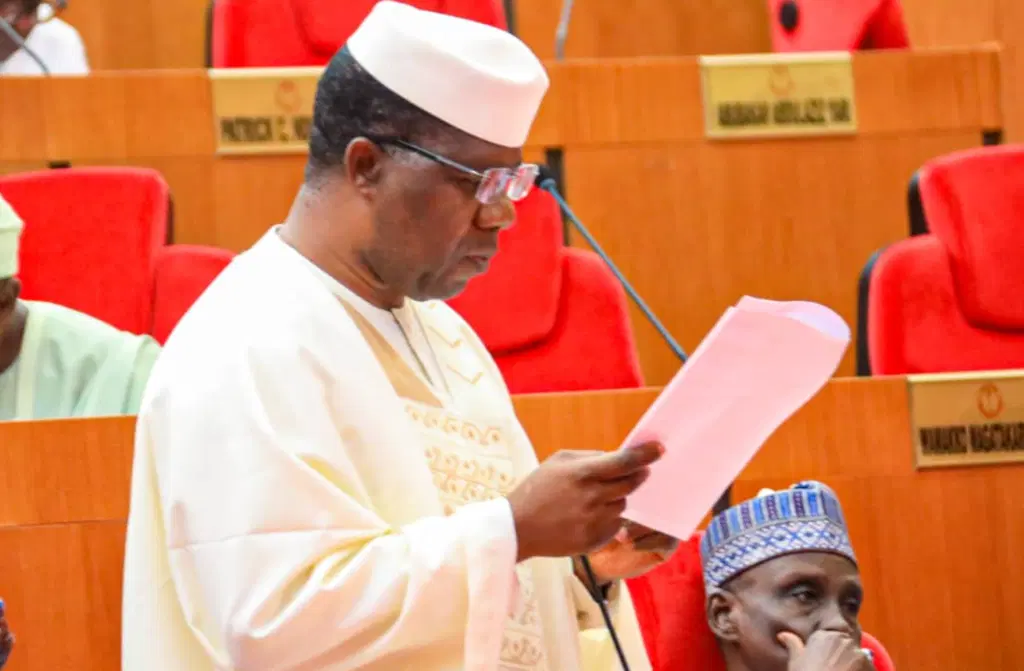
*Raises vital questions on the irresponsible use of social media
*Receives ‘The Sun Senator of the Year’ Award
*Dedicates award to God, President Tinubu, and 108 other senators
By Henry Umoru
ABUJA – LEADER of the Senate, Senator Opeyemi Bamidele, APC, Ekiti Central has disclosed that the National Assembly will this week the State Police Bill to President Bola Tinubu for assent.
He said the National Assembly is expecting four State Houses of Assembly to turn in their reports on or before the National Assembly reconvenes on November 17, 2026, saying with this development, next week is going to be decisive and defining in the National Assembly.
Bamidele said whether the remaining states turn in their reports or not, the National must move forward and fulfil the aspiration of the people.
According to Bamidele, the principle of proactive lawmaking guided the resolve of the National Assembly to pass the State Police (Constitution Alteration) Bill, which, according to him, proposed the creation of a Federal Police Service and State Police Services.
The proposed constitutional amendment which is part of ongoing efforts to restructure Nigeria’s policing architecture by providing for the establishment of State Police Services, is intended to create the constitutional foundation for decentralised policing, amid continuing national discussions on how to strengthen security arrangements and improve responses to security challenges across the country.
Bamidele spoke after he received “The Sun Senator of the Year” Award for efficiently managing the business of the parliament and for his proactive approach to lawmaking, which has guided all the undertakings of the Senate since its inauguration in June 2023.
In a statement from his Media Directorate on Sunday, the Senate Leader further explained that the creation of the state police service had moved from rhetoric to reality after more than 15 years of unsuccessful attempts to reform the country’s police system.
As shown in the records of the National Assembly, Bamidele revealed that no fewer than 32 State Houses of Assembly “have approved the State Police (Constitution Alteration) Bill, 2026. With this, we have successfully crossed the constitutional threshold under Section 9(2) of the Constitution of the Federal Republic of Nigeria, 1999 (as amended).
“We are now expecting four State Houses of Assembly to turn in their reports on or before the National Assembly reconvenes on November 17, 2026. This suggests that next week is going to be decisive and defining in the National Assembly. Whether the remaining states turn in their reports or not, we must move forward and fulfil the aspiration of our people.
“We are now under obligation to transmit the State Police (Constitution Alteration) Bill, 2026 to the President and Commander-in-Chief of the Armed Forces, His Excellency Bola Ahmed Tinubu, GCFR, for assent. This is a responsibility we must consciously discharge on behalf of our constituents and in the interest of national peace, progress, and stability,” he explained further.
Contrary to critics of the State Police bill, Bamidele clarified that the initiative was not designed to create ethnic or state armies, but was about establishing state-led, community-anchored policing within clear constitutional safeguards.
The Senate leader said as the parliament of the people, the National Assembly had pursued, consciously and conscientiously, people-centred legislation that had direct bearing on the welfare of citizens.
Recall that on November 4th, the Senate announced that the proposed State Police system had crossed a major constitutional hurdle, with 30 State Houses of Assembly approving the amendment required to pave the way for its establishment, remaining six others yet to forward theirs to the National Assembly for onward transmission to the President for subsequent assent.
As at November 4th, the six states that were yet to Approve the bill for onward transmission to the National Assembly were Kano, Cross River, Abia, Niger, Benue and Oyo.
The Senate however gave the six State Houses of Assembly yet to communicate their positions on the proposed constitutional amendment establishing State Police until November 15 to do so, warning that failure to respond by the deadline could be deemed as withholding approval.
The remaining six states were expected to communicate their decisions before November 15, when the National Assembly intends to forward the proposed constitutional amendment to President Bola Tinubu for subsequent.
The development brought the proposed restructuring of Nigeria’s policing system closer to the final stage of the constitutional amendment process, with presidential assent expected after the National Assembly completes the necessary procedures.
Disclosing this penultimate week while updating lawmakers on the progress of consultations with the 36 state legislatures on the proposed amendment, the Senate Leader had said the number of approvals had exceeded the constitutionally required two-thirds of the 36 state legislatures.
According to him, for the process to be rounded off, it has to be in three phases with the National Assembly expected to pass the bill, the approval by at least two-thirds of the state legislature and the President to sign the bill into law, adding that the National Assembly had fulfilled its responsibility by passing the bill and transmitting it to all 36 State Houses of Assembly for consideration and approval.
Bamidele then said, “Let me explain again, for the avoidance of doubt, three keywords are used in the Constitution of the Federal Republic of Nigeria 1999, as amended. The first word is passage, the second word is approval and the third word is assent.
“The reason the writers of our Constitution, our forefathers, put all these specific words is to ensure that no part of the Constitution of the Federal Republic of Nigeria can be easily amended without the buying in of all the critical stakeholders at all levels of governance.
“The passage of the bill was the responsibility of the National Assembly, and that has been completed. Approval is required from at least two-thirds of the 36 State Houses of Assembly in the country, while assent must subsequently be given by the President to complete the constitutional amendment process.
The Senate Leader explained that the constitutional requirements were deliberately designed to ensure that amendments to the nation’s supreme law enjoyed the participation and agreement of critical stakeholders across the different levels of government.
Bamidele stressed that the 30 approvals already received were significantly above the constitutional requirement of 24 states, describing the development as evidence of widespread support for the proposed reform.
“Two important points need to be emphasised. First, we needed the approval of at least two-thirds of the states for this constitutional amendment to proceed.
“Two things that need to be emphasised here is that we needed two-thirds of the states at the very least for this to pass, and already two-thirds will be 24. So, as of yet, we already got 30 states, showing the popularity of this bill among Nigerians through the elected representatives in the State Houses of Assembly,” he said.
The 30 states that as at that week approved the proposal are Adamawa, Akwa Ibom, Anambra, Bauchi, Bayelsa, Borno, Delta, Ebonyi, Edo, Ekiti, Enugu, Gombe, Imo, Jigawa, Kaduna, Katsina, Kebbi, Kogi, Kwara, Lagos, Nasarawa, Ogun, Ondo, Osun, Plateau, Rivers, Sokoto, Taraba, Yobe and Zamfara.
According to the statement from his Media Office on Sunday, Bamidele who explained how the National Assembly championed the Student Loan (Access to Higher Education) Act, 2024, which replaced a restrictive regime with an inclusive, technology-driven, interest-free loan scheme, said through the Nigerian Education Loan Fund (NELFUND), according to him, over ₦204 billion has been disbursed to applicants across 89 colleges, 108 polytechnics, and 126 universities nationwide, adding that rhe Fund has significantly reduced the rate of dropouts in tertiary institutions.
He said. “We also championed the National Social Investment Programmes Act, 2023, which gave statutory backing, coordination, and accountability to our social protection system, for poverty reduction, economic inclusion, and social welfare for vulnerable Nigerians.
“With the utmost sense of responsibility, we passed the Minimum Wage (Amendment) Act, 2024; Tax Reform Acts, 2025; Investments and Securities Act, 2025; Electoral Act, 2026; Nigerian Insurance Industry Reform Act, 2024; and Regional Development Commissions Acts, among others. Each of these laws has transformed our economy, strengthened public finance, and deepened electoral credibility,” Bamidele said as he rolled out the achievements of the parliament.
While thanking the media for serving as formidable partners in deepening the country’s democracy, Bamidele reaffirmed his commitment “to press freedom, an open parliament, and continuous engagement with journalists. But we must work together to define the responsible use of social media.”
He raised highly fundamental questions about the devastating activities of some individuals on social media, noting: “We have seen characters assassinated. We have seen public institutions blackmailed. We have watched people deliberately distort facts. We have seen people unjustifiably peddling lies. We cannot fold our hands and allows this illegality to continue.
“I have been a victim of these outlawed activities at different times. I know many Nigerians have been victims as well. But the urgent questions are: Should we leave unregulated this space that define our lives in the decades to come? Or do we prefer a space where characters are assassinated daily, lies peddled, and public institutions unjustifiably discredited?
“These are questions that key media actors – Newspaper Proprietors’ Association of Nigeria, Broadcasting Organisations of Nigeria, Nigerian Guild of Editors, and Nigeria Union of Journalists – must honestly answer in this age of information technology. Otherwise, we must all brace up for the consequences of our inability to act at the time that matters most.
“We all know that information is critical to our national development as much as to our internal stability. Obviously, this suggests that the way we disseminate information, whether through the traditional or social media, must be well guided by international best practices.
“This further suggests that information must be disseminated objectively and responsibly with the intention to inform and not disinform; build and not destroy; develop and not blackmail.”
Speaking on the award from Sun Newspapers, Bamidele, however, noted that the award was not a personal achievement or trophy, but purely a validation of collective responsibility, thereby dedicating it to Almighty God, President Bola Ahmed Tinubu, GCFR, 108 other senators, and his constituents, who entrusted him with their mandates.
According to the statement, ” He received the award Friday night from the Founder of The Sun Publishing Limited and Chairman of the South East Development Commission, Senator Orji Uzor Kalu, accompanied by several serving senators, governors (serving and former), and his political associates from Ekiti and Lagos States.
“Among others, former Ogun State Governor, Chief Olusegun Osoba; his predecessor and Chairman, Senate Committee on Navy, Senator Gbenga Daniel; Chairman, Senate Committee on Banking, Insurance and Other Financial Institutions, Senator Adetokunbo Abiru; Chairman, Senate Committee on Works, Senator Patrick Ndubueze; and Chairman, Senate Committee on the National Agency for Science and Engineering Infrastructure, Senator Francis Onyewuchi, accompanied Bamidele to receive the honour.
While thanking The Sun Publishing Limited for conferring the prestigious honour on him, Bamidele emphasised again the need to judge the National Assembly not by the volume of bills passed into law, but by the impact of its initiatives on the lives of the people.
He said: “I believe in proactive lawmaking. I believe Nigeria must move from reactive governance to proactive governance. I believe our laws must be evidence-based, efficiently implemented, effectively monitored, periodically reviewed, and ultimately measured by their impact on citizens.
“I believe that separation of powers is not about hostility, but synergy; not grandstanding, but collaboration; not dissension, but interdependence among the arms of government. I have served most dutifully in the Senate with independence, but at the same time with constructive engagement with other arms because our collective responsibility is national development, peace, and security.”
The post State Police: NASS to transmit bill to Tinubu this week -Senator Bamidele appeared first on Vanguard News.