

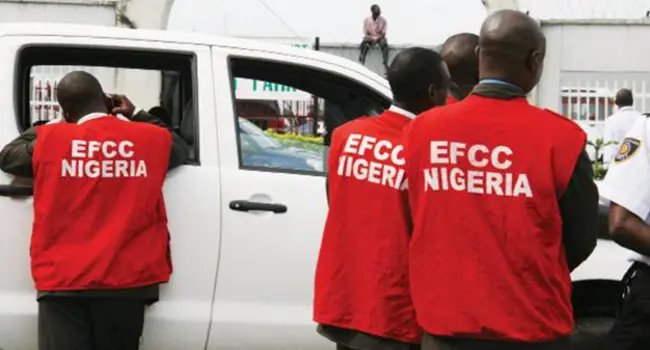
..Commission turns to 72-hour freezes
By Soni Daniel, Emma Ujah & Luminous Jannamike
A government account is debited. The money moves through another account, perhaps into a private company, and then into another. Before investigators react, it may have been converted to cryptocurrency or moved beyond Nigeria’s borders.
By then, the investigation is no longer about stopping the money from leaving. It is about tracing where it went.
That is the problem the Economic and Financial Crimes Commission, EFCC, says it is trying to tackle with a new preventive approach.
“Why must we be waiting for money to be stolen? When we see money moving suspiciously, we move in and freeze,” EFCC Chairman, Ola Olukoyede, said while presenting his three-year scorecard to senior journalists in Abuja last week.
The approach centres on the Fraud Risk Assessment and Control Department, FRAC, which the commission says can detect and temporarily restrict suspicious transactions for up to 72 hours while investigators establish their source, destination and purpose.
Money is Usually Gone Before the Alarm Sounds
For years, anti-corruption enforcement in Nigeria has largely followed the same sequence: petition, investigation, arrest, prosecution and recovery.
Olukoyede said that between October 2023 and July 2026, the EFCC received 49,673 petitions, investigated 39,615 cases, filed 14,476 cases in court and secured 10,872 convictions, a 75.1 per cent conviction-to-filing ratio.
The commission also reported recoveries of N1.233 trillion, $684.48 million, £373,905.78 and €9.34 million during the period.
But the new strategy shifts attention to what happens before recovery becomes necessary.
EFCC Wants to Catch the Money in Motion
The commission has cited a case in which funds were traced from a local government account to a private company and subsequently into cryptocurrency wallets.
According to the EFCC, FRAC detected the suspicious movement and intervened by freezing the funds for 72 hours while investigators established where the money was going and why.
The commission also said its preventive interventions had saved more than N4 billion by blocking transfers before they were completed.
That figure is separate from the N1.233 trillion recovery total because the money was reportedly stopped before it left the system.
The distinction could become important if prevention becomes a regular part of the EFCC’s performance reporting.
The Law Behind The 72-Hour Freeze
The EFCC says its authority to impose the temporary restriction is supported by Section 7(6) of the Money Laundering (Prevention and Prohibition) Act, 2022.
The provision allows the commission or authorises representatives to place a stop order not exceeding 72 hours on an account or transaction suspected to be connected with an unlawful act.
The EFCC also relies on Section 34 of the EFCC Act, 2004, which provides for an ex-parte application to the Federal High Court where funds are suspected to be proceeds of crime.
The legal position, however, has been contested.
In 2025, the Court of Appeal, in NPG Event, Gardens & Parks Ltd v Zenith Bank Plc, held that freezing an account without a prior court order violated Section 34(1) of the EFCC Act and stressed that temporary possession under the Constitution must follow the process prescribed by law.
In April 2026, the Federal High Court in Abuja also held that freezing orders could only be granted by the Federal High Court or a State High Court.
Senior Advocate of Nigeria, Femi Falana, however, has argued that the EFCC can freeze government accounts for up to 72 hours before obtaining a court order.
The legal question, therefore, is not only whether the EFCC can intervene but how the 72-hour power is exercised and what happens when the period expires.
The Real Test May Be States and Local Governments
The issue became particularly contentious after the EFCC froze Osun State government accounts in August during a probe involving about N11 billion in ecology, intervention and FAAC funds.
The commission said it detected huge transfers into different corporate entities and acted to prevent suspected diversion.
The case highlighted the wider implications of freezing public accounts.
Government funds are used for salaries, schools, hospitals, roads, water projects and payments to contractors.
A restriction can therefore affect services beyond the transaction under investigation.
That does not place government accounts outside the reach of investigators.
It makes the accuracy and speed of intervention more important.
A large transfer from a government account is not, by itself, proof of an offence.
Investigators have to establish the purpose and circumstances surrounding the transaction.
The Thief’s Escape Route is Changing
Financial crime has also become more difficult to trace. Money can move through several corporate accounts, pass through intermediaries and enter cryptocurrency platforms within a short period.
Olukoyede said the EFCC handled 920 specialised cases involving money laundering, unlicensed bureaux de change operations, illegal mining, virtual assets and terrorist financing, securing 212 convictions.
The commission recorded 11 virtual-asset cases: five under investigation, four under prosecution and two convictions. Forfeited assets included Bitcoin, USDT and Ethereum.
The development explains why the EFCC is placing greater emphasis on detecting transactions while they are still in motion. But a temporary freeze does not establish criminal liability. Suspicion remains subject to investigation and due process.
Some Money Never Became a Recovery Statistic
The traditional anti-corruption scorecard focuses on convictions and recoveries. Prevention introduces another metric: money that was stopped before it became a loss.
If a suspicious N500 million transfer is detected and blocked before completion, there may be no recovery to announce. Yet the funds have remained within the system.
For that reason, the EFCC’s preventive programme will require measurable indicators if it is to be assessed independently.
Among the relevant figures would be the number and value of preventive interventions, restrictions lifted after investigation, cases taken to court and funds ultimately recovered.
Forty Officers Dismissed — and Five Facing Prosecution
Olukoyede also disclosed that more than 40 EFCC officers had been dismissed for misconduct, corruption or financial malpractice, while more than five were facing prosecution.
The disclosure is significant in the context of FRAC because the preventive system gives officers access to sensitive financial information and the ability to trigger temporary restrictions.
The internal safeguards around that power will therefore matter.
Questions include who can authorise a freeze, who reviews the decision, how long the review takes and what happens when an intervention is found to have been unjustified.
Recovery Still Matters — But it is No Longer Enough
The EFCC said N661.32 billion and $492.37 million had been released to beneficiaries, while N71.01 billion and $18.29 million remained pending restitution.
Olukoyede also said some contractors who received government payments and abandoned projects were compelled to return to site and complete their contracts.
That brings the recovery debate closer to its public purpose. Money returned to government accounts is one measure. A completed road, functioning hospital, school or other public project provides another measure of what enforcement achieves.
The Bigger Question is Whether this Survives One Chairman
Olukoyede described the commission’s assignments as onerous, saying that with “clear focus, energy, passion and faith in God”, the EFCC had improved its records.
The longer-term question is whether the preventive architecture becomes institutional.
FRAC, its procedures, data systems and safeguards will have to survive changes in leadership if the strategy is to remain part of the commission’s normal operations.
The Human Economy Cannot be Ignored
Olukoyede has also argued that the average Nigerian does not necessarily want to steal and called for stronger access to affordable credit for middle- and low-income workers.
That places corruption within a wider economic context.
Financial hardship and weak access to legitimate credit can create pressure, while weak controls can create opportunities for abuse of public resources.
The anti-corruption response therefore extends beyond arrests and prosecutions to the systems governing public money and the wider economy.
Put More Eyes on the Money
FRAC cannot operate alone. Banks, the Nigerian Financial Intelligence Unit, the Central Bank of Nigeria and payment-system operators all hold information relevant to financial transactions.
The effectiveness of preventive enforcement will depend partly on how quickly those pieces of information can be brought together.
Questions for the EFCC and its financial-sector partners include what data FRAC receives, how quickly it is processed, how suspicious transaction reports are used, and how legitimate unusual transactions are separated from potentially unlawful ones.
The number of false positives and restrictions subsequently lifted would also provide useful measures of the system’s accuracy.
Questions the Freeze Must Answer
The 72-hour period raises a straightforward question: what happens next?
If investigators find insufficient evidence, the restriction should have a clear route to termination.
Where continued restriction is required, the process for obtaining judicial authority must be clear.
There is also the question of remedy where a person, company or government institution is wrongly affected.
These safeguards matter because a bank account can represent payroll, suppliers and business operations. For government, it can represent salaries and public services.
The Real Measure of Success
The EFCC’s 34-month figures show what conventional enforcement has produced: 49,673 petitions, 39,615 investigations, 14,476 cases filed, 10,872 convictions and more than N1.23 trillion recovered.
The preventive approach introduces a different test. A transaction is flagged. The money is temporarily restricted. Investigators establish its source and destination. A suspicious transfer is stopped, while legitimate funds are released.
There may be no arrest or recovery figure. But if the money belonged to the public, and it remains available for the purpose for which it was appropriated, the outcome can be measured in a different way.
The school gets its funding. The hospital receives what was budgeted. Salaries are paid. A road project continues. A contractor delivers.
For the EFCC, the 72-hour freeze will ultimately be judged by whether it can protect public funds quickly, lawfully and transparently, before the money disappears.
The post Stop the money before it disappears, EFCC takes on new challenge appeared first on Vanguard News.