

By Luminous Jannamike, ABUJA
Nigeria’s leading presidential contenders have begun laying out competing answers to the country’s economic and security crisis. But there is one question their promises have not yet fully answered: how much will all this cost, and who will pay?
Read Also: 2027 Peace Accord not uhuru for credible electoral process – CSOs, lawyers
From cheaper fuel and millions of jobs to free education, more electricity, stronger healthcare and safer communities, the offers are getting bigger.
Yet, across the campaign speeches and policy documents released so far, detailed costings, funding mechanisms, implementation timelines and measurable delivery targets remain unclear.
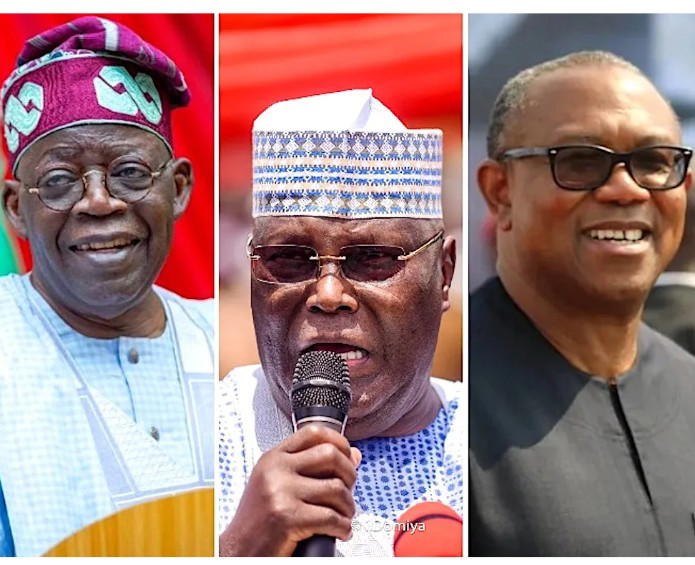
The candidates are offering Nigerians different diagnoses of the same crisis. President Bola Tinubu (All Progressives Congress) says the country needs continuity and consolidation of painful reforms. Atiku Abubakar (African Democratic Congress) argues that some of those reforms, especially fuel subsidy removal, should be reversed. Peter Obi (Nigeria Democratic Congress) says Nigeria must move from consumption to production. Adewole Adebayo (Social Democratic Party) places full employment and decentralised production at the heart of his prescription, while Omoyele Sowore (African Action Congress) presents education and technology as the foundation for long-term transformation.
Beneath the differences, however, there is striking agreement: insecurity, electricity, jobs, education, healthcare and productive economic activity dominate the competing platforms.
The real battle, therefore, may not be over who can make the biggest promise, but who can explain how the promise becomes a result.
Tinubu: ‘Don’t stop the reforms’
For Tinubu, the 2027 election is fundamentally a referendum on continuity.
Accepting the APC presidential ticket at the party’s convention in Abuja on May 24, 2026, he argued that Nigeria must stay the course.
“Today, our task is to affirm that continuity is essential to consolidate reform, secure progress, and strengthen the foundation of a modern Nigeria,” Tinubu declared.
The message was unmistakable. The APC presidential candidate is asking voters to look beyond the immediate pain of adjustment and judge whether the reforms initiated since 2023 can eventually deliver a stronger economy.
At the same convention, he defended the removal of fuel subsidies and exchange rate reforms, saying: “We moved away from wasteful fuel subsidies, unstable exchange rates, and weak infrastructure. Today, we are witnessing a turnaround: the naira is strengthening, foreign reserves are rising, and our economic outlook is positive…”
His campaign also points to infrastructure, including major roads, highways, airports, seaports and irrigation projects, while promising further restructuring of the electricity sector.
On power, Tinubu said: “Our strategy is focused on redesigning the power sector into a bankable, investable, and capable sector that delivers power to homes and industries.”
He cited peak generation of 6,000MW and also highlighted NELFUND, saying more than N282 billion had been disbursed to more than 1.5 million beneficiaries.
On security, he backed constitutional reform to permit state police, saying: “We also expect the National Assembly to amend the Constitution to allow the creation of State police as a matter of national emergency.”
The political strength of this pitch is also its central vulnerability.
Tinubu is asking Nigerians to believe that today’s economic pain is part of a necessary transition. But the immediate experience of inflation and the cost of living can be more tangible to households than improvements in reserves, revenue or other macroeconomic indicators.
The question for the administration is therefore not simply whether the reforms are defensible. It is whether enough Nigerians will feel their benefits strongly enough to accept the argument for continuity.
Atiku: ‘Change the prescription’
Atiku has chosen a fundamentally different route.
Accepting the ADC presidential ticket in Abuja on May 28, 2026, he identified five broad priorities: “Security, education, economy, healthcare and the challenge of power-sharing among the constituent units of our country.”
But his most politically striking intervention has come on fuel subsidy.
On the campaign trail last week, Atiku said: “If I win the presidential election, I will restore fuel subsidy.”
That is more than a policy disagreement with Tinubu. It is an attempt to speak directly to Nigerians who associate subsidy removal with the sharp rise in the cost of living.
Atiku has argued that Nigerians have not benefited sufficiently from subsidy removal and has also spoken of recovering funds he alleges were stolen after its removal.
But this is where political appeal meets fiscal reality. If the subsidy is restored, what pays for it?
Atiku’s campaign chat with the BBC does not provide enough detail to answer that question. And that gap matters because Atiku is simultaneously promising to expand security recruitment and equipment, improve education and healthcare, attract investment and address electricity constraints while criticising excessive borrowing.
His security promise is similarly immediate. Atiku said his administration would take decisive action in its first 100 days through recruitment, equipment, training, improved welfare and stronger leadership across the security agencies.
The attraction is clear: offer voters immediate relief and visible action. The challenge is equally clear: demonstrate how the competing financial demands can be met without simply shifting the burden elsewhere.
Obi: ‘Produce, don’t just consume’
Peter Obi’s campaign takes a more structural approach.
Launching the 2027 presidential and National Assembly campaign in Onitsha recently, Obi asked questions designed to frame the election around household economic reality: “Are Nigerians better off than they were four years ago? Can they afford food, education, and healthcare? Can businesses produce, expand, and create jobs?”
His answer is built around production.
“With your mandate, our economic agenda will put production, investment, enterprise, and human capital at the centre of how we lead,” he said at the campaign launch.
The agenda proposes greater agricultural productivity through farm security, irrigation, rural roads, storage, finance and markets, alongside manufacturing and agro-processing to increase exports of finished goods.
Obi distilled the philosophy into another line from the same campaign address: “Nigeria cannot import its way to prosperity. We will produce more of what we consume, process more of what we produce, and compete more effectively in global markets.”
This is arguably the clearest structural economic argument among the competing platforms.
But Obi also introduces another important dimension: the federation itself.
“Every region must produce. Every region must contribute. Every region must benefit,” he declared.
His region-by-region economic blueprint assigns different productive priorities to Nigeria’s geopolitical zones.
That makes the proposal more than an economic programme. It touches the deeper question of how Nigeria’s federation should work — what each region contributes, what it produces and how the benefits of national economic activity are distributed.
His emphasis on decentralised security management similarly suggests an institutional shift, while his insistence that major public investments should have measurable outcomes places implementation at the heart of his own proposition.
That creates a test for the campaign too: what are the precise targets, timelines and institutional responsibilities for turning production from a slogan into measurable economic change?
Adebayo: ‘Full employment’ as the engine
Adewole Adebayo broadens the debate by making employment the central economic objective.
At a policy unveiling in June, he said his administration would pursue full employment, with a target of 30 million jobs through agriculture, manufacturing, digital innovation and enterprise development.
His platform also proposes enrolling 20 million out-of-school children and training five million young Nigerians in environmental sustainability and green technology.
On electricity, Adebayo has proposed a long-term target of 50,000 to 75,000MW by 2050, combining gas-fired generation, solar power and rehabilitation of existing hydroelectric infrastructure.
He has also called for decentralised production and formal regulation of mining, arguing against what he describes as the ‘criminalisation of mining’.
Recently, he also argued that insecurity could not be defeated simply by reacting after attacks, calling for a security architecture that is more responsive to communities and more intelligence-led.
The ambition is substantial. But the distinction between a long-term destination and a four-year presidential programme matters.
What is the bridge between today’s electricity crisis and a 2050 target?
Adewole has not established the intermediate milestones, financing structure or institutional delivery mechanism that would answer that question.
Sowore: Education as the revolution
Sowore has chosen education as his signature battleground. Unveiling his 20-point education policy in July, he declared: “No government under a Sowore2027 administration will ever ask your child to pay WAEC, NECO, or any other public examination fee. Education will be free because knowledge is a right, not a privilege.”
His proposal goes far beyond eliminating school fees. It promises free education from early childhood through university, semester grants for students in public tertiary institutions and community colleges in every local government area.
The policy also proposes high-speed internet in schools, digital classrooms, virtual laboratories, online libraries, AI-assisted learning, coding from primary school, robotics and automation.
Sowore’s ‘Teachers first’ proposal includes better salaries, housing and research opportunities, while the blueprint calls for university autonomy and merit-based research grants.
The underlying argument is that education should not merely produce certificates. It should create the human capital required for Nigeria’s next economic phase.
But again, the biggest unanswered question is financial. What would such a nationwide system cost, and from where would the money come?
Sowore has not provided sufficient figures to establish the full national fiscal requirement.
Five candidates, one Nigerian problem
For all their ideological and political differences, the candidates are converging around the same basic reality.
Nigeria needs security. Nigeria needs reliable electricity. Nigeria needs jobs. Nigeria needs functioning schools and healthcare. And Nigeria needs to produce more, rather than remain heavily dependent on consumption and imports.
That convergence is significant because it suggests that the political conversation is shifting towards tangible outcomes.
But it also exposes a contradiction. The candidates are proposing substantial government intervention while simultaneously promising fiscal discipline, reduced waste, accountability and responsible borrowing.
Those positions are not necessarily incompatible. But they require arithmetic. And that arithmetic has not yet been sufficiently placed either on paper or before the electorate.
The manifesto Nigeria is still waiting to see
Perhaps the most important development in the campaign will therefore be what comes after the speeches.
Many of the campaigns have released policy priorities, speeches and individual proposals rather than comprehensive, costed manifestos.
That should now change. The question for every candidate should move from “What will you do?” to “Exactly how will you do it?”
How much will the programme cost? What revenue will finance it? How much borrowing is assumed? Which ministry, agency or level of government will deliver it? What laws must the National Assembly change? What will be achieved in the first 100 days, first year and by the end of four years? What measurable indicators will Nigerians use to judge success? And, perhaps, most importantly, who takes responsibility when the promised result does not arrive?
Those questions are as relevant to Tinubu’s reform consolidation as they are to Atiku’s subsidy reversal. They apply to Obi’s production agenda, Adebayo’s employment and power targets and Sowore’s education blueprint.
This is not about demanding that candidates stop dreaming big. Nigeria needs big ideas. It is about demanding that those ideas survive contact with the realities of public finance, institutions and implementation.
For the ordinary Nigerian, the distinction is crucial. A promise of electricity means little if the business owner still cannot plan a working day without a generator. Millions of jobs mean little to a young graduate if there is no credible pathway from training to employment. Cheaper fuel matters only if it translates into lower pressure on household budgets. Free education matters if schools can actually deliver quality learning.
The 2027 election should therefore be more than a competition in political ambition. The candidates have begun telling Nigerians where they want to take the country. Now they need to show the road map.
Because the most convincing manifesto in 2027 may not be the one with the biggest promises, but the one that can answer, in clear numbers and clear timelines: how much, from where, by when, and who will be accountable when the promise meets reality.
Vanguard News
The post Tinubu, Atiku, Obi, others: Big promises, bigger questions ahead of 2027 appeared first on Vanguard News.