

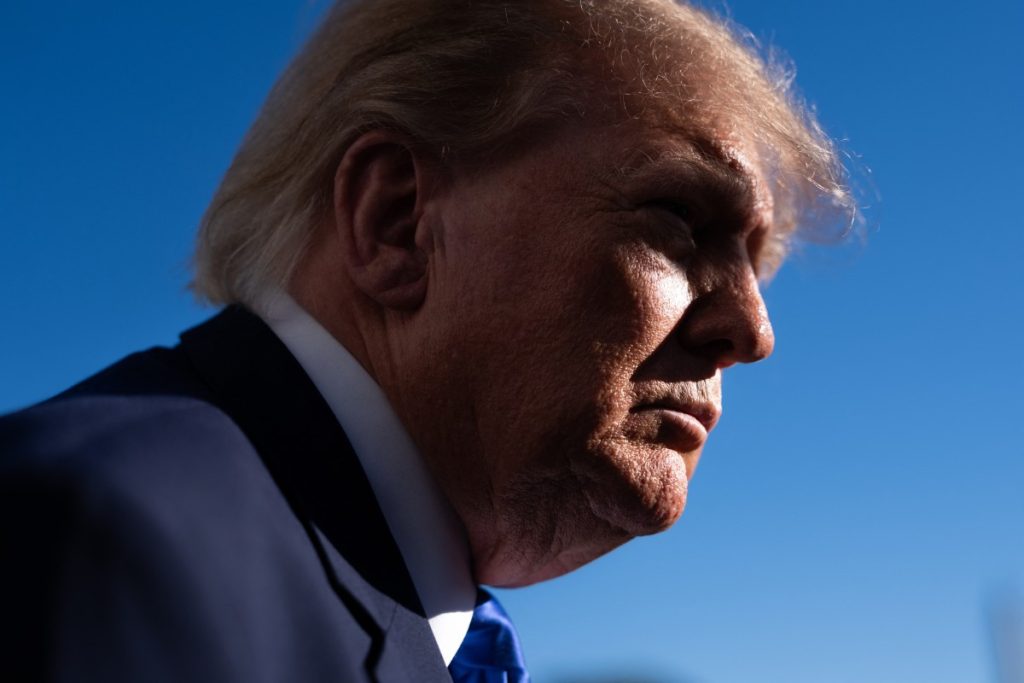
Donald Trump wanted the November 3 midterm elections to be about him. He said so repeatedly, urging Americans to vote as though his name were on the ballot. He wanted a Republican victory to demonstrate that his presidency still commanded popular support and that his influence over American politics remained firmly intact.

Well, Americans took him seriously. Perhaps more seriously than he expected.
Democrats have won control of both chambers of the United States Congress, delivering a major electoral setback to Trump and his Republican Party. Yet, as the results became clear, Trump reached for an explanation that seemed to contradict his own campaign message. In a post on his Truth Social platform, he declared: “I wasn’t on the Ballot and if I was, we would have won IN A LANDSLIDE!”
The irony is difficult to miss. He had spent weeks asking Americans to treat the election as a verdict on his presidency. When the verdict went against him, he suddenly appeared to be distancing himself from it. He wanted the political benefits of making the election about him without accepting the consequences when voters delivered an unfavourable answer.
For readers in Nigeria, it is worth explaining what America calls midterm elections and why they matter.
In the United States, a president is elected for a four-year term, but congressional elections take place every two years. This means that halfway into a president’s tenure, Americans return to the polls to elect members of the legislature. These elections are called midterms because they take place in the middle of a presidential term.
Congress has two chambers: the House of Representatives and the Senate. All 435 seats in the House are contested every two years, while senators serve six-year terms, with approximately one-third of the 100 Senate seats contested every two years.
Midterm elections do not determine who becomes president. The sitting president remains in office. Instead, voters decide which party controls Congress and, by extension, how much support or opposition the president will face in the legislature
This gives Americans an opportunity to express satisfaction or dissatisfaction with a president’s performance without waiting another four years. They can strengthen the president’s party in Congress or hand control to the opposition, making it considerably more difficult for the president to advance his legislative agenda.
That is precisely what has happened to Trump.
American presidents often benefit from what is known as the coattail effect. When a president is popular, candidates from the same party can benefit from that popularity. His political strength becomes an advantage for others seeking elective office. But when a president becomes unpopular, the effect can work in reverse. Candidates associated with his administration may find themselves paying the price for public dissatisfaction with his leadership. In political terms, this is sometimes described as negative or reverse coattails.
Trump’s decision to place himself at the centre of the midterm campaign made this effect particularly consequential. Instead of allowing individual Republican candidates to make their own cases to voters, he encouraged Americans to judge them through the prism of his presidency. He effectively turned hundreds of congressional contests into a national assessment of his administration.
And voters had reasons to be dissatisfied. The cost of living, inflation, rising fuel prices, economic anxiety and concerns about his administration’s policies, including the war with Iran, featured prominently in the political atmosphere surrounding the election. The Associated Press’s voter analysis identified frustration over high costs and the direction of the administration among the forces behind the Republican setback. Not every voter necessarily shared the same grievance, but the cumulative dissatisfaction proved politically damaging.
The scale of the Democratic victories was particularly striking in traditionally Republican territory. Texas provided one of the clearest illustrations. For decades, the state had been one of the Republican Party’s most dependable strongholds. Yet Democrat James Talarico defeated Trump-backed Ken Paxton in the Senate contest, becoming the first Democrat elected to a Texas Senate seat since 1988. In the gubernatorial race, Democrat Gina Hinojosa defeated incumbent Greg Abbott, ending Republican control of the governorship.
These were not merely victories for individual candidates. They challenged the assumption that established Republican strongholds were beyond the reach of Democratic competition. One election does not permanently change a state’s political identity, but it can expose the vulnerability of a party that has grown accustomed to treating certain constituencies as guaranteed territory.
The election also produced historic breakthroughs in American political representation. In Georgia, Keisha Lance Bottoms became the first Black woman elected governor of an American state. In New Hampshire, Chris Pappas became the first openly gay man elected to the United States Senate. Michigan’s Abdul El-Sayed became the first Muslim elected to the Senate. Meanwhile, Hakeem Jeffries is positioned to become the first Black Speaker of the House if formally elected by the incoming Democratic majority. These achievements extend beyond party victories; they represent significant milestones in the country’s political history.
But beyond the personalities and historic milestones, the institutional consequences are substantial.
With Democrats controlling both chambers, Trump will face a Congress less willing to accommodate his agenda. The new majority can obstruct legislation, scrutinise government spending, investigate the administration and subject presidential appointments requiring congressional approval to greater scrutiny. Control of the Senate is particularly important because of its role in confirming federal judges and senior government officials.
Trump remains president and retains his constitutional powers, including the power to veto legislation. A Democratic Congress cannot simply remove him from office or take over the executive branch. But the political environment in which he must govern has changed considerably. The final two years of his presidency will be more complicated, and his administration will have to contend with an opposition that now controls the legislative machinery.
The results also raise questions about the future of the Republican Party. Trump’s endorsement has long been a powerful instrument in Republican politics. Candidates have sought his support, elected officials have adjusted their positions to accommodate his preferences, and the party has increasingly organised itself around his political identity. But when candidates associated with a president begin losing elections on a significant scale, an uncomfortable question emerges: is his influence still an electoral advantage, or has it become a liability?
The answer will matter as Republicans consider their political direction beyond Trump’s second term and the road to the 2028 presidential election.
None of this means that Democrats have secured a permanent realignment of American politics. Nor does it automatically determine who will win the next presidential election. Midterm results are not a crystal ball. They reflect the political mood at a particular moment, and voters can change their minds again. The Democratic Party must also demonstrate that winning control of Congress can translate into meaningful improvements in people’s lives. Defeating an unpopular administration and earning lasting public confidence are two different challenges.
There is, however, a lesson here for political leaders everywhere, including in Nigeria.
Elections are not always about the candidates whose names appear on the ballot. Sometimes, voters use the choices available to them to pass judgment on the person already occupying the highest office. A president may not be contesting, but his record, policies and conduct can still become the central issue in an election. Political power does not insulate an incumbent from electoral accountability, even when his name is nowhere on the ballot.
Trump invited Americans to make the midterm elections a referendum on his presidency. They did. When the result went against him, he insisted that his absence from the ballot was the problem.
But he cannot have it both ways.
He wanted the credit if Republicans won. He cannot so easily disown the verdict because they lost. The slingshot has turned in the opposite direction. Trump asked Americans to vote as though he were on the ballot. They did something more consequential: they voted on the presidency he was already exercising.
He asked for a political endorsement and received an electoral verdict.
The post Trump: Lesson for Nigeria, by Stephanie Shaakaa appeared first on Vanguard News.