

By Morenike Taire, Woman Editor
RECENTLY, an unprecedented interview session with former Nigerian President Olusegun Obasanjo broke the Internet. Obasanjo is one of the most interviewed Nigerians ever, yet this interview was different, specifically because it was conducted by Adebayo Ridwan Abidemi, more popularly known as Isbae U.
The interview, which succeeded in revealing a side of the statesman that had never been obvious to the public, garnered millions of views within the first 24 hours and continues to fascinate viewers because of its sheer creativity, audacity and innovation. The YouTube chat, during which Abidemi referred to the former president as his “tenant” and “employee” for eight years, is a classic illustration of the contrast between the old and new generations, highlighting the conservatism of the older generation and the audacity of the younger one.
On the other hand, 15 former nursing students who were recently suspended or expelled following the publication of a video in August were not so lucky. The young women, who participated in a viral video captioned “No sick oo, na Gen Z full hospital”, were apparently taking part in a “challenge”—a term used to describe the replication of particular digital content for the purpose of trending online.
Generational ‘Wars’ Are Normal, But…
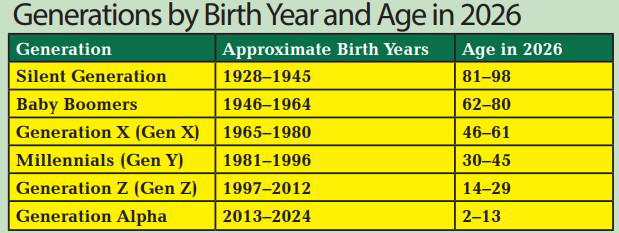
Abidemi and the 15 nursing students were displaying behaviours characteristic of a generation known as Gen Z. Some love them, some hate them, some vilify them; while others admire them.
Generations are groups of people born within roughly the same period who may share similar historical experiences, cultural influences, technologies and social values. These labels are commonly used in sociology, marketing, media and workplace research.
Every generation has regarded the ones that follow as somewhat morally inferior. However, criticism of Gen Z does not seem to fall within the typical complaints about youthful exuberance that have persisted across generations. The major concern is that Gen Z appears to have a disdain for, and disregard for, well-established societal, social and professional norms.
“What sets Gen Z apart,” says Olatoun Lufadeju, a Lagos-based sociologist, “is that they seem to be the only living generation that does not defer to age. They don’t associate wisdom with age or even experience.
“For them, the generations before them have failed them and have been unable to give them a better life. They think, if you are so smart, why is the country like this? Why is the world like this? We should actually listen to them.”
As far as Lufadeju is concerned, the upsides of the generation’s characteristics far outweigh the downsides.
Asked to comment on the expulsion and suspension of the Madonna University students, she told Vanguard, “Is there an actual law against dancing? Seriously, I am asking not rhetorically. I might be wrong.”
Your Negativity, Their Creativity
Despite the admiration for their resilience, most members of older generations regard Gen Z with wariness, at best.
The 15 Madonna University students, despite the initial public outrage, have nevertheless garnered considerable sympathy over the disciplinary actions taken against them, particularly given that they were all in their fifth and final year at the School of Nursing.
Amnesty International has weighed in on the expulsion and suspension of the TikTok dancers, describing the actions as “disproportionate”.
The organisation’s published statement reads: “Imposing heavy-handed academic or disciplinary sanctions would terminate the academic progress of the affected students. The students have the rights to freedom of expression, academic freedom and education. The expulsion and suspension are harsh and would create a chilling effect on the enjoyment of these rights.”
The organization called on the university to ensure that its disciplinary policies and procedures comply with international human rights standards.
A Social Contagion?
While Gen Z is widely perceived as using negativity to make a point, its members do not necessarily have anything to prove. Nonconformity, by its very nature, does not always require justification.
A quick online poll conducted by Vanguard on the subject asked:
“Gen Z is completely rewriting the rules for school, work, and life. If you had to define their ultimate mindset, which trait takes the crown?”
Some 33.3 per cent of respondents described them as “unbound or free”, while 28.6 per cent described them as “nonconformist”; another 14.3 per cent said they were “fluid” or “always varying”, while 23.8 per cent described them as “pragmatic” and “system hacks”.
A UNICEF-led private-sector partnership study, however, found that despite their resilience, creativity and determination, a worrying combination of geopolitical conflicts, climate and ecological crisis, economic slowdowns and mental health challenges is leaving young people feeling overwhelmed, disconnected and adrift, without adequate mental health support or services.
The study, based on a survey of more than 1,000 Gen Z respondents aged 14-25 worldwide, found that, contrary to the beliefs of other generations, Gen Z is deeply engaged with global issues and consumes more news than any other form of content. Its members are also eager to help shape the future.
New Life Realitie
Born during the dot-com era, Gen Z did not have to acclimatize to a digital world. Rather, its members grew up helping to define it. As the generation prepared to enter the job market, the world was hit by the COVID-19 pandemic and the ensuing global shutdowns, accelerating the adoption of remote work—a development that has helped shape Gen Z’s attitude towards employment.
Iyin Aboyeji, a millennial and founder of two billion-dollar companies, found himself in the bad books of Gen Z after publishing a highly controversial LinkedIn article suggesting that young people should work in person during the early stages of their careers.
He stated, “What AI cannot automate is proximity, the senior colleague who corrects your first draft, the room where decisions are made and the peer mentorship and networking that build the skills for us which tomorrow’s business deals are built.”
While members of older generations largely agreed with him, the backlash from Gen Z was phenomenal, targeted a usually beloved tech guru whom many young people look up to. For them, even workplace networking can be disrupted.
One response read, “Working on-site for me isn’t a problem, but for a young person in Nigeria in 2026, what does that cost me in terms of finances, physically, and mentally? There are infrastructural problems that make it harder for a young person such as myself.”
Is the Rash of Information Shaping Gen Z’s Attitudes?
Social media has been widely blamed for Gen Z’s attitudes, with endless scrolling, the promotion of an unrealistic lifestyle, poor attention spans and inadequate sleep cited as some of the consequences of un-fettered access to various platforms.
Speaking recently at the Vanguard Mental Health Summit in Lagos, Professor of Psychiatry Moshood Abiola Bello-Mojeed highlighted concerns about cyberbullying, online exploitation, misinformation, unhealthy social comparison and pressures associated with body image.
Bello-Mojeed added that the digital environment creates additional challenges for young people and called for coordinated action by all stakeholders. She also urged greater accountability in the digital environment.
Lafadeju offers a more nuanced perspective, arguing that Gen Z, as digital natives, has adapted better to digital cultural changes than other generations.
“We always paint bugbears at Gen Z. Different generations, different beliefs. In our own days, we were happy to have any job… For Gen Z, who watched their parents struggle as the Nigerian economy took a nosedive, work just has to pay the bills. Remember they are usually multitalented and capable of multitasking, and they are not shy about having conversations around money.
“I saw one Gen Z individual on social media recently calling out a popular blogger for not paying for services rendered. Only a Gen Z individual can do that, and I assure you, he will get his money. Whether we like it or not, we all have to begin to empathize with their point of view,” she said.
The post Understanding the Gen Z approach to life appeared first on Vanguard News.