

…Warn FG against rising debt burden
Emma Ujah, Abuja Bureau Chief
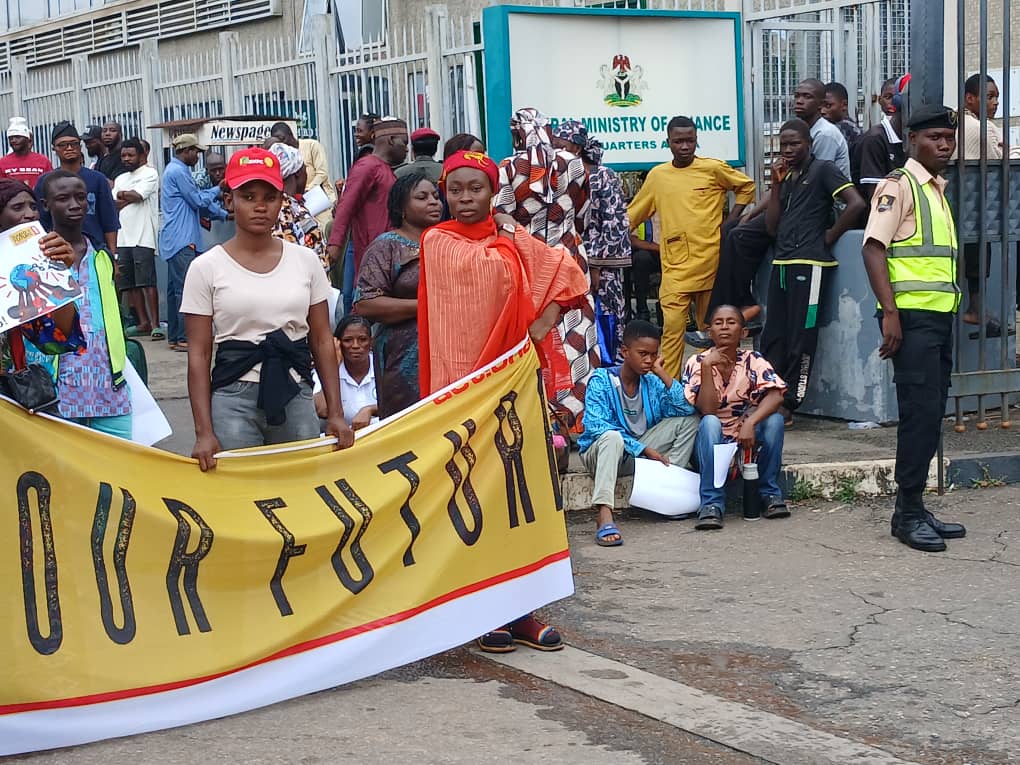
Civil society organisations, youths, students and market women, yesterday, took their protest against rising public debt to the Federal Ministry of Finance, Abuja, demanding that the Federal Government reduce borrowing and channel more resources into critical sectors of the economy.
The protesters, under the aegis of Climate Action, said the country’s rising debt-servicing burden was crowding out funding for essential public services and undermining efforts to tackle climate change, poverty and unemployment.
Carrying placards with various messages, the demonstrators urged the government to stop accumulating more loans from the World Bank, International Monetary Fund, IMF, and other development finance institutions.
They also demanded greater transparency in the management of the country’s debt and called on the government to prioritise spending that directly improves the welfare and livelihoods of Nigerians.
Speaking on behalf of the protesters, Social Mobilisation Specialist, ActionAid Nigeria, Mr Newton Otsemaye, said the groups were at the Finance Ministry to draw attention to the implications of rising debt for the future of Nigerians, particularly young people.
He said: “Save the future of Nigerians. We have the largest young population in Africa, if not globally. But what are we doing with their future?
“The question is: what are the resources that will be enough for us to be able to address their issues? Those resources, the Nigerian government is prioritising the World Bank and IMF, instead of the people.
“So, we are saying that it is not about profit; it should be about the people. Development is about people. Development is not about profit.
“That is the reason we are here. We are using this year’s Climate Week of Action to rally around these issues at the Federal Ministry of Finance.”
Otsemaye said the Finance Ministry was an appropriate place for the protesters to make their demands because of its role in the management of the nation’s finances and public debt.
He said: “Why are we here? This is the seat. This is the ministry that hosts debt management in Nigeria.
“Let somebody step out of this place to tell us: how are you going to manage the debt crisis that we are finding ourselves in Nigeria, and how will future Nigerians benefit from the way you manage this debt crisis?
“That is just what we are asking for. It’s a clear demand. The future should be guaranteed for Nigerian young people.”
Explaining the composition of the protesters, he said the demonstration brought together women’s groups, activists, young people and university undergraduates, among others.
According to him, the groups may be different, but they were united by concerns over the country’s debt profile and its implications for future generations.
“We have so many groups here. We have women’s groups, activists, young people and university undergraduates. You have so many groups here.
“It is not enough for me to just say this is the group that is here. It is a combination of different groups, but one demand.
“What is our future? What does the future hold for us if our debt, as we speak, can no longer be sustained by Nigeria?”
Otsemaye further expressed concern over the country’s debt-to-revenue ratio, warning that a continued rise could worsen poverty, unemployment and loss of livelihoods.
“If you have read the debt-to-revenue ratio, it has risen so high; it is unsustainable.
“We are saying that once you have that ratio, there are going to be more people in debt. There are going to be more people in poverty. There are going to be more unemployment.
“Many people are going to lose their livelihoods.
“So, the Nigerian government should be able to tell us how it wants to guarantee our escape from the poverty trap.
“Yes, stop more borrowing, reduce borrowing and channel the resources to fix our future. Reduce borrowing and improve public services.
“We need more money to go into the real sectors of the economy and into social protection.”
The post Updated: CSOs protest at Finance Ministry, demand end to excessive borrowing appeared first on Vanguard News.